What Is Root Canal Treatment? How Is It Done? How Long Does It Take?
"Root canal" is still a phrase that causes needless fear in many people. Yet in today's dentistry, thanks to proper anesthesia, modern instruments and experienced hands, root canal treatment is a procedure that can be far more comfortable than an ordinary filling.
In this guide, we cover root canal treatment from start to finish, in full detail. When it is needed, how it is done, whether it is painful, how many visits it takes, what happens after treatment — the answers to all your questions are here.
What Is Root Canal Treatment?
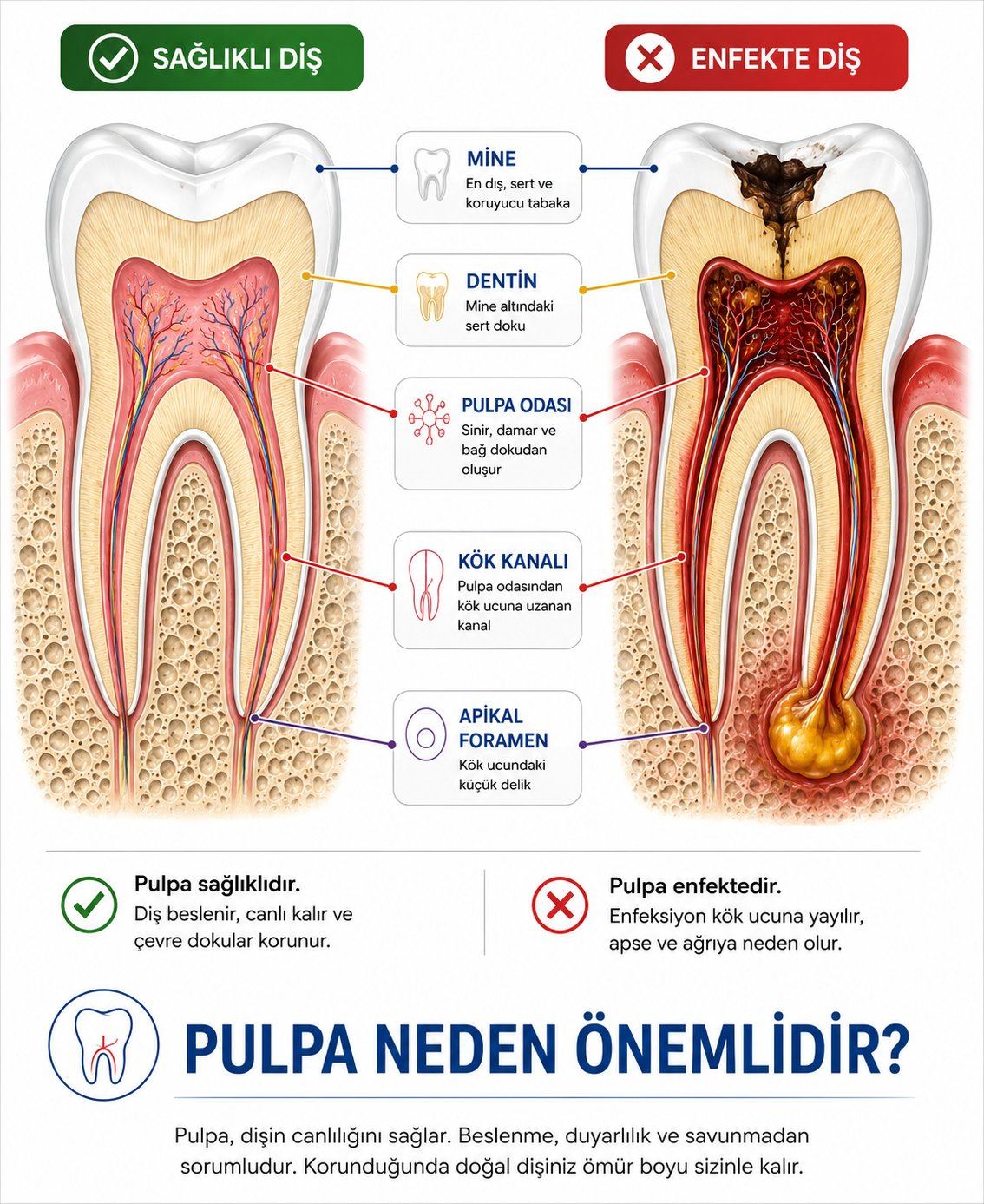
Beneath the visible white part of the tooth, there is a thin canal system running along the roots. Inside these canals is a living structure called the pulp, made up of blood vessels and nerve tissue. The pulp plays a critical role during the development of the tooth; however, once the tooth has fully matured, the presence of this tissue is not essential — the tooth continues to be nourished by the surrounding tissues.
When bacteria reach the pulp because of decay, a fracture or trauma, infection begins. An infected or damaged pulp cannot heal on its own; on the contrary, it can spread to the tip of the root and from there to the jawbone.
Root canal treatment is a restorative process in which this infected or damaged pulp is completely cleaned out, the canal system is filled in a sterile manner, and the tooth can continue to remain in the mouth.
In short: root canal treatment saves the tooth.
Why Is Root Canal Treatment Needed?
The main causes of pulp damage are:
- Deep decay: Decay that has progressed without treatment passes through the enamel and dentin and reaches the pulp.
- Repeated dental procedures: Intervening on the same tooth many times can wear down the pulp.
- Tooth fractures and cracks: Bacteria can leak into the pulp along fracture lines.
- Trauma: As a result of a blow, the tooth may have been loosened, displaced or broken. The pulp may be damaged even if the outer appearance is intact.
- Advanced gum disease cases: Bacteria seeping in from the root surface can affect the canal.
- Abscess: A pus-filled formation at the root tip or in the gum that shows itself with swelling, throbbing and pain — it is a sign of an advanced pulp infection.
Symptoms That Indicate You Need Root Canal Treatment
The following symptoms indicate that you should definitely see a dentist:
- Prolonged sensitivity to hot and cold (pain that continues even after the stimulus is gone)
- Spontaneous, throbbing pain that comes on its own
- Pain when chewing or biting
- Darkening of the tooth color (gray-black tone)
- A pimple-like swelling or discharge on the gum
- Swelling in the face, jaw or neck
- A feeling of pressure on the tooth
An important point: in some cases there may be no symptoms at all. The tooth may have died completely — and the pain may have gone away as well. This does not mean the problem has been resolved; the infection can continue to silently progress toward the bone.
How Is Root Canal Treatment Done?
Diagnosis and Radiological Evaluation
Everything starts with proper imaging. A periapical X-ray reveals the condition of the bone around the root tip, the number of canals and the spread of the infection. In complex cases, CBCT (cone beam tomography) provides more detailed information.
At this stage, the dentist:
- Determines the number of canals (usually 1 in front teeth, 2–4 in molars)
- Evaluates the root anatomy
- Determines whether the infection has spread to the root tip or the bone
- Assesses the tooth's viability after treatment
Anesthesia
Most of the fear of root canal treatment is based on past experiences or hearsay. Today, local anesthesia is extremely effective.
Throughout the treatment, the patient may feel pressure, vibration and a slight stretching, but not pain. During an active infection, anesthesia can sometimes be difficult to achieve — in this case, the dentist applies additional techniques or first calms the infection and then continues the treatment.
Rubber Dam Application
Before treatment, a small latex or silicone barrier called a rubber dam is placed around the tooth. This barrier:
- Protects the canal from saliva and oral bacteria
- Prevents the swallowing of the instruments and solutions used
- Provides a sterile working area
Rubber dam application is a standard requirement for both patient safety and treatment quality.
Creating Access
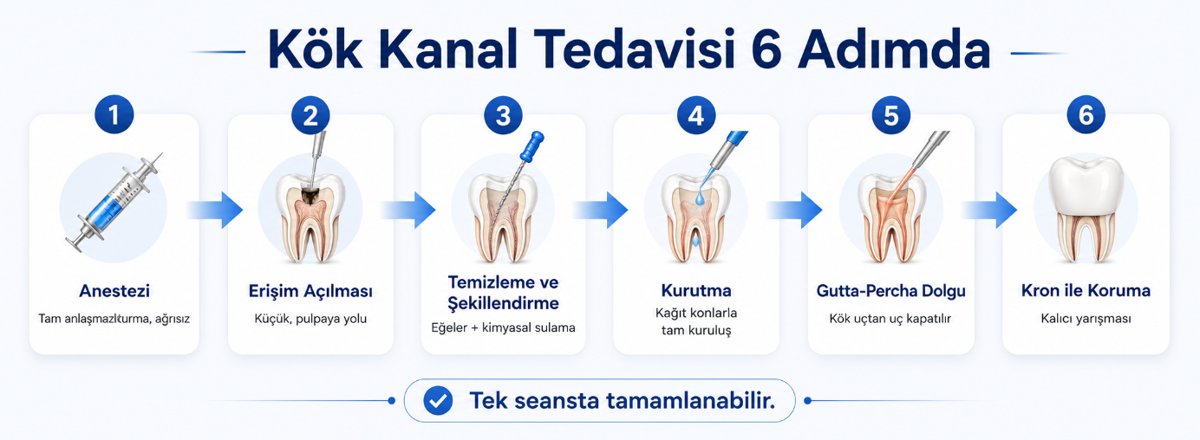
The dentist creates a small opening in the top surface of the tooth (the back surface in front teeth). This opening provides access to the canal system. Since the procedure is performed under local anesthesia, no pain is felt.
Cleaning the Pulp
Using small, flexible canal files (hand files or rotary nickel-titanium instruments), the infected pulp tissue is removed from the canal. At this stage:
- The length of the canal is measured electronically with an apex locator device
- The working length is verified with the support of an X-ray
- The canals are cleaned both mechanically (with files) and chemically (with sodium hypochlorite and EDTA solutions)
Chemical irrigation eliminates the lateral canals and bacterial biofilm that cannot be reached with instruments alone. This stage is the most critical and most time-consuming part of the treatment.
Canal Shaping
The cleaned canals are shaped into a tapered form in which the filling material can be firmly seated. Modern rotary systems (rotary endodontics) perform this process both faster and more consistently.
Canal Disinfection and Drying
After shaping is complete, the canals are irrigated one last time and completely dried with the help of paper points. Even a single trace of moisture can threaten long-term success.
Canal Filling (Obturation)
The sterile and dry canals are filled with a plant-derived, rubber-like material called gutta-percha, together with canal sealer. The filling must seal the canal completely, leave no voids and extend all the way to the root tip.
At this stage, an X-ray is taken to check that the filling is adequate. If necessary, corrections are made.
Temporary or Permanent Final Restoration
After the canal is filled, the opening is closed with a temporary filling. A permanent restoration is planned for the final visit or for the same visit (if the case is suitable).
How Many Visits Does It Take?
This question varies depending on the complexity of the case:
- Single visit (one-visit): Simple cases, and teeth with no active infection or only minimal infection. Cleaning, shaping and filling are completed in a single session. The advantages: fewer appointments, lower risk of infection, high comfort.
- Two visits: In cases of active infection or abscess, difficult canal anatomy or calcification, the first visit is completed with cleaning and medication (calcium hydroxide). The patient returns for the second visit after 1–3 weeks, and the canal is filled.
- Three or more visits: Complex cases with multiple roots, curved canals or chronic infection. This is rare.
Each visit lasts on average between 45 minutes and 90 minutes.
What Happens After Treatment?
The First 24–72 Hours
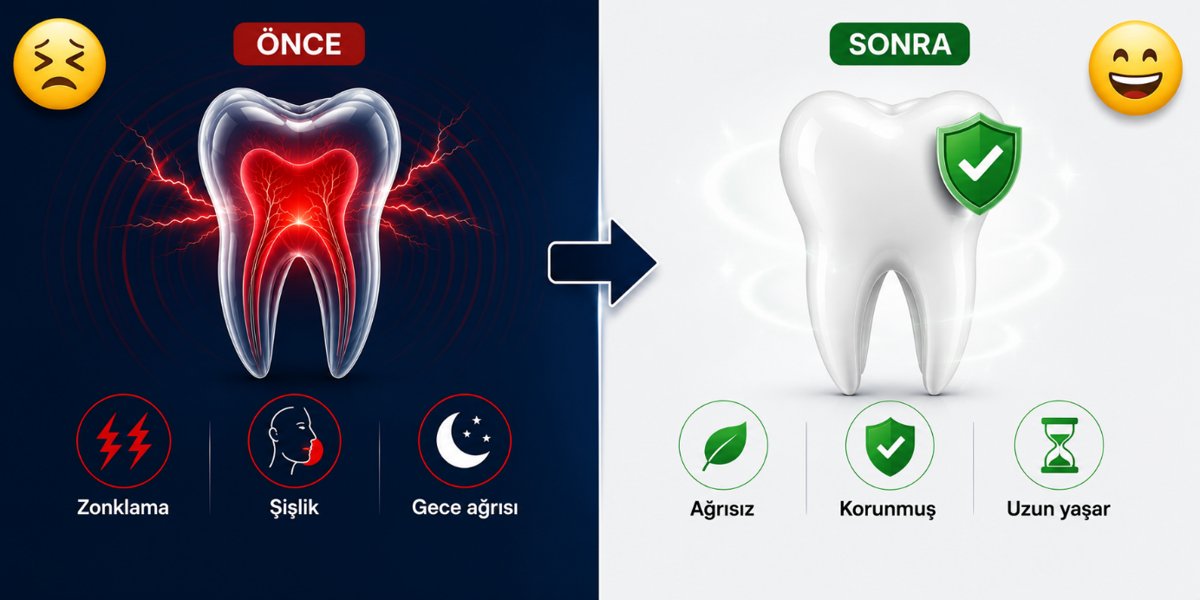
Once the anesthesia wears off, mild soreness or sensitivity is considered normal. The cause is the response of the tissues to the mechanical and chemical work inside the canal. This reaction usually goes away on its own within 2–3 days.
- A prescription painkiller eases this period
- Temporarily avoid hard foods
- Do not disturb the area with your tongue or finger
If the pain increases after the first few days, if swelling develops or if you have a fever — call your clinic immediately.
Permanent Restoration: Why Is It Important?
Root canal treatment alone is not enough. If a treated tooth is left without a final restoration, it is extremely vulnerable to fracture.
- Front teeth: A filling or laminate veneer may be sufficient.
- Back teeth (premolars, molars): Because chewing pressure is high, a crown is strongly recommended. The long-term success of root canal treated teeth protected with a crown is significantly higher than those with only a filling.
The earlier the restoration is done, the lower the risk of the tooth fracturing.
Can Root Canal Treatment Fail?
The success rate is reported in the literature as between 85% and 95%. However, in some cases the treatment may fall short:
- Missed canal: Some teeth may have non-standard, hidden canals. If these canals are left uncleaned, the infection persists.
- Canal perforation: The instrument going outside the canal — it is rarely seen in experienced hands.
- Delayed final restoration: A tooth with an open or temporary filling can pick up bacteria again.
- Vertical root fracture: A lengthwise fracture of the root, independent of the root canal treatment. In this case, the tooth usually has to be extracted.
Root Canal Treatment or Tooth Extraction?
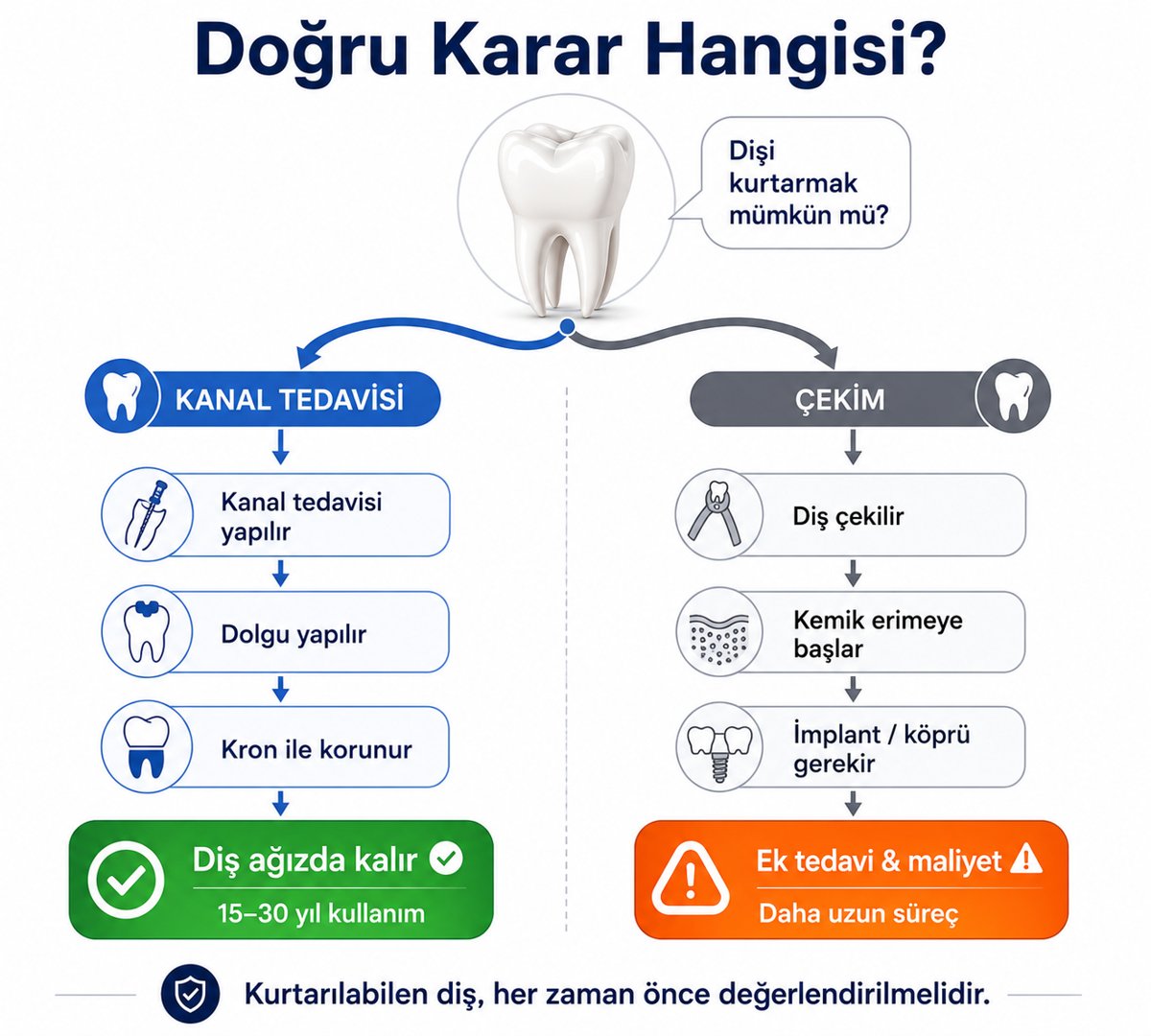
Many patients faced with this question consider extraction the "easier and cheaper" option. In the short term, that is true. But the long term presents a different picture:
- An implant or bridge must be made to replace the extracted tooth. These procedures are both longer and more costly.
- Bone resorption begins in the empty area.
- Neighboring teeth may start to drift toward the gap.
- The chewing balance is disrupted.
A tooth that can be saved with root canal treatment is an option that should always be considered before extraction. "Your own tooth is always the best implant" is one of the fundamental principles of dentistry.
Root Canal Retreatment
Root canal treatment can be performed again (retreatment) on canals that have failed or become reinfected years later. The old filling material is removed, and the canals are cleaned and filled again.
Retreatment is a more demanding procedure; however, in many cases the chance of saving the tooth is high. In cases where retreatment also fails, apical surgery (apicoectomy) may come into question — a minor procedure in which the root tip is surgically cleaned.
How Long Does a Root Canal Treated Tooth Last?
With a combination of properly performed root canal treatment and an appropriate final restoration (especially a crown), the tooth can function trouble-free for decades. The literature contains examples of successful cases lasting 20–30 years and more.
Factors affecting long-term success:
- The canal being fully cleaned and filled
- The permanent restoration being done on time
- Regular check-ups
- Oral hygiene
- Use of a night guard if you have bruxism
Frequently Asked Questions
Is root canal treatment really very painful?
With modern anesthesia techniques, no pain is felt during the procedure. A few days of mild sensitivity after treatment is normal. Many patients say it was not as difficult as they feared.
Will I feel a root canal treated tooth?
Since the nerve tissue of the tooth has been cleaned out, there is no response to hot and cold stimuli. However, the tooth continues to sense chewing pressure through its connection with the jawbone.
What is felt during root canal treatment?
Pressure, slight vibration and the movement of instruments. Not pain. If the anesthesia wears off, tell your dentist right away — an additional dose will be given.
Can root canal treatment be done during pregnancy?
It can be done in necessary cases, especially in the second trimester. Imaging is minimized and a suitable anesthetic is chosen. Non-urgent situations can be postponed until after birth.
How many days until I can return to work?
Most patients return to normal life the same day or the next day. Desk workers can usually continue working on the day of the procedure.
Is root canal treatment covered by insurance?
Public health insurance coverage varies depending on the case and the type of tooth. Private and supplementary insurance depends on the policy terms. It is recommended that you call your insurer before treatment to get coverage information.
Can an implant be placed on a tooth that has had root canal treatment?
If the root canal treatment has failed and the tooth has had to be extracted, an implant can be placed in the area after healing.
What is the likelihood of needing a second root canal treatment (retreatment)?
It depends on the quality of the first treatment and the patient's care. In successful cases, the need for retreatment is quite low.
Conclusion: Don't Be Afraid, Save Your Tooth
Root canal treatment is a far quieter experience than its name and reputation suggest. This procedure, unfairly feared for years, is in fact the smartest way to keep your tooth in your mouth, avoid a surgery and escape long-term costs.
If you have throbbing, prolonged sensitivity or swelling in your tooth — don't wait. The earlier the intervention, the cleaner the canal system stays, the simpler the treatment goes and the longer the tooth lives.
The first step: an examination. The treatment plan becomes clear there.
Don't Waste Time With Your Toothache
Book an appointment with our specialist dentists for root canal treatment and an examination.
Book an Appointment