How Are Aesthetic Veneers Made? What Are the Types?
"I don't like my teeth, but I can't have them pulled or crowned" — for everyone who says this, dentistry has developed an answer: aesthetic veneers.
Not as limited as a filling, not as radical as an implant. Applied to the right case, an aesthetic veneer is one of the least invasive and most striking restoration options that can transform a smile from the ground up.
But "aesthetic veneer" is actually not a single treatment; it is an umbrella term covering multiple materials and methods. In this guide, we have covered each of them in detail.
What Is an Aesthetic Veneer?
An aesthetic veneer is a thin restorative layer applied to the visible surface of a tooth — usually the front surface. Its purpose is to correct color, shape, size, or surface problems and give the tooth a natural-looking, aesthetically harmonious whole.
As a general rule, we can say this: aesthetic veneers correct while preserving tooth structure. Unlike zirconium or metal-supported crowns, they do not wrap around every surface of the tooth; they cover only the area that needs it.
This minimalism is both an advantage — less material is removed from the tooth tissue — and a limitation: they may not be suitable as a solution for every problem.
What Are the Types of Aesthetic Veneers?
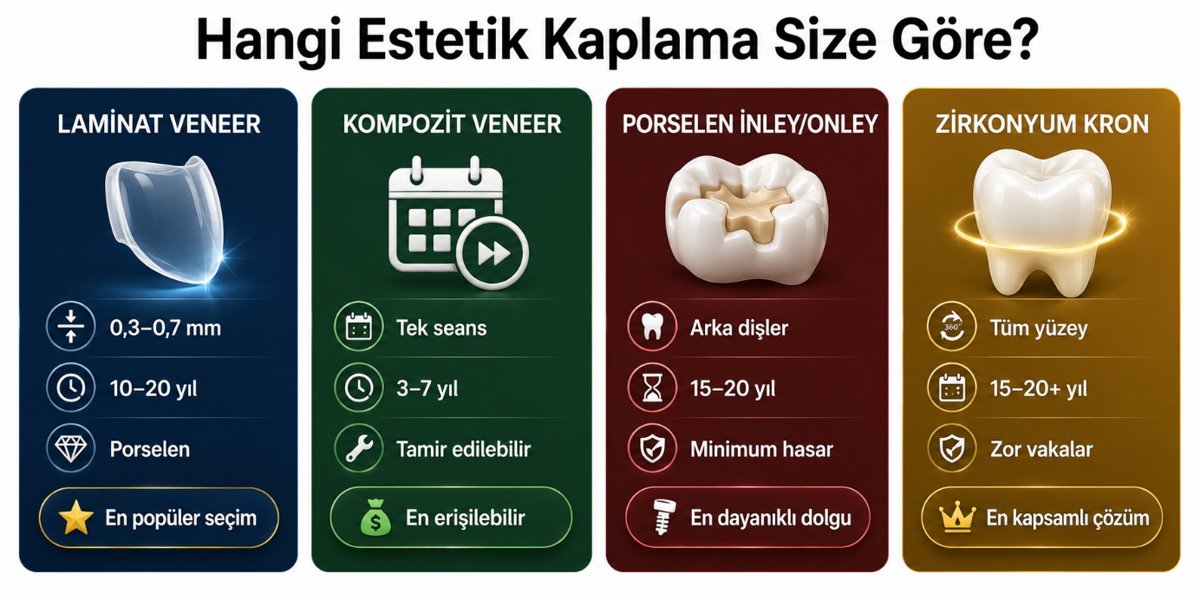
When it comes to aesthetic veneers, four main options come up in practice. Each has a different area of use, advantage, and limitation.
1. Laminate Veneer (Porcelain Laminate)
A laminate veneer is a restoration made by bonding a thin shell, 0.3–0.7 mm thick and produced from porcelain or zirconium, to only the front surface of the tooth. The seashell metaphor is often used — and it is an apt comparison.
- Areas of use: Discoloration (including tetracycline-stained teeth that do not respond to whitening), shape irregularities, mild fractures, small gaps (diastema), short or worn teeth.
- Amount of reduction: Minimal — only 0.3–0.7 mm of the front surface. In some cases no reduction may be needed at all (no-prep veneer).
- Lifespan: 10–20 years.
- Where it gives the best results: In Hollywood Smile cases, where many front teeth need to be aesthetically standardized at the same time.
2. Composite Veneer (Direct / Indirect)
Composite veneers are veneers created by bonding and shaping tooth-colored, resin-based filling material (composite) onto the front surface of the tooth layer by layer.
Direct composite veneer: The dentist applies the material directly in the mouth and completes it in the same session. There is no laboratory stage.
Indirect composite veneer: An impression is taken, it is prepared in the laboratory, and it is bonded in the next session. A surface smoothness close to porcelain quality can be achieved.
- Areas of use: Small cracks, shape defects, color differences, small gaps. It is also used as a temporary solution in young people whose teeth have not yet finished developing.
- Amount of reduction: Minimal or none.
- Advantage: Can be completed in a single session, is more affordable than porcelain laminate in terms of cost, and can be repaired.
- Disadvantage: Shorter-lived than porcelain laminate (5–8 years), slightly lower color stability, faster surface wear.
- Lifespan: Direct 3–7 years; indirect 7–12 years.
3. Porcelain Inlay / Onlay
Technically, inlays and onlays can be considered fillings rather than veneers; however, when it comes to aesthetic restorations, they are discussed in this group.
- Inlay: A porcelain filling prepared in the laboratory and applied to a decayed or fractured area between the two cusps (peak points) of the tooth. It lasts much longer than traditional amalgam or composite fillings.
- Onlay: A restoration that spreads over a wider area and also covers one or several cusps. It sits somewhere between an inlay and a crown; it preserves the tooth structure to the maximum extent.
- Areas of use: Back teeth with large decay or fractures; cases where there is not yet enough damage for a full crown but a large filling is inadequate.
- Advantage: Minimal material is removed from the healthy tissue of the tooth, it is very long-lasting (15–20 years), aesthetic, and durable.
4. Zirconium / All-Ceramic Crown (as an Aesthetic Veneer)
Although technically in the full crown category, it is considered part of aesthetic veneers, especially in front-area restorations and Hollywood Smile applications.
It wraps around the entire surface of the tooth. It comes into play as the first alternative when a laminate veneer cannot be applied — a very large filling, a root canal-treated tooth, extreme shape defects.
We have covered zirconium veneers in a separate, comprehensive guide; here we have only touched on their place within the aesthetic veneer system.
Who Are Aesthetic Veneers Suitable For?
- Individuals with discolored teeth — especially tetracycline-stained or fluorosis-affected teeth where whitening has not worked
- Those with diastema (a gap between the front teeth)
- Those with broken, cracked, or irregular teeth
- Those with small or short teeth who feel that too much gum shows
- Those who want to replace worn-out fillings with a more aesthetic option
- Individuals with slightly rotated or misaligned teeth — as an alternative to or complement of orthodontic treatment
- Patients who want to achieve a Hollywood Smile and are seeking aesthetic standardization across many front teeth
Who Are Aesthetic Veneers Not Suitable For?
As with every aesthetic approach, there are situations where aesthetic veneers are not suitable:
- Severe bruxism: Uncontrolled teeth grinding can cause laminate veneers to break or bonding to fail. Use of a night guard is required.
- Insufficient enamel tissue: Sufficient enamel surface is required for bonding a laminate veneer. Bonding success decreases in teeth that are extremely worn or have large fillings.
- Advanced periodontal disease: Aesthetic veneers cannot be applied when gum and bone loss has not been treated.
- Deep bite problems (malocclusion): Severe bite problems must first be resolved orthodontically or prosthetically.
- Active decay: Aesthetic restoration is not performed in the presence of untreated decay.
How Are Aesthetic Veneers Made? Step by Step
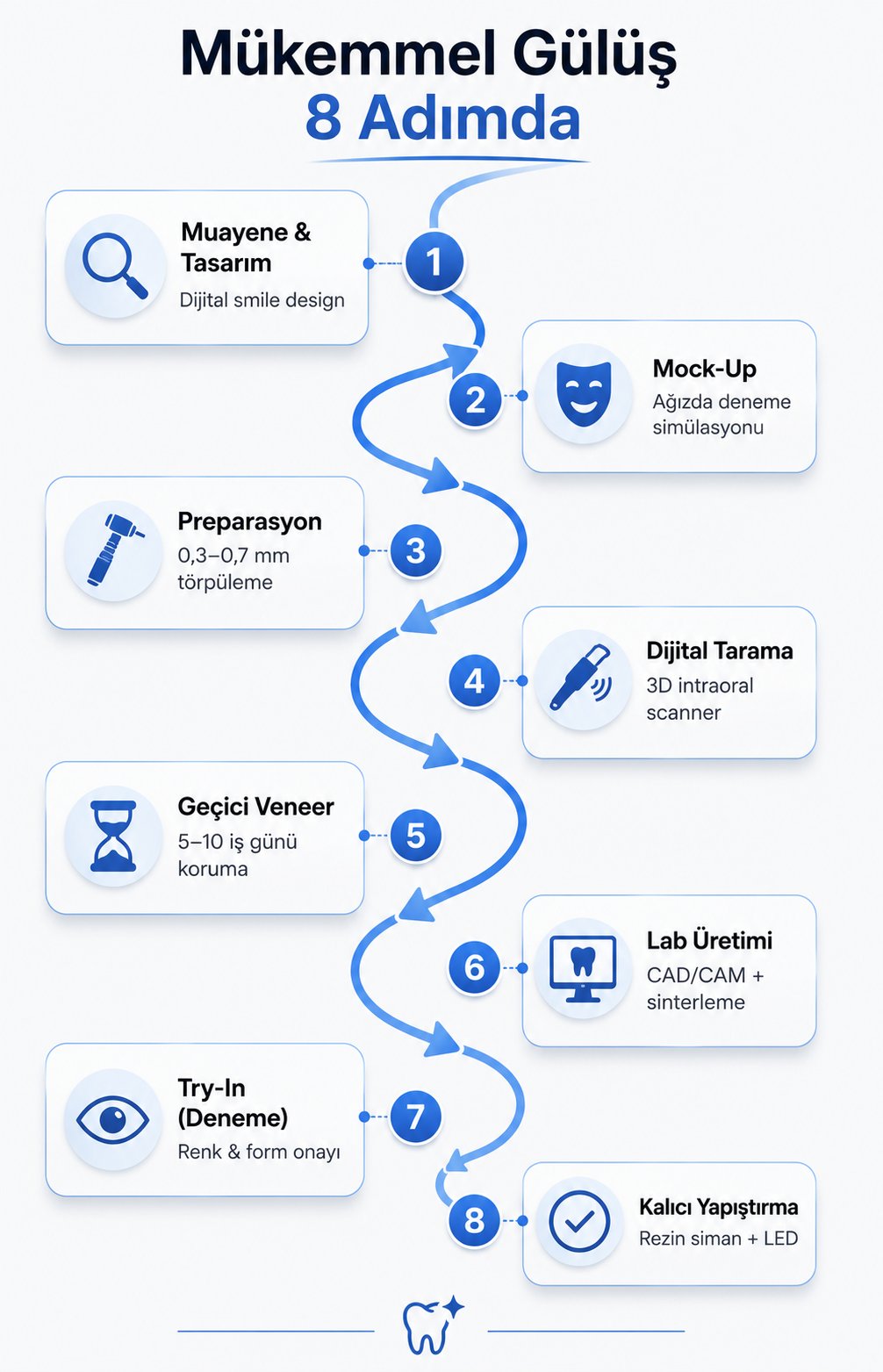
Examination and Smile Design
Everything starts with a proper assessment. At this stage:
- Intraoral photographs and X-rays are taken
- The color, shape, size, and position of the teeth are analyzed
- Gum health is evaluated — if necessary, periodontal treatment is planned before the veneers
- The post-treatment appearance is simulated with digital smile design; the patient gives approval
- The treatment plan is finalized: how many teeth, which material, how much reduction
Mock-Up (Trial in the Mouth)
It is an important stage in the quality planning of laminate veneer applications. A temporary simulation is created on the teeth using composite material. The patient experiences their smile before it is made:
- How long will the teeth be?
- Does the shape look natural?
- How does it harmonize with the lip line?
The desired corrections are made on the mock-up, and then the actual preparation begins.
Preparation (Tooth Reduction)
For a laminate veneer, only 0.3–0.7 mm of material is removed from the front surface of the tooth. This procedure is performed under local anesthesia and is painless.
In no-prep veneer cases, this step is skipped — but not every tooth is suitable for it; the decision is made according to the tooth's position, size, and current condition.
Taking the Impression
- Digital method: The mouth is scanned in 3D with an intraoral scanner. Precise, comfortable, fast.
- Traditional method: A tray impression taken with silicone impression material is sent to the laboratory.
Temporary Veneers
While the laminates are being prepared (5–10 business days), temporary composite veneers are applied. They keep the patient comfortable during this period and protect the prepared teeth.
Laboratory Production
Based on the impression, the ceramic artist / dental technician:
- Creates the veneer design in CAD/CAM software
- Mills the porcelain or zirconium block
- Completes the sintering, staining, and glazing processes
- Checks each veneer individually
Try-In
Before permanent bonding, the veneers are placed on the teeth for trial purposes with a temporary cementing gel:
- The color is evaluated under different lighting conditions
- The shape and fit are checked
- The patient's approval is obtained
- Necessary minor adjustments are made
Surface Preparation and Bonding
Before the approved veneers are permanently bonded, both the tooth surface and the inner surface of the veneer are prepared:
- Acid gel is applied to the tooth surface (etching) — it roughens the bonding surface
- Silanization is applied to the inner surface of the veneer — it strengthens the chemical bond
- Bonding agent (adhesive primer) is applied to both surfaces
- The veneer is placed on the tooth using light-cured resin cement
- The cement is polymerized (hardened) with LED light
- Excess cement is cleaned off, and the occlusion (bite balance) is checked
Laminate Veneer vs. Composite Veneer Comparison
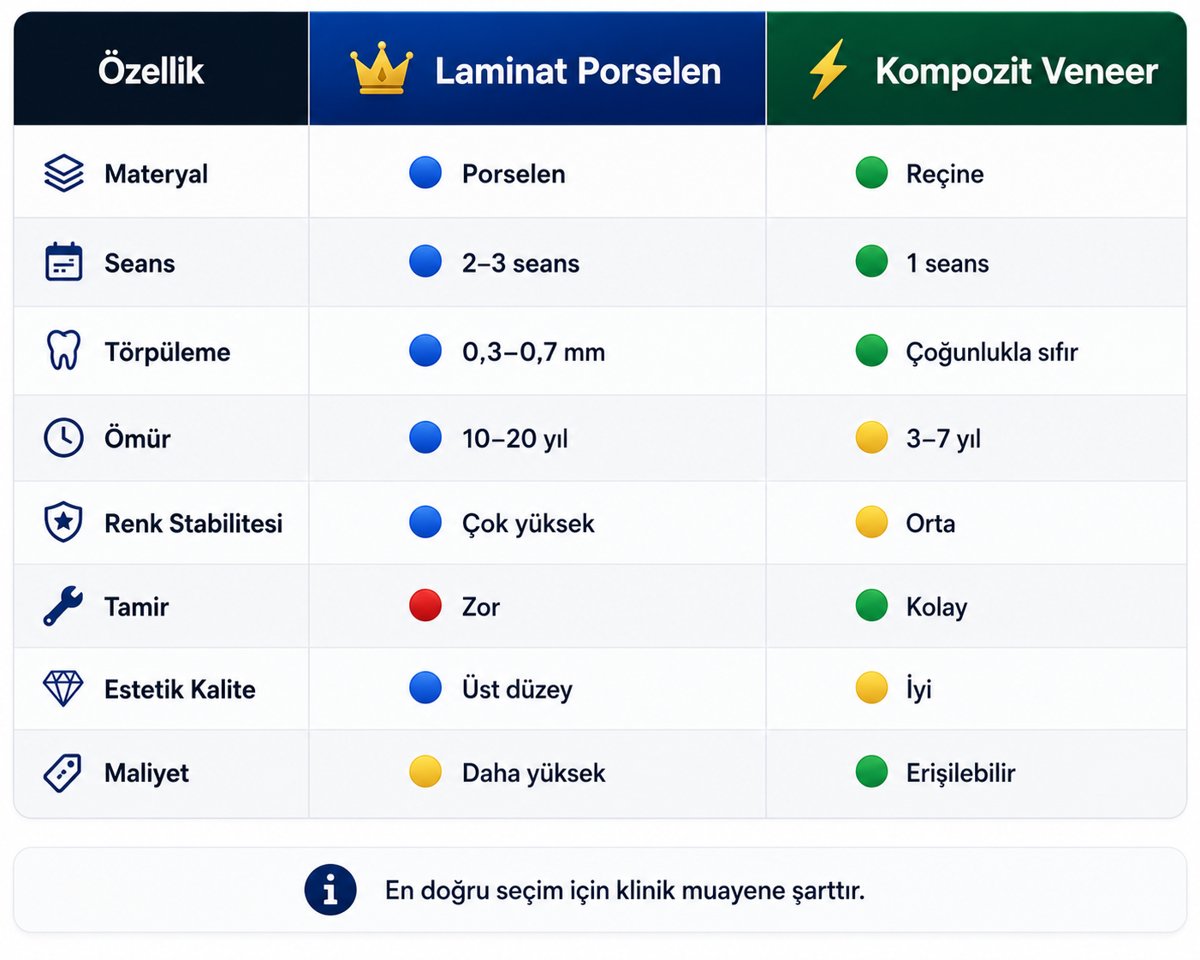
| Feature | Porcelain Laminate | Composite (Direct) |
|---|---|---|
| Material | Porcelain / Zirconium | Composite resin |
| Number of sessions | 2–3 sessions | 1 session |
| Reduction | Minimal (0.3–0.7 mm) | Mostly none |
| Lifespan | 10–20 years | 3–7 years |
| Color stability | Very high | Medium |
| Repairability | Difficult (replacement needed) | Easy |
| Aesthetic quality | Superior | Good |
| Cost | Higher | More affordable |
| Natural feel | Very natural | Natural |
Aesthetic Veneers vs. Orthodontics
These two options are sometimes considered for the same patient. The difference between them is clear:
- Orthodontics changes the actual position of the teeth — it moves the teeth. The result is permanent and there is no intervention on the tooth tissue at all. Its duration varies between 6 months and 2 years.
- Aesthetic veneers do not change tooth position; they change visual perception. Mild rotations and gaps can be corrected optically. The result is seen instantly.
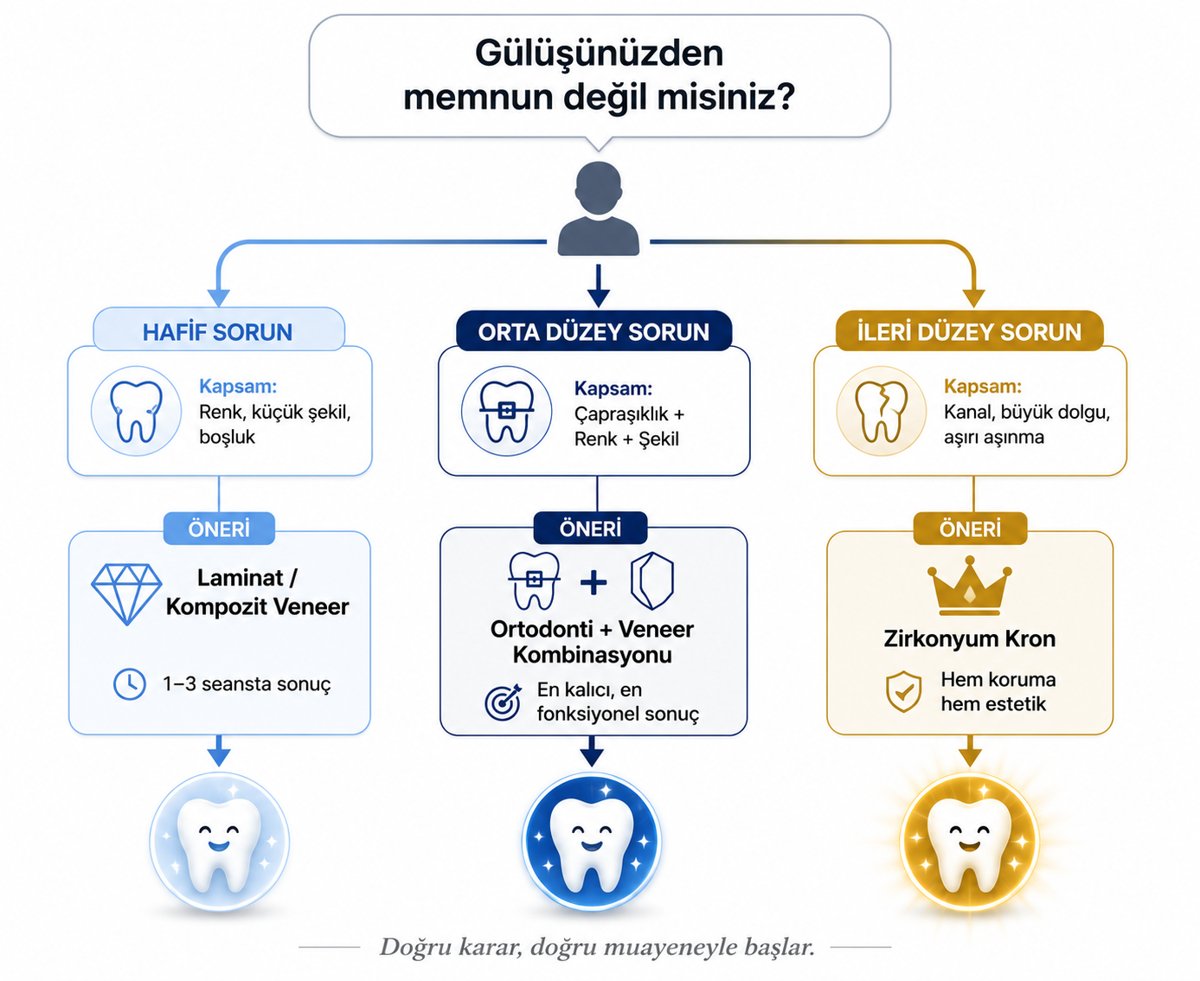
The two can be not conflicting but complementary options. In some cases, orthodontics is performed first, followed by aesthetic veneers — this combination gives the best result both functionally and aesthetically.
What Is a Hollywood Smile? How Does It Differ from Aesthetic Veneers?
Hollywood Smile is a concept describing the simultaneous restoration of many front teeth (generally 8–10 on top, 6–8 on the bottom) with aesthetic veneers. It is not a single treatment, but a comprehensive aesthetic transformation program.
The material used is mostly laminate veneer or zirconium. The goal is to achieve a fully standardized result in terms of color, shape, size, and symmetry that creates harmony when smiling.
In Hollywood Smile applications:
- Digital smile design (DSD) is essential
- The mock-up stage cannot be skipped
- Occlusion analysis is critical — the bite balance of all teeth is re-established
- Expectation management between the dentist and the patient is decisive
Care After Aesthetic Veneers
- First 48 hours: Avoid tea, coffee, red wine, and colored foods — the bonding cement reaches its full hardness during this time.
- Brushing: Choose a soft-bristled brush and a toothpaste that contains no abrasives. Hard brushes can damage the surface shine.
- Dental floss: Daily use is essential to prevent plaque buildup along the sides of laminate veneers.
- Night guard if you have bruxism: It prevents excessive force from being applied to the veneers.
- Hard foods: Habits such as chewing ice, cracking nuts with your teeth, and biting pens are the main causes of veneer breakage.
- Check-up every 6 months: Bonding integrity, gum condition, and veneer surface are evaluated.
How Many Years Do Aesthetic Veneers Last?
- Porcelain laminate veneer: 10–20 years; clinical studies report a 10-year success rate of 90–95 percent.
- Direct composite veneer: 3–7 years; replacement may be needed more often because of discoloration and surface wear.
- Indirect composite veneer: 7–12 years.
- Zirconium aesthetic crown: 15–20 years and beyond.
These figures can vary significantly depending on the patient's oral hygiene, the dentist's technique, the quality of the material used, and the patient's habits.
Frequently Asked Questions
Do the teeth hurt after laminate veneers?
There may be mild heat sensitivity in the first few days. This is normal and usually passes in 1–2 weeks. If you have persistent or severe pain, consult your dentist.
Can laminate veneers come off?
With the correct bonding technique and a compatible tooth structure, unintended detachment is very rare. Bonding failure is mostly due to technical error or bruxism.
Do aesthetic veneers look natural?
Porcelain laminates prepared by a qualified ceramic artist can be produced at a level that is indistinguishable from a natural tooth even at very close range. The result depends largely on the experience of the technician and the dentist.
Do I choose the tooth color myself?
Yes. The shade selection process is carried out together with the dentist. A Vita shade guide (color scale) and digital color analysis devices are used. Production begins after the patient's approval is obtained at the mock-up stage.
Which should I choose between laminate veneer and zirconium?
If little reduction is sufficient and the tooth structure is sound, laminate; if the tooth has a large filling, root canal treatment, or extreme color/shape defects, a zirconium crown may be more suitable. Make this decision together with your dentist, after an intraoral examination and X-ray.
I smoke; can I have aesthetic veneers?
You can; however, smoking negatively affects gum health and speeds up discoloration, especially in composite veneers. Porcelain laminates are more resistant to smoking.
Which problems cannot be solved with aesthetic veneers?
Severe crowding, serious bite disorders, advanced bone loss, and active gum disease cannot be solved with aesthetic veneers. In these cases, orthodontics, periodontal treatment, or prosthetic rehabilitation is a prerequisite.
Can no-prep (reduction-free) veneers be applied to everyone?
No. No-prep veneers are applied in selected cases where the position of the teeth is suitable and adding extra volume will not cause an aesthetic problem. They are not suitable for every patient.
Conclusion: What Can Be Achieved with Aesthetic Veneers?
An aesthetic veneer that comes from the right dentist, with the right material, in the right case can solve color, shape, size, and symmetry problems with a single treatment. It can standardize the smile and renew self-confidence.
But the key word here is "right" — the right indication, the right material choice, the right laboratory craftsmanship, and the right patient expectations. When one of these four components is missing, the result ends in disappointment.
The best starting point: a comprehensive examination, a transparent planning consultation, and not giving approval without seeing the treatment result with a mock-up.
Ready to Renew Your Smile?
Get a free consultation with our expert dentists for aesthetic veneers and smile design.
Book an Appointment