Teeth Whitening Methods: Laser or At-Home?
Do you ever avoid smiling when you look in the mirror? Are yellowing or discoloration on your teeth bothering you, but you don't know which method to choose? Perhaps you have searched online — some say "get laser," some say "just buy a gel for home," and others advise "rub on baking soda."
After reading this guide, most of the question marks in your mind will be cleared up. We cover the scientific basis of teeth whitening, the real differences between methods, the option that suits you best, and the points you need to watch out for — all from an expert's perspective, in plain language.
Table of Contents
- Why Do Teeth Yellow and Become Discolored?
- What Are the Teeth Whitening Methods?
- Laser or At-Home? Comparison Table
- Who Cannot Have Teeth Whitening?
- How Does the Treatment Process Work?
- What to Watch Out for After Teeth Whitening
- Do Homemade / Natural Methods Really Work?
- Factors Affecting Teeth Whitening Prices
- Which Method Is Right for You? Decision Guide
- Frequently Asked Questions
Why Do Teeth Yellow and Become Discolored?
To choose the right whitening method, you first need to understand where the discoloration comes from. Because the wrong method wastes money and fails to meet your expectations.
External Discoloration (Extrinsic)
Extrinsic discoloration refers to stains that have built up on the outer surface of the tooth — that is, on top of the enamel layer. Over time they can work into the gum groove and the enamel pores, but fundamentally they are surface stains.
The most common causes are:
- ☕ Coffee and tea: Tannins contain chromogen substances that easily stick to the enamel surface.
- 🍷 Red wine: It contains both acid and color pigment, so it acts on two fronts.
- 🚬 Cigarettes and tobacco products: Nicotine and tar cause deep yellowing in the long term.
- 🥤 Dark-colored drinks: Cola, fruit juices, energy drinks.
- 🍅 Some foods: Tomato sauce, curry, soy sauce.
Extrinsic discoloration is the group that responds best to whitening treatment.
Internal Discoloration (Intrinsic)
Intrinsic discoloration covers color changes that occur in the inner structure of the tooth — that is, in the dentin layer. These cannot be removed by surface cleaning or standard whitening; they require more specialized approaches.
The main causes are:
- 💊 Tetracycline antibiotics: When used in childhood, they penetrate the inner structure of the tooth and leave characteristic gray-brown bands.
- 🦷 Fluorosis: White-brown spots caused by excessive fluoride intake during tooth development.
- 🩸 Trauma: When a tooth takes a blow, internal bleeding can occur; the dentin darkens over time.
- 👴 Aging: As the dentin layer thickens, the enamel wears away; the tooth naturally turns yellow.
- 🔬 Root canal-treated teeth: When the pulp is removed, the tooth may darken over time.
📦 Info Box — Which Method Works for Which Discoloration?
| Type of Discoloration | Recommended Method |
|---|---|
| Coffee, tea, cigarette stains (superficial) | Laser or at-home whitening |
| Age-related yellowing | Laser or combined whitening |
| Tetracycline discoloration (mild) | Combined whitening (long-term) |
| Darkening of a single root canal-treated tooth | Internal whitening (walking bleach) |
| Fluorosis stains | Laminate veneers or composite |
What Are the Teeth Whitening Methods?
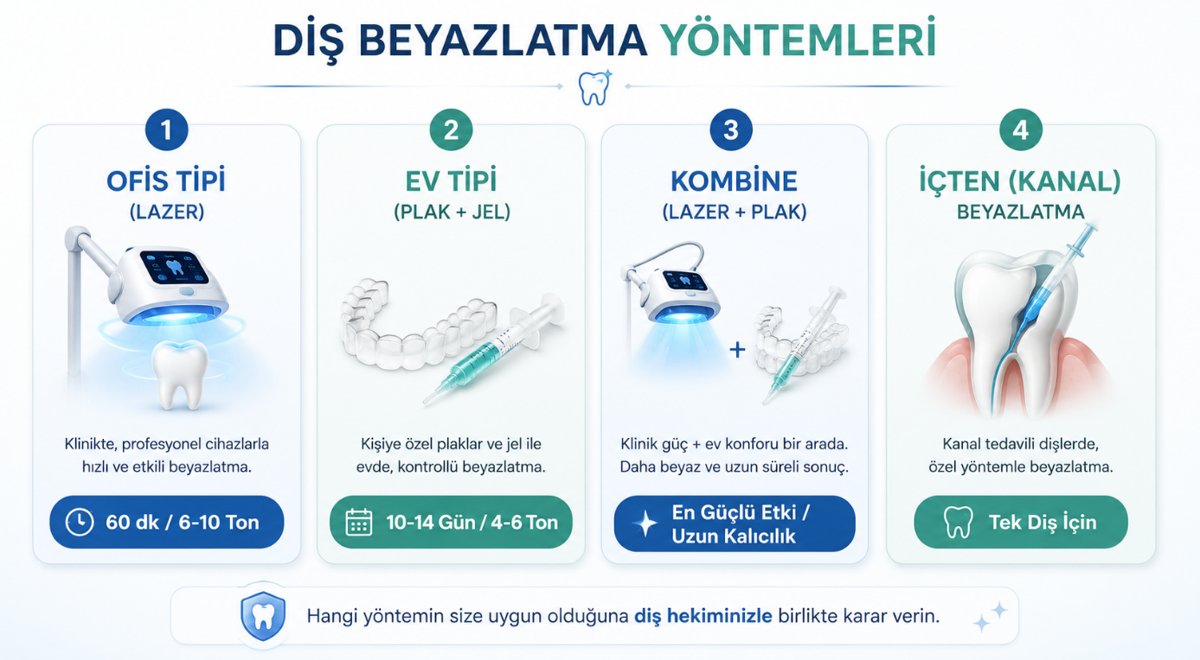
Today there are four main teeth whitening methods performed under a dentist's supervision. Each has its own indications, application time, and level of effect.
1 — In-Office (Clinical) Laser Whitening
In this method, performed by the dentist in a clinical setting, a high-concentration hydrogen peroxide gel (25–40% concentration) is applied to the teeth. A laser or special LED light source then activates the gel, releasing oxygen. The free oxygen radicals break down the color molecules in the enamel and dentin.
Application details:
- Session time: 60–90 minutes (3 × 15–20 minutes of active application)
- Typical whitening: 6–10 shades
- Longevity: 1–2 years, depending on lifestyle
- Dentist supervision: Mandatory
The biggest advantage of this method is that it gives fast and noticeable results. It is preferred before a wedding, graduation, or an important event.
2 — At-Home Whitening (Under Dentist Supervision)
In this method, the dentist takes an impression of the patient's teeth and prepares custom-made clear trays. The patient is given a low-concentration carbamide peroxide gel (10–22%). The patient places this gel in the trays and wears them for a few hours a day or overnight while sleeping.
Application details:
- Application time: 2–4 hours a day or overnight, for 10–14 days
- Typical whitening: 4–6 shades
- Longevity: 1–1.5 years
- Dentist supervision: Initial and check-up appointments
The key difference from ready-made strips or gels bought at the pharmacy is this: a custom-made tray ensures the gel is distributed evenly over every tooth and stays away from the gums. Ready-made products lack this control; the risk of ineffectiveness and sensitivity is higher.
3 — Combined Whitening (The Most Effective Protocol)
Immediately after the clinical session, the patient is sent home with custom trays and a low-concentration gel. This two-stage approach delivers both immediate and long-term results.
Why is it longer-lasting? The clinical session kicks off the color change quickly; the home application stabilizes this change and slows the rate at which the enamel layer re-stains. Studies show that the combined protocol provides 30–40% longer-lasting results compared with a clinical application alone.
4 — Internal Whitening (Walking Bleach)
This method is applied only to single teeth that have had root canal treatment and have darkened. Without reopening the root canal, the dentist places a whitening agent (sodium perborate or hydrogen peroxide) inside the dentin. The tooth is temporarily sealed; the agent works from the inside for a few days. The procedure can be repeated over several sessions.
It should not be confused with general whole-mouth whitening; it is a specific procedure with a completely different indication.
Laser Whitening or At-Home? Comparison Table
To understand which method suits you, it is enough to review this table:
| Criterion | Clinical Laser | At-Home (Under Dentist Supervision) | Combined | Pharmacy Products |
|---|---|---|---|---|
| Application time | 60–90 min (1 session) | 10–14 days | 1 session + 7–10 days at home | 4–6 weeks |
| Whitening shades | 6–10 shades | 4–6 shades | 8–12 shades | 1–3 shades |
| Longevity | 1–2 years | 1–1.5 years | 2–3 years | 3–6 months |
| Sensitivity risk | Moderate | Low–Moderate | Moderate | Low |
| Dentist supervision | ✅ Mandatory | ✅ Prescribed | ✅ Mandatory | ❌ None |
| Cost | High | Moderate | Highest | Lowest |
| Ideal profile | Those who want fast results | Those with sensitive teeth, those with flexible time | Those who want maximum results | Mild surface stains |
💡 Important Note: Shade values are given according to the VITA shade guide. Depending on the starting color and the type of discoloration, these values may vary from person to person.
Who Cannot Have Teeth Whitening?
Teeth whitening is a safe procedure — but not for everyone, and not under all conditions. Knowing this clearly both prevents disappointment and avoids unnecessary cost.
Absolute Contraindications
Teeth whitening must absolutely not be performed in these conditions:
- 🚫 Children and adolescents under 18: The enamel layer and pulp (the tooth nerve) have not finished developing. Strong whitening agents can cause permanent damage.
- 🚫 Pregnancy and breastfeeding: There are not enough clinical studies on the effects of whitening agents on the fetus or baby. Postponing it during this period is recommended.
- 🚫 Active periodontal disease (gum inflammation): Your dentist will not perform whitening while your gums are inflamed. Gum treatment must be completed first.
- 🚫 Untreated cavities and broken fillings: The whitening agent can seep into the inner tissue through these openings; the risk of pain and damage can become serious.
Situations Requiring Caution
Whitening can be performed in these groups; however, a special protocol and care are required:
- ⚠️ Excessive tooth sensitivity: A low-concentration at-home method should be preferred, and the intervals between sessions should be extended.
- ⚠️ Crowns, bridges, implants, and composite fillings: These structures do not respond to the whitening agent. While natural teeth whiten, these restorations stay the same color; a color mismatch may appear. Your dentist must inform you about this.
- ⚠️ Heavy smokers: Even if whitening is successful, re-staining happens much faster. Quitting or cutting down smoking before and after the procedure significantly increases longevity.
📦 Warning: If you already have crowns, bridges, or implants, these restorations may also need to be replaced after your natural teeth are whitened. This affects the total cost. Be sure to discuss this detail with your dentist during treatment planning.
How Does the Treatment Process Work?
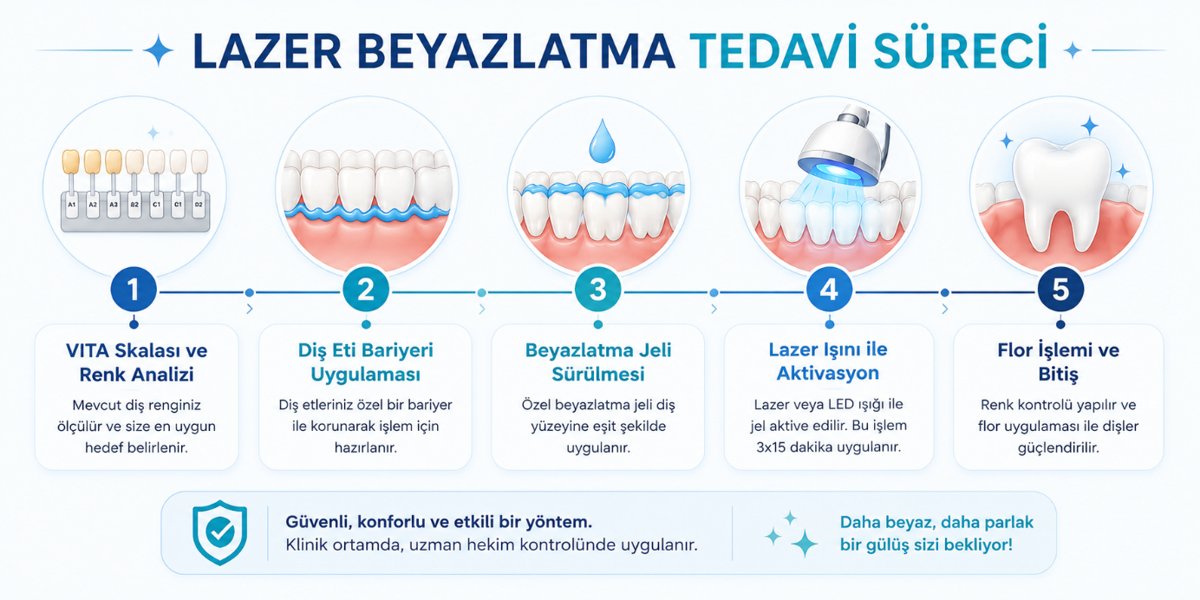
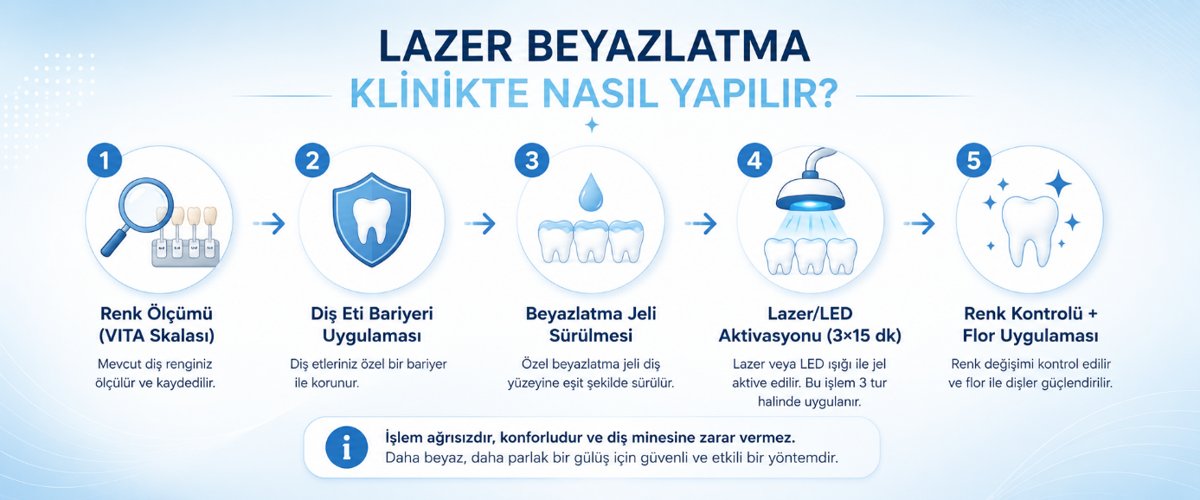
Clinical Laser Whitening — 5 Steps
The 60–90 minutes you spend in the clinic is actually an extremely comfortable process. Here is what you will experience, step by step:
- Preliminary Examination and Shade Determination: The dentist determines your starting tooth shade with the VITA shade guide and takes a photograph. This is important both as a reference and for comparing the results.
- Application of the Gum Protective Barrier: Your gums are sensitive to light and gel. The dentist applies a barrier (liquid dam) that covers your gums. This step greatly reduces the risk of sensitivity and irritation.
- Application of the Whitening Gel: High-concentration hydrogen peroxide gel is applied evenly to your teeth.
- Laser / LED Light Activation: The special light source activates the gel, producing free oxygen radicals. These radicals break down the color molecules. The procedure is usually applied in 3 rounds; each round lasts about 15 minutes.
- Cleaning, Shade Check, and Fluoride Application: After the gel is cleaned off, the tooth shade is measured again with the VITA guide — you can see how many shades it has whitened. Finally, fluoride gel is applied to the teeth; this both reduces sensitivity and strengthens the enamel.
At-Home Whitening — 3 Steps
- Custom Tray Preparation: At the first appointment, your dentist takes a plaster model of your upper and lower jaws. Personal clear trays are made from these models (ready within 1–2 days).
- Daily Application Protocol: You put a small amount of gel into the trays and wear them on your teeth. You use them 2–4 hours a day or 6–8 hours at night. The total duration is usually 10–14 days.
- Check-Up Appointment: When the treatment is completed, your dentist evaluates the result, recommends an additional application if needed, and explains the maintenance protocol for long-term protection.
What to Watch Out for After Teeth Whitening
What happens afterward is as important as the procedure itself. The first 48 hours and long-term care directly affect how long the result lasts.
"White Diet" — The First 48 Hours
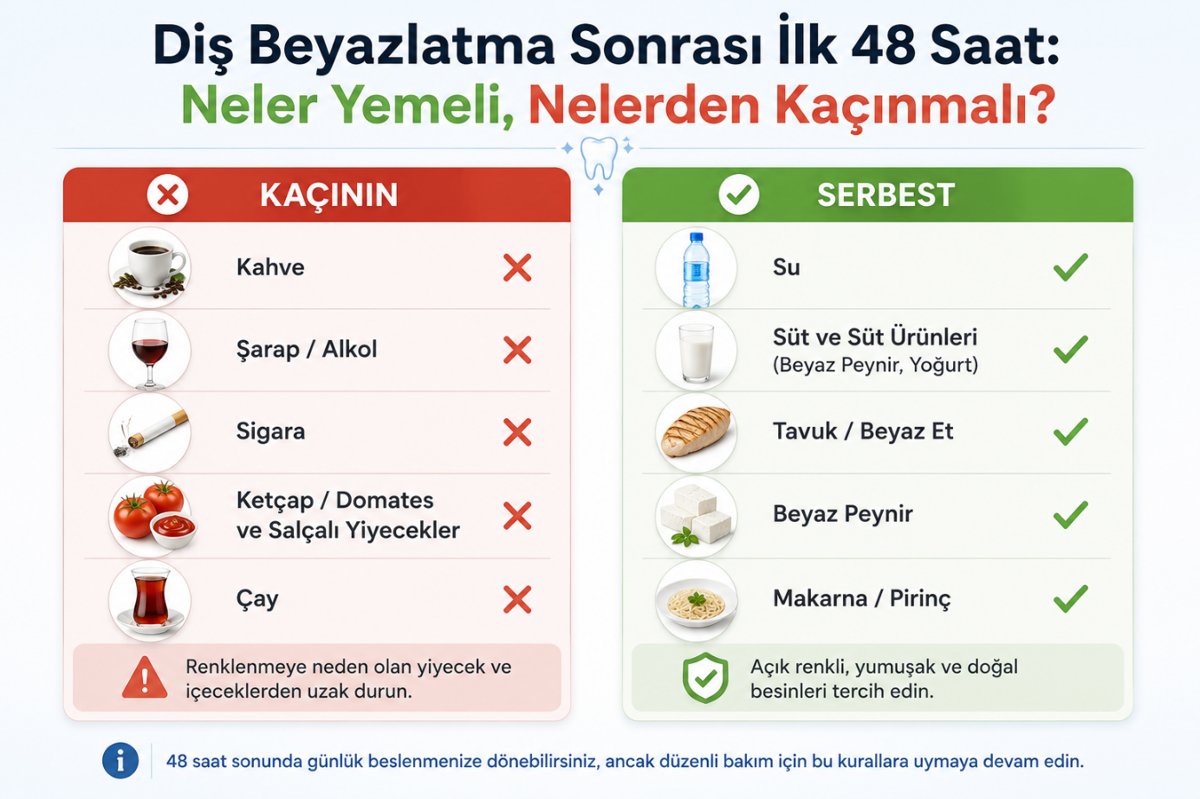
Immediately after whitening, the enamel pores stay temporarily open; they absorb color pigments much more easily. During this critical window, the following should be avoided:
| ❌ To Avoid | ✅ Can Be Consumed |
|---|---|
| Coffee, tea, Turkish coffee | Water, milk |
| Red wine, cola | White cheese |
| Tomato, tomato sauce | Rice, pasta (without sauce) |
| Chocolate, boza | Chicken, fish (without sauce) |
| Cigarettes | Banana, apple (peeled) |
| Soy sauce, curry | Yogurt |
General rule: "Anything that would stain your white clothes will also stain your teeth."
Care for Long-Term Results
Once whitening is done, it does not last forever; depending on lifestyle habits, the color gradually starts to return. To extend longevity:
- 🦷 Tartar cleaning every 6 months: Professional cleaning removes surface stains that are starting to build up at an early stage.
- 🪥 Whitening toothpaste: These abrasive toothpastes do not whiten deeply; they prevent the buildup of surface stains.
- 📅 Annual "touch-up" application: A short application once a year with at-home trays and low-concentration gel refreshes the color.
- 🚭 Smoking: It is the factor that causes the fastest color loss after whitening. Quitting or cutting down directly affects the result.
Do Homemade / Natural Methods Really Work?
Let's look at a few of the most common suggestions found online from a scientific perspective:
Baking soda (sodium bicarbonate): With its mild abrasive property, it can physically remove surface stains. However, regular use wears down the enamel layer. Once enamel is worn away, it does not grow back — and thin enamel makes the darker-looking yellow dentin more visible. Net result: slight whitening in the short term, worse color in the long term.
Activated charcoal: This method, popular in recent years, has no scientific validity. The American Dental Association (ADA) clearly states that there is not enough evidence supporting the safety of activated charcoal for teeth. Its abrasive nature poses a risk to the enamel.
Lemon juice / apple cider vinegar: Because of their strongly acidic nature, they cause enamel erosion. The short-term brightening comes from acid wear — this is a dangerous trade-off.
Coconut oil (oil pulling): It may indirectly contribute to oral hygiene, but it has no proven effect on tooth color.
📦 Conclusion: Homemade methods are either ineffective or, in the long term, do more harm than good. For a safe and lasting result, methods under a dentist's supervision should be preferred.
Factors Affecting Teeth Whitening Prices
Teeth whitening prices vary within a wide range in Turkey. The reason for this difference is not merely clinical differences, but a combination of several key factors:
- 🏥 Type of method: Clinical laser has the highest cost; at-home is more affordable; combined is close to the sum of the two.
- 📍 Clinic location: In big cities such as Istanbul and Ankara, prices may be higher than at clinics outside the city.
- 🔬 Quality of the product used: Gel concentration, brand, and certifications (CE, FDA-approved products) affect the price. Higher quality deserves a higher price.
- 🦷 Need for preparatory work: If tartar cleaning, cavity treatment, or filling replacement is needed before treatment, these procedures are added to the cost separately.
- 👨⚕️ The dentist's experience and expertise: A certified, experienced dentist makes a difference in terms of both safety and quality.
📦 Important Warning: When researching prices, don't focus only on the number. Be sure to ask: "How many sessions are included?", "Which gel is used?", "Is the tray fee included?", "Is there a check-up appointment?" Low-priced packages often do not include these details.
For an exact price, you can book a free shade analysis and treatment planning appointment at our clinic.
Which Method Is Right for You? — Decision Guide
There is no single right answer; the right answer is specific to your situation. This table will help you decide:
| Your Situation | Recommended Method |
|---|---|
| Wedding, graduation, important event — I want fast results | ✅ Clinical laser whitening |
| My teeth are sensitive, I want a slow but safe result | ✅ At-home (low-concentration, long-term) |
| I want maximum whiteness and the longest-lasting results | ✅ Combined whitening (laser + at-home) |
| A single root canal-treated tooth has darkened | ✅ Internal whitening (walking bleach) |
| I have mild stains and first want to understand what it's like | ✅ Start with at-home or a preliminary examination |
| I have existing crowns/bridges and color match matters | ✅ Consult your dentist first — restoration replacement may be needed |
| I am pregnant or breastfeeding | 🚫 Postponing is best |
The most reliable decision is personal advice given after a dentist's intraoral examination. This table is a starting point — the final decision should be made together with your dentist.
Frequently Asked Questions (FAQ)
Is teeth whitening permanent?
No, it is not permanent. Depending on lifestyle and the method used, results are expected to last 1–3 years. Smoking, coffee, and tea consumption shorten this period. With annual "touch-up" applications, the result can be maintained for many years.
Is laser teeth whitening harmful?
It is safe when performed under a dentist's supervision with approved products. Temporary sensitivity after the procedure is normal and goes away within a few days. Using unapproved or high-concentration gels without a dentist can cause enamel and gum damage.
How effective is at-home whitening?
At-home whitening performed under a dentist's supervision with custom-made trays is quite effective: it provides an average of 4–6 shades of whitening. It should not be confused with ready-made products bought at the pharmacy; although the mechanism of action is similar, the level of control and results is much lower.
How long does sensitivity last after teeth whitening?
Temporary sensitivity to cold/hot for 24–72 hours after the procedure is considered normal. Fluoride gel applied by the dentist and desensitizing toothpaste ease this period. Pain that lasts longer than 72 hours, intensifies, or comes on spontaneously should be reported to your dentist.
How many sessions are needed to get results?
With clinical laser whitening, noticeable results are generally achieved in a single session. The at-home method requires 10–14 days of regular application. With the combined method, the first session is in the clinic, followed by 7–10 days of home application.
Can teeth be whitened during pregnancy?
No. Whitening procedures should be postponed during pregnancy and breastfeeding. There is not enough safety data on the effects of the substances used during these periods.
Are crowns and fillings affected by whitening?
No. Porcelain crowns, bridges, composite fillings, and implant superstructures do not respond to whitening agents. While natural teeth whiten, these restorations stay the same color; a visible color mismatch may occur. For this reason, it is critically important to share your existing restorations with your dentist during treatment planning.
How many years does the result last?
Clinical laser: 1–2 years; at-home: 1–1.5 years; combined: 2–3 years. These periods vary significantly depending on lifestyle habits, dental care, and annual touch-up applications.
Can smokers whiten their teeth?
Technically it can be done; however, longevity is significantly reduced. Smoking is the factor that causes the fastest color loss after whitening. Not smoking for at least a few weeks before and after the procedure directly affects the quality of the result.
What is the difference between teeth whitening and laminate veneers?
Teeth whitening is a chemical procedure that lightens the tooth's own color; it does not change the tooth structure. Laminate veneers, on the other hand, are thin porcelain shells bonded to the front surface of the tooth; they offer the possibility of changing both color and shape. In cases such as tetracycline discoloration, fluorosis, or shape irregularities, whitening falls short; veneers are a longer-lasting and more comprehensive solution.
Conclusion
Teeth whitening is a treatment that delivers safe, effective, and satisfying results with the right method and a dentist's guidance. However, there is no single answer for the "best method" — the best method is the one that suits your oral structure, the cause of your discoloration, your expectations, and your lifestyle.
Keep three key messages in mind:
- Find out the source of the discoloration. Extrinsic or intrinsic? This is the foundation of choosing a method.
- Don't decide without a dentist. Homemade methods and pharmacy products may give a slight effect in the short term, but can threaten your enamel health in the long term.
- Protect the result with your lifestyle. Whitening is a beginning; your care habits determine longevity.
Get Your Free Shade Analysis
Contact our expert dentists for the teeth whitening method best suited to you.
Book an Appointment