What Is an All-on-4 Implant? Who Is It Suitable For? The Complete Guide

The first thing you do when you wake up should not be putting in your denture. You should not have to think about what you can eat rather than what you want to eat. Hesitating to smile, worrying while you speak — these are burdens that millions of people living with removable dentures carry silently.
All-on-4 implant treatment is a surgical solution designed to remove this burden completely. Giving an entire jaw fixed, permanent and natural-looking teeth with only 4 implant screws, this method has become the most preferred full-arch restoration protocol in the world today.
In this guide, we will cover in full what All-on-4 is, how it is done, who it suits and the critical details you will rarely find in competing sources — including failure risks, material options, the All-on-6 comparison and the health tourism perspective.
What Is an All-on-4 Implant?
All-on-4 is an implant treatment protocol, developed by Nobel Biocare and scientifically proven worldwide, in which a fixed full-arch prosthetic bridge is placed on a single jaw with only 4 titanium implant screws.
Where Does the Name Come From?
The name explains the logic: "All-on-4" — "all on four." In other words, all the teeth of an entire jaw (10 to 14 teeth) are secured with the support of just 4 implants. While the conventional approach may require a separate implant for each missing tooth, All-on-4 distributes this load across 4 strategic points.
How All-on-4 Works: The Angled Implant Principle
The ingenuity of the system lies in the angle at which the implants are placed. Of the 4 implants, the front two are placed at a straight angle (90°), while the back two are positioned at an angle of 30 to 45 degrees. This angled placement provides two critical advantages:
First, the rear implants contact a wider area of bone, which provides sufficient stability without an additional bone graft. Second, the angled implants overcome anatomical obstacles by bypassing the sinus region in the upper jaw and the nerve canals in the lower jaw. As a result, many patients can be treated without the sinus lifting or bone graft surgeries that are mandatory in conventional implant protocols.
Who Developed All-on-4, and When?
The protocol was developed in the late 1990s by the Portuguese implantologist Dr. Paulo Maló and was offered to clinics in partnership with Nobel Biocare. The first comprehensive clinical study, published in 2003, documented a 94.8% success rate with 10 years of follow-up data, and the method quickly became standard worldwide. Today it has been performed on more than 500,000 patients in over 100 countries.
How Is All-on-4 Done? Step-by-Step Treatment Process
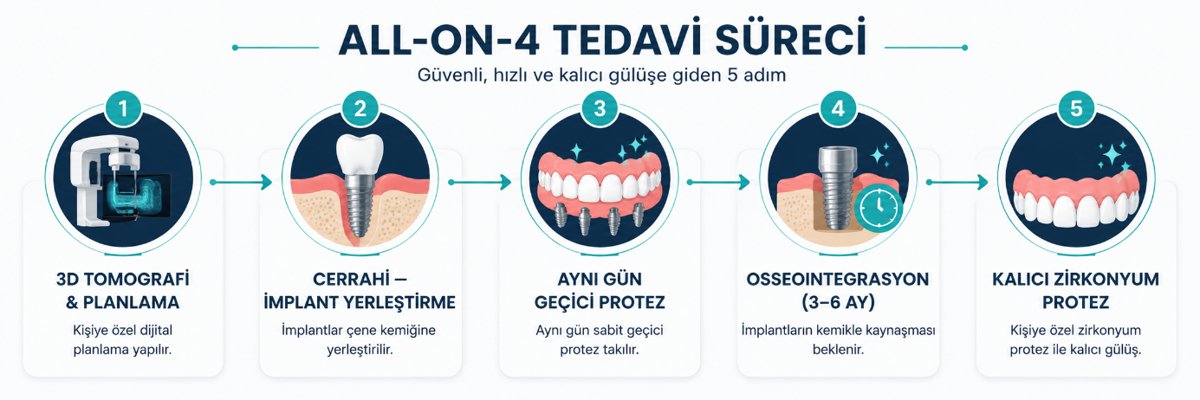
Although All-on-4 treatment may look like a single surgical session, it is in fact a meticulously planned process made up of several stages.
Stage 1 — Digital Planning and 3D Tomography
Everything begins with a correct diagnosis. The surgeon first takes a cone beam computed tomography (CBCT) scan to evaluate the volume and density of the jawbone and its relationship with anatomical structures in three dimensions. These images are analyzed with specialized software; where, at what angle and at what depth the implants will be placed is simulated in a virtual environment. In some clinics, this planning results in the production of 3D-printed surgical guides that direct the surgery. These guides significantly increase the precision and safety of the operation.
Stage 2 — Surgery Day: Placing the Implants
The main surgical stage of the treatment is usually performed under local anesthesia; however, the choice of sedation or general anesthesia is determined by the clinic and the patient's anxiety level. Following the prepared plan, the surgeon places the 4 implant screws in the determined positions. The average surgery time ranges from 90 minutes to 3 hours in uncomplicated cases. If there are teeth that have not yet been extracted, extraction can also be performed in the same session.
Stage 3 — Same-Day Temporary Prosthesis
The most striking feature that sets All-on-4 apart from conventional implant protocols is that a temporary fixed prosthesis is screwed onto the implants within a few hours of completing the surgery. The patient enters the clinic toothless or with a denture and returns home the same day with fixed teeth. This temporary prosthesis provides chewing function and aesthetics until the implants fuse with the bone (osseointegration).
Stage 4 — The Osseointegration Process (3–6 Months)
Osseointegration is the process by which the titanium implant biologically fuses with the surrounding bone tissue. During this period the implants practically "grow" into the bone. The duration is planned as an average of 3–4 months in the lower jaw and 4–6 months in the upper jaw, because bone density is generally lower there. During this phase, it is critical for the patient to eat soft and semi-solid foods, avoid smoking and alcohol, and attend scheduled check-ups regularly.
Stage 5 — Placing the Permanent Prosthesis
After osseointegration is complete, the temporary prosthesis is removed, the implants are evaluated one last time, and the permanent prosthesis — most often made of zirconia or hybrid material — is fabricated and screwed in. The permanent prosthesis is designed specifically for the patient's facial structure, tooth shade and jaw anatomy. With proper care, it can function for 15–25 years, even for a lifetime.
💡 Expert Note — Preparation Checklist for Surgery Day: Fast starting 6 hours before the operation (if sedation is planned). Bring a person you trust with you; do not drive yourself after surgery. Wear comfortable, front-opening clothing — garments that must be pulled over your head are not recommended, so that nothing touches the area around your mouth. For after the operation, have cold compresses, soft foods (yogurt, soup, milk pudding) and your prescribed medications ready at home.
Who Is All-on-4 Suitable For?
Ideal Candidate Profile
All-on-4 is designed for adult patients who experience one or more of the following situations:
People who have lost all of their teeth, or the vast majority of them across the jaw, are priority candidates. People who have used a removable full denture for years but suffer because the denture does not stay in place, causes discomfort while eating or provides insufficient chewing strength are also in this group. Patients who have lost multiple teeth and whose remaining teeth will not be able to continue functioning in the long term because of advanced decay or periodontal destruction can also benefit from the treatment.
Why Is It Advantageous for Patients with Bone Loss?
After teeth are extracted or fall out, the jawbone resorbs over the years because it no longer bears the load. This process of "bone atrophy" makes conventional implants impossible once the bone volume falls below the minimum required for a classic implant. All-on-4, on the other hand, uses the front region, where bone volume is more abundant, and the lateral walls through its angled implant placement. In this way, the majority of patients with moderate bone loss can become All-on-4 candidates without additional bone graft surgery. Even in severe bone loss cases, a solution can usually be provided in the same session with mini graft procedures.
Who Is All-on-4 Not Suitable For?
In many sources this section is either skimmed over very briefly or left out entirely. Yet a true sign of expertise is to state clearly not only "what is possible" but also "what is risky."
- Uncontrolled diabetes: High blood sugar directly and negatively affects wound healing and the osseointegration process. While well-controlled diabetic patients with an HbA1c below 7.5 can generally be suitable candidates, the risk of implant failure increases significantly in patients whose blood sugar remains uncontrolled.
- Active and heavy smoking: Smoking impairs tissue nutrition, disrupts osseointegration and increases the risk of peri-implantitis by 2–3 times. For patients who smoke more than 10 cigarettes a day, a smoking cessation period of at least 8 weeks before treatment is recommended.
- Bisphosphonate medication use and osteoporosis: Bisphosphonate-class drugs used against bone loss (alendronate, zoledronic acid) increase the risk of osteonecrosis (bone death) in the jawbone. In patients using these drugs, the medication history must be evaluated in detail before a treatment decision is made.
- Patients under 18: Implants placed before jawbone growth and development are complete will shift along with the bone and therefore fail in the long term. All-on-4 is performed on patients over 18, whose jaw development is complete.
- Uncontrolled bleeding disorders: Blood thinners such as warfarin, or hematological diseases such as hemophilia, are factors that increase surgical risk. In these cases, a coordinated evaluation with the relevant specialist physician is essential before deciding on treatment.
- Active gum infection or untreated periodontal disease: Implant treatment performed while there is an active source of infection in the mouth carries the risk of the infection spreading to the implant tissues. Existing gum problems must be resolved before starting treatment.
The Difference Between All-on-4 and a Removable Denture
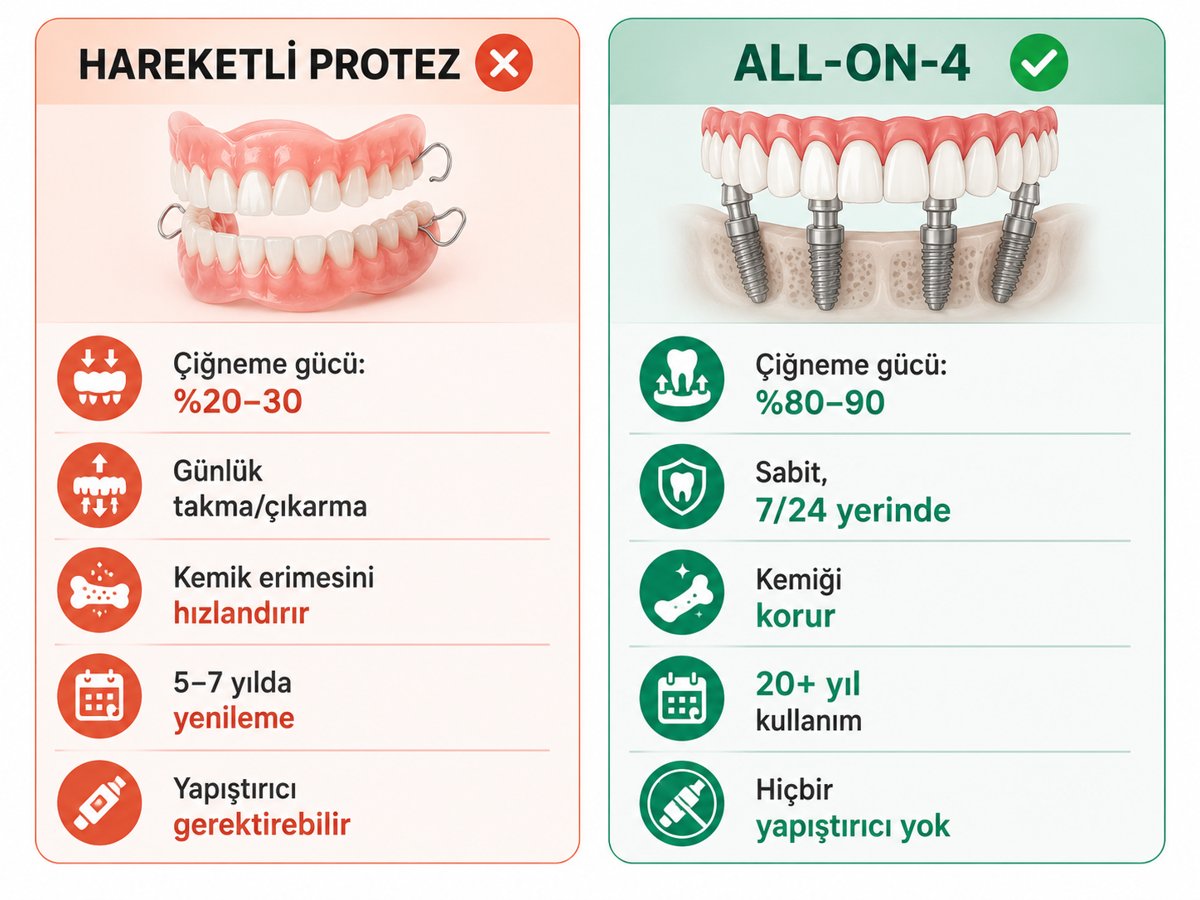
Comparing these two options shows the value All-on-4 offers in the most concrete way.
Difference in Function
A removable full denture rests on the gum and bone; its chewing force is only about 20 to 30 percent of that of natural teeth. Hard and crunchy foods, nuts, apples or meat are often off the menu. All-on-4, on the other hand, is anchored to the bone with implant screws and therefore transmits chewing force directly to the bone. Effective chewing capacity can reach 70 to 90 percent of natural teeth. Patients report that after treatment they are enjoying many foods again that they had not been able to eat for years.
Difference in Aesthetics
Removable dentures pave the way for a sunken facial contour and an aged appearance because of bone that is lost over time. Since All-on-4 is anchored to the bone, it largely prevents this effect; it provides a look in harmony with natural gums and preserves the patient's facial support structure.
Difference in Comfort and Quality of Life
More than 60 percent of removable denture wearers report using denture adhesive, and 40 percent report worrying that their denture will fall out in public. All-on-4 eliminates these worries completely: there is no putting it in in the morning and taking it out at night; oral hygiene is maintained in a way similar to natural teeth.
Long-Term Cost Comparison
Although the initial investment in a removable denture appears low, when you factor in replacement every 5 to 7 years, the cost of adhesive, readjustment due to gum shrinkage and the additional interventions required later by the accompanying bone loss, the 20-year cumulative cost can approach or exceed that of All-on-4. In addition, by slowing bone resorption, All-on-4 reduces the likelihood of needing more extensive interventions in the future.
All-on-4 or All-on-6?
Although this is one of the questions patients researching the treatment ask most often, it is largely not addressed adequately in most sources.
What Is All-on-6, and How Does It Differ?
All-on-6 works on the same principle: a fixed bridge prosthesis is placed on a single jaw. The only difference is that the number of supporting implants is 6. These additional 2 implants increase the supporting surface of the prosthesis and distribute chewing force over a wider area.
Which Is Right for You? Decision Criteria
Bone volume and density are the main factors determining the decision between the two methods. In patients with sufficient bone volume, All-on-6 theoretically offers better load distribution. On the other hand, in patients with pronounced bone atrophy, the angled implant strategy of All-on-4 may be the more suitable solution, because trying to place additional implants into the reduced bone in the rear region may increase the risk of a failed implant. In terms of cost, All-on-6 is generally 20 to 30 percent more expensive. The long-term success rates of both methods are very close to each other; therefore, the decision should be made only as a result of a clinical evaluation.
Upper Jaw vs. Lower Jaw: Different Requirements
The lower jawbone is generally denser and more compact; it is therefore relatively easier to achieve sufficient stability with 4 implants. The upper jawbone, on the other hand, is more porous, and the presence of the sinus cavities makes surgical planning more complex. Because of this anatomical difference, some surgeons prefer All-on-6 in upper jaw cases; however, this decision varies from patient to patient.
Prosthesis Material Options
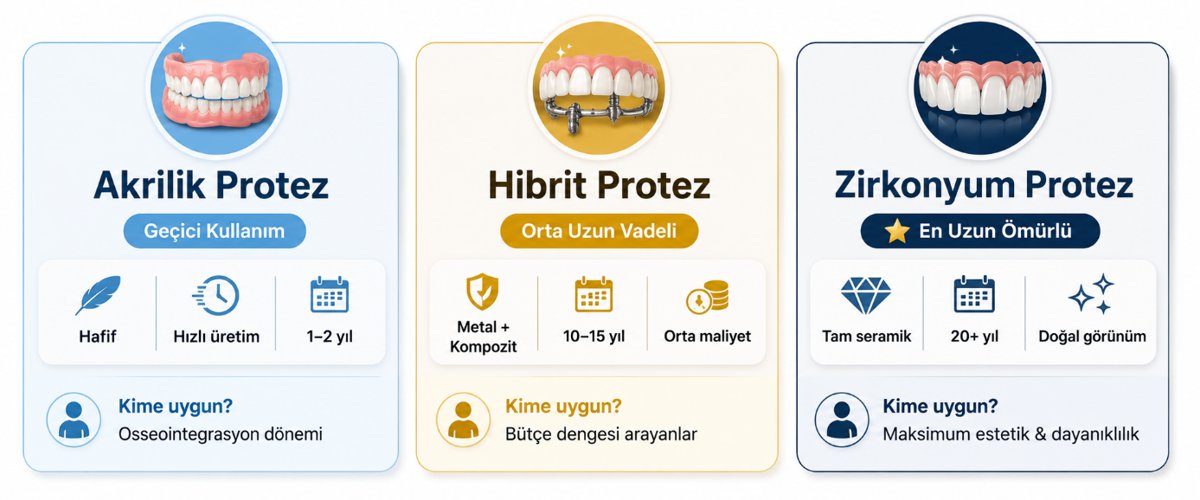
In All-on-4 treatment, although the implants are permanent, the bridge prosthesis placed on top of them can be fabricated from different material options. This choice directly affects durability, aesthetics and cost.
Acrylic (Temporary) Prosthesis
The temporary prosthesis fitted right after the day of surgery is mostly made of acrylic. It is lightweight and quick to produce. However, it is not designed for long-term use: it is more prone to wear, may discolor over time and carries a risk of fracture in some patients. It is used during the 3 to 6 month osseointegration period and is then replaced with a permanent material.
Hybrid Prosthesis (Composite + Metal)
This option, in which composite or acrylic teeth are set onto a metal framework, offers a more affordable middle ground compared with full zirconia. Its weight is greater than acrylic but less than zirconia. In the long term, the composite teeth on the outer surface may wear and may need to be renewed in later years.
Zirconia Prosthesis — The Longest-Lasting Option
The full zirconia prosthesis is regarded today as the superior material option for All-on-4. Thanks to its ceramic structure, it offers the light transmission closest to natural teeth; since it does not require a metal framework, its biocompatibility is high. It is extremely resistant to scratching and wear. With proper care it can function for 20 years or more. Its cost is higher than the other options; however, considering its long-term durability, the cost-benefit balance generally comes out in favor of zirconia.
Which Material Suits Whom?
For patients with no budget constraints who have long-term, high aesthetic expectations, a zirconia prosthesis is the first choice. For patients who want to balance their budget but are looking for a durable solution, a hybrid prosthesis is a reasonable alternative. The temporary prosthesis, on the other hand, should be planned only for the osseointegration period and should not be chosen as a long-term solution.
Advantages and Disadvantages of All-on-4
Proven Advantages
More than ten years of clinical data have consistently documented the following advantages of All-on-4:
A high success rate comes first among them; the 10-year follow-up data published by Nobel Biocare show an implant survival rate of 98.0 percent in the lower jaw and 95.2 percent in the upper jaw. Zero waiting time is also an important advantage; same-day fixed teeth rapidly raise the patient's quality of life, both functionally and psychologically. The elimination of the need for bone grafts in most cases makes the treatment both shorter and less invasive. The slowing of bone resorption is another significant benefit; implants stimulate the jawbone and delay atrophy. In terms of predictable results, the protocol is also standardized and offers repeatable success rates in experienced centers.
Overlooked Disadvantages and Risks
An honest guide does not only list the advantages. Although All-on-4 is a powerful treatment, ignoring the following risks prevents the patient from making an informed decision.
- Possibility of failed osseointegration: Roughly 2 to 5 out of 100 implants may fail to achieve complete fusion with the bone. Smoking, uncontrolled diabetes and insufficient bone quality are the main factors that increase this risk. A failed implant may require removal of the implant, a healing period and a re-placement procedure.
- Risk of peri-implantitis: This inflammation developing in the tissues around the implant is the leading cause of implant failure. The risk is higher in patients with a history of gum disease and in those who do not maintain adequate home care.
- Fractured or worn prosthesis: Especially with hybrid and acrylic prostheses, fracture or surface wear may occur over the years. The risk increases markedly in patients with a bruxism (teeth clenching) habit; a night guard is recommended for these patients.
- Long adaptation period: Speech, bite angle and tongue movement require several weeks to a few months to adjust to the new prosthesis, so an adjustment period should be expected. During this time, mild difficulty speaking and unusual sensations are normal.
Aftercare Guide Following All-on-4
The First 72 Hours: What to Eat and What to Avoid
The first three days are the most critical window of the healing process. During this period, soft-textured foods that are cold or lukewarm should be preferred: yogurt, milk pudding, soup, puree, smoothies and soft cheese are suitable for this period. Hot, hard, crunchy, sticky and hard-to-chew foods must be strictly avoided. Using a straw increases pressure on the clot tissue because it creates a suction motion, and should be avoided. Alcohol and smoking seriously disrupt tissue healing during this period.
Long-Term Oral Care
An All-on-4 prosthesis requires regular care just like natural teeth. Cleaning the prosthesis surfaces with a soft-bristle toothbrush at least twice a day is essential. For the spaces between the implants, the use of an interdental brush or a water flosser (oral irrigator) is recommended. Alcohol-based mouthwashes should be avoided; antiseptic and fluoride mouthwashes may be preferred instead. If there is a habit of clenching at night, a night guard must be used.
How Often Should You Have Check-ups?
During the first year, a check-up session is scheduled every 3 months. From the second year onward, a routine check-up every six months is sufficient. At these check-ups, implant stability, prosthesis fit, gum health and bone level are evaluated; professional cleaning is performed if necessary.
How Long Does All-on-4 Last?
Titanium implant screws are designed to function for a lifetime under proper care. The superstructure prosthesis varies depending on the material: zirconia prostheses can last 20 years or more, hybrid prostheses 10 to 15 years, while acrylic prostheses may need replacement after 5 to 7 years. Tobacco use, teeth grinding and poor oral hygiene are the main factors that shorten lifespan.
All-on-4 and Health Tourism: Why Is Turkey Preferred?
The Cost Difference Between Turkey and Europe
In the UK, full-arch All-on-4 treatment is priced at an average of £15,000 to £25,000, in Ireland at €18,000 to €28,000, and in Germany in the range of €20,000 to €30,000. In Turkey, the same treatment is offered in internationally certified clinics using top-tier materials for between €4,000 and €9,000.
This difference does not stem from the quality of service; it stems from labor costs in Turkey, the exchange rate advantage and the competitive environment within the country. A significant portion of the treating doctors are specialist physicians who trained in Europe or the US and completed international implant certification programs.
How Do You Choose the Right Clinic for All-on-4 in Istanbul?
Certification is the first step in evaluating clinics. Check whether they are active partner clinics of leading implant brands such as Nobel Biocare or Straumann. Review patient reviews on Google and Trustpilot, in terms of both the number of reviews and their content. Do not hesitate to ask about the implant brand and model they use; request information that can be verified through the authorized distributor. Ask for written documentation of the treatment guarantee and the scope of the warranty. Confirm that 3D tomography and digital planning technology are available at the clinic.
How Does the Treatment Process Work for a Health Tourist?
Most international patients complete the treatment in two separate visits. At the first visit, the examination, tomography, planning, surgery and placement of the temporary prosthesis take place; this visit usually lasts 5 to 7 days. At the second visit, after the three to six month osseointegration period, the permanent prosthesis is placed, and this stage can be completed in 3 to 5 days. Reputable clinics provide coordination for online follow-up, translation support and transportation arrangements throughout the treatment process.
Frequently Asked Questions
How long does an All-on-4 implant take?
The surgical procedure takes an average of 90 minutes to 3 hours. The temporary prosthesis is fitted the same day. Osseointegration takes 3 to 6 months; the permanent prosthesis is placed after this period. In total, the treatment is completed in about 6 to 8 months.
Is All-on-4 or All-on-6 better?
Both are safe and proven protocols. The choice is made together with the surgeon according to bone volume, jaw anatomy and budget criteria. In cases with bone loss, All-on-4 is often the more suitable option.
What happens if there is not enough bone for All-on-4?
With moderate bone loss, an additional graft is generally not needed thanks to the angled implant strategy. With severe bone loss, a mini bone graft can be performed in the same session. The assessment is made with 3D tomography.
How many years does All-on-4 last?
The implant screws are designed to last a lifetime. The superstructure prosthesis can last 10 to 25+ years depending on the material. A zirconia prosthesis is the longest-lasting option.
What can you eat after All-on-4?
Soft foods should be preferred in the first few weeks; after full osseointegration, patients can comfortably eat most types of food. Extremely hard foods and biting ice are behaviors that should be avoided in the long term as well.
Is All-on-4 painful?
Because the surgery is performed under local anesthesia, no pain is felt during the procedure. Mild to moderate discomfort can be expected over the following 48 to 72 hours; this period is managed comfortably with prescribed painkillers.
How much does All-on-4 cost in Istanbul?
It ranges between €4,000 and €9,000 depending on the implant brand and prosthesis material used. A Nobel Biocare or Straumann implant + zirconia prosthesis combination generally falls in the upper band of this range.
What is the difference between All-on-4 and a removable denture?
All-on-4 is screwed fixed into the bone and is not removed; its chewing strength reaches about 80 percent of natural teeth. A removable denture, on the other hand, rests on the gum, its chewing strength remains at 20 to 30 percent and it accelerates bone resorption over time.
Can All-on-4 fail?
Yes, but it is rare. In ten-year clinical data, the implant failure rate is between 2 and 5 percent. Smoking, uncontrolled diabetes and inadequate care are the main risk factors. In experienced centers, most problems can be resolved with early intervention.
Is All-on-4 suitable for people coming from abroad?
Yes. With a structure that can be completed in two visits (surgery + permanent prosthesis), All-on-4 is an extremely suitable treatment for health tourism. Istanbul is one of Europe's leading destinations in terms of international patient experience.
Conclusion
All-on-4 is today the most proven fixed jaw restoration protocol available for patients who have experienced bone loss, who want to get rid of a removable denture or who are looking for a comprehensive solution because of multiple tooth losses. While the angled implant strategy, the possibility of same-day fixed teeth and long-term success data offer strong arguments on their own, when evaluated together with material options, comparability with All-on-6 and the health tourism perspective, it becomes clear that the decision process should be approached within a much broader framework.
The right decision always begins with a detailed clinical examination, a 3D tomography evaluation and a treatment plan prepared according to your specific bone structure and lifestyle.
Free Implant Consultation
Including 3D tomography, let us evaluate your situation without any obligation.
Book an Appointment