Everything About Implant Treatment: Answers to All Your Questions
Over the past thirty years, the dental implant has become the most talked-about and fastest-evolving solution in dentistry. The reason is not just aesthetics — an implant is the only treatment option that can rebuild a missing tooth in its entirety, root included.
But the question "should I get an implant?" brings dozens of other questions with it. Is it painful? How much does it cost? How long does it take? What if I don't have enough bone? How long does it last? Does insurance cover it?
In this guide, we cover the entire implant treatment process in full detail. We bring together information that is scattered across other websites in one place — complete and easy to understand.
What Is a Dental Implant?
A dental implant is a screw system that is surgically placed into the jawbone and carries an artificial tooth (crown) on top. It consists of three main parts:
- Implant body: The screw-shaped main part made of titanium and placed inside the jawbone. It takes over the function of the natural tooth root.
- Abutment: The connecting element between the implant body and the crown. In some systems it is a separate piece, while in others it comes as a single piece with the implant body.
- Crown: The visible, tooth-mimicking artificial tooth made of porcelain or zirconia. Its color, shape and size are designed to blend harmoniously with the neighboring teeth.
The combination of these three parts creates a restoration that onlookers cannot tell apart from a real tooth, that resists fracture, and that lasts for decades.
What Sets Implants Apart from Other Treatments?
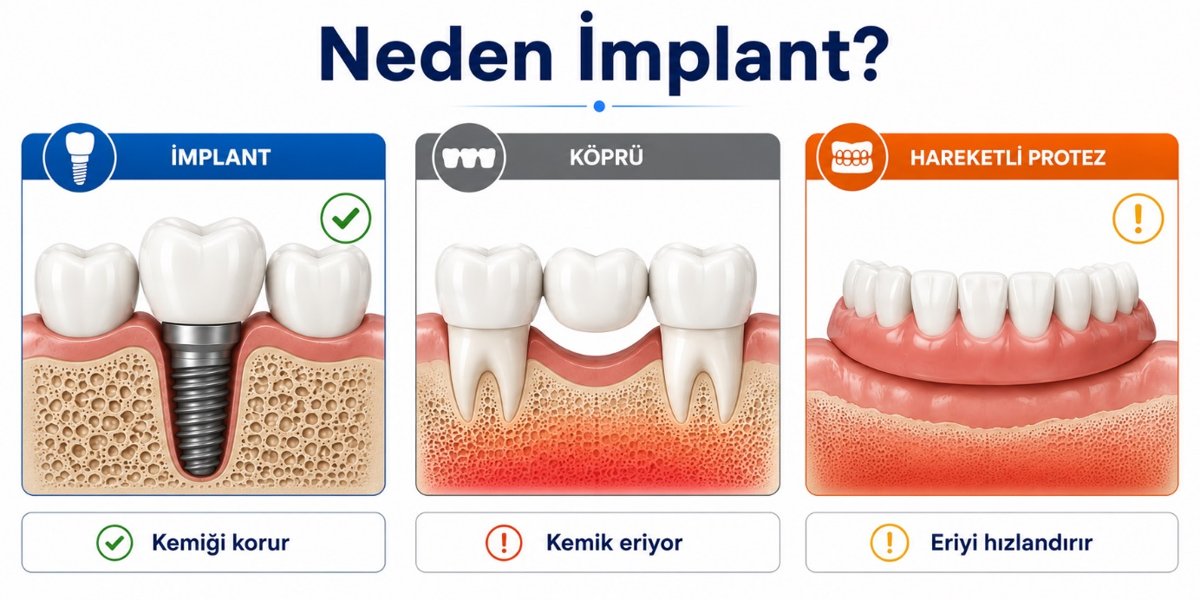
There are three main options for a missing tooth: an implant, a bridge and a removable denture. Each has its own limitations — but the differences become clear when viewed from a biological perspective.
The root of a natural tooth transmits mechanical stimulation to the jawbone during chewing. This stimulation keeps the bone alive and prevents atrophy. Once a tooth is extracted, this stimulation stops — and the bone gradually but continuously melts away. In medical terms, this is called bone resorption.
A bridge looks functional on the surface, but the bone loss cannot be stopped. A removable denture, on the other hand, transmits chewing force not to the bone but to the gums — accelerating bone loss.
The implant is the only option that breaks this chain. The titanium screw embedded in the bone transmits mechanical stimulation much like a natural tooth root. Once osseointegration occurs, the bone practically "wraps around" the implant and continues to support it.
This difference is why the implant, compared with the other options, can be considered more economical in the long run and biologically superior.
Who Can Get an Implant?
A missing tooth is not the only requirement for an implant. Suitability is determined by evaluating bone structure, general health and oral hygiene together.
- Individuals who have completed 18 years of age: Jaw development takes place during adolescence. Implants cannot be placed before development is complete. There is no upper age limit — people in their 70s and even 80s achieve successful results if their bone and health status are suitable.
- Those with sufficient bone volume: For the implant to be held in the bone, a certain bone height and width must be present. These values are recorded with digital tomography (CBCT). If the bone is insufficient, the foundation can be prepared with a graft procedure.
- Those whose general health is under control: Diabetes, hypertension and thyroid conditions — if these are under control, implant placement is possible. Uncontrolled systemic disease interrupts success.
- Those who care about oral hygiene: Long-term implant success depends on care just as much as on surgery.
- Smokers: They can have implants; however, smoking reduces osseointegration and increases the risk of failure. Quitting or significantly cutting down is recommended.
Who May Not Be Able to Get an Implant?
The following conditions are not absolute barriers — they call for careful evaluation and preparation:
- Uncontrolled diabetes: High blood sugar impairs wound healing and causes bone loss.
- Active gum or bone infection: Treatment first, implant afterward.
- Head and neck radiotherapy: Because the blood supply to the bone is affected, it requires special evaluation.
- Bisphosphonate-group medications: Some medications used for osteoporosis affect bone metabolism. Medication management is carried out before treatment.
- Pregnancy: Implant placement should be postponed until after birth.
- Under 18 years of age: It cannot be performed while jaw development continues.
How Is Implant Treatment Done? The Whole Process Step by Step
Examination and Radiological Evaluation
Everything starts with a correct diagnosis. A panoramic X-ray provides a general view; however, the gold standard is three-dimensional dental tomography (CBCT). Thanks to this imaging method, the dentist:
- Determines bone volume and density distribution with millimetric precision,
- Pinpoints the exact location of nerve canals and sinus structures,
- Simulates digitally at which angle and to what depth the implant will be placed,
- Designs an integrated surgical guide.
At the same time, gum health is improved step by step, active cavities are detected and any necessary preliminary treatments are planned.
Preparatory Treatments
Before an implant, some preliminary procedures are occasionally needed:
- Gum treatment (periodontitis treatment): If there is active inflammation, gum health is restored.
- Cavity treatment: Active cavities in neighboring teeth are eliminated.
- Bone graft: Where the bone is insufficient, a suitable foundation is created by placing graft material. The implant is placed once graft healing is complete.
- Sinus lifting: If the bone in the upper back region is insufficient, the sinus floor is raised.
- Tooth extraction: If there is a hopeless tooth, it is included in the implant plan.
Surgical Placement
Implant surgery is a far more comfortable experience than most people imagine. Under local anesthesia, you feel pressure and vibration rather than pain throughout the procedure.
The surgical process proceeds as follows:
- The treatment area is completely numbed with local anesthesia.
- The gum is opened with an incision, or the procedure is performed with a "flapless" (stitchless) technique.
- The implant socket is prepared in the bone with special drills. During this stage, a cooling solution is used to keep the system from overheating.
- The titanium implant is placed at the planned angle and depth.
- The area is closed. Dissolvable stitches are placed — you do not need to come back to the clinic to have them removed.
Placing a single implant takes 20–45 minutes on average. The patient leaves the clinic the same day.
Osseointegration: Fusing with the Bone
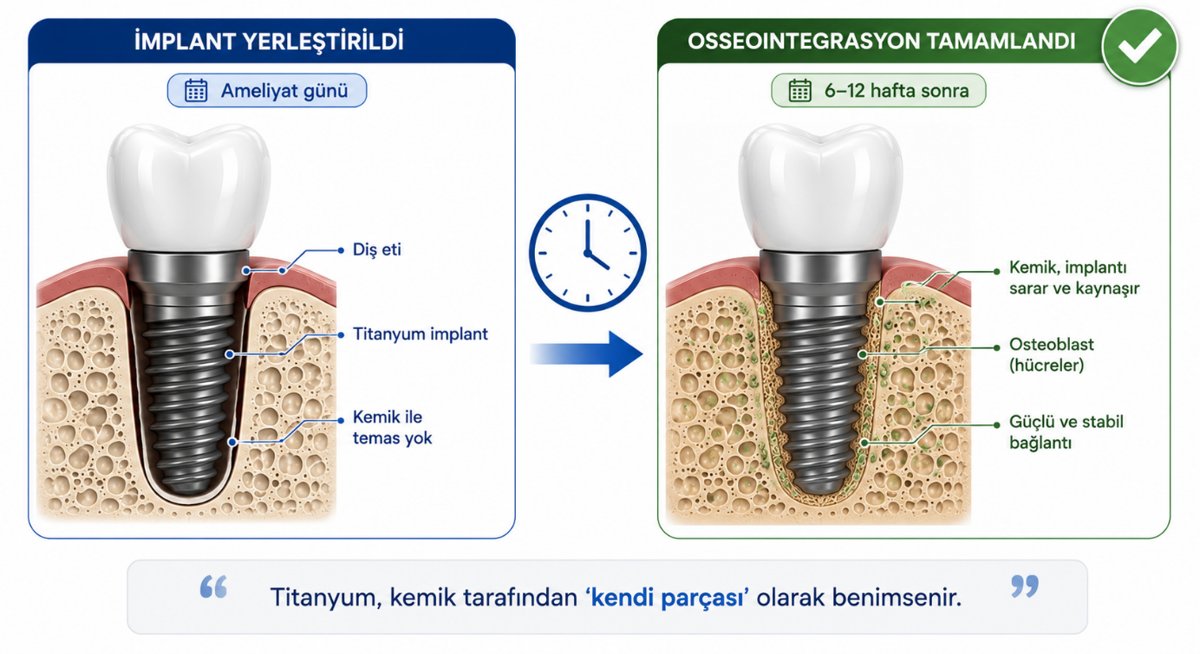
After the implant is placed, the most critical biological process begins. The titanium's self-protecting surface structure attracts bone-forming cells (osteoblasts). These cells form new bone tissue around the implant screw — the implant practically becomes part of the bone.
This process is called osseointegration. Its duration is:
- On average 6–8 weeks in the lower jaw
- On average 8–12 weeks in the upper jaw
Because the upper jaw is less dense, fusion takes slightly longer. During the osseointegration period, excessive force should not be applied to the implant. In the front region, a temporary tooth can be fitted for aesthetics.
Abutment and Crown
Once osseointegration has occurred, the abutment is placed and then an impression is taken. The crown is custom-made for you in the laboratory — it matches the neighboring teeth perfectly in color, shape and size.
At crown delivery, the bite balance is checked and fine adjustments are made. The treatment is complete.
How Long Does Implant Treatment Take?
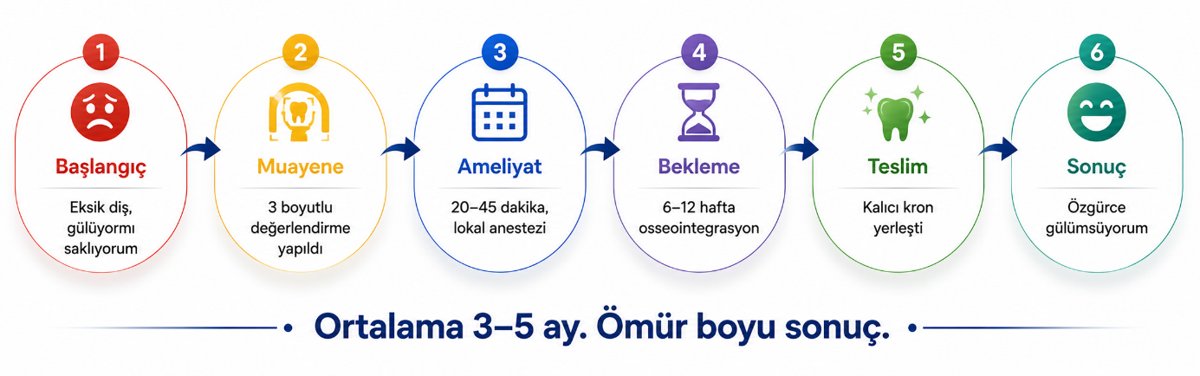
In a standard case, the treatment timeline can be summarized as follows:
- Evaluation and examination — 1–2 sessions
- Preparatory treatments (if any) — variable
- Surgery — a single day, 20–45 minutes
- Osseointegration waiting period — 6–12 weeks
- Abutment + impression — 1–2 short sessions
- Crown delivery and placement — 1–2 weeks
Total: 3–5 months on average. In special cases such as bone grafting or sinus lifting, this period may be longer. With the immediate implant technique, on the other hand, extraction and placement take place on the same day, which can shorten the process.
Types of Implants: Which Is Right for You?
Choosing an implant system is not just a matter of brand. It is shaped by bone structure, the treatment area and the complexity of the case.
Endosseal Implants
The most widely used type today. It is embedded directly into the jawbone. It can be screw-, cylinder- or disc-shaped. It is the first choice when there is sufficient bone volume.
Mini Implants
They have a thinner structure than standard implants. They are used where bone volume is insufficient or to stabilize removable dentures. They are suitable for same-day protocols.
Zirconia Implants
Ceramic-based implants as an alternative to titanium. They may be preferred for patients with a metal allergy or for front-region cases where aesthetics is a high priority. Although long-term clinical data are not as extensive as for titanium, strong results are emerging in the literature.
All-on-4 / All-on-6
A restoration concept for individuals who are missing all of their teeth or who are about to lose them. A complete fixed prosthesis per jaw is supported by 4 or 6 implants. A temporary set of teeth can be placed on the same day.
Immediate Loading Implants
A protocol in which a temporary or permanent crown is placed after extraction or on the day of surgery. In a suitable case it shortens the process dramatically; however, it requires suitable bone characteristics, the absence of contraindications and sufficient primary stability.
Implant Brands: What Is the Difference?
There is a wide range of implant brands on the market. They can be evaluated in three categories:
Premium (Tier 1) Brands
Such as Straumann, Nobel Biocare, Osstem (South Korea) and Zimmer Biomet. Decades of clinical research, an extensive database and international certifications. Higher cost.
Mid-Range Brands
Such as BioHorizons, MIS and Neodent. Clinical success rates are comparable to those of premium brands. More affordable.
Domestic Brands
Implants produced in Turkey and covered by the national health insurance (SGK). They are certified and regulated; however, long-term clinical data are not as comprehensive as those of international brands.
Critical point: For successful osseointegration, the surgeon's skill and planning quality matter as much as the implant brand — or even more.
Is an Implant Painful?
This is one of the questions patients ask most often.
During surgery: You do not feel pain under local anesthesia. You may notice pressure, vibration and a light sound — these are normal.
After surgery: In the first 24–72 hours, local soreness, a feeling of heaviness and mild bruising may occur. This is a normal tissue reaction to surgery. It is managed with prescribed painkillers and antibiotics.
Many patients return to their daily routine after a few days. Some can even continue their normal routine on the day of the procedure.
The First Days After an Implant: What to Do and What to Avoid
First 24 hours:
- Avoid hot food and drinks — they can disrupt clotting.
- Do not disturb the implant area with your tongue, fingers or foreign objects.
- Stay away from smoking and alcohol.
- Take your prescribed medications regularly.
- Cold compress — it reduces swelling.
Throughout the osseointegration period:
- Do not neglect oral hygiene; brush the implant area too.
- Avoid hard, shelled or very sticky foods.
- Postpone heavy physical exercise for the first few days.
- If you have bruxism (teeth grinding), tell your dentist — a night guard can be used.
Long-Term Care After an Implant
The lifespan of an implant depends largely on its care. For long-term success:
- Brushing twice a day: When the soft tissues around the implant are left uncared for, a process called peri-implantitis occurs, which leads to bone loss.
- Interdental care and dental floss: Cleaning under the crown and between neighboring teeth.
- Check-ups every 6 months: Checking for abutment loosening, crown wear, gum condition and bone level measurement.
- Professional cleaning: At least once a year, plaque and tartar around the implant are removed with special instruments.
- Smoking: If you smoke, quit — it is the single factor that most shortens the life of an implant.
How Long Does an Implant Last?
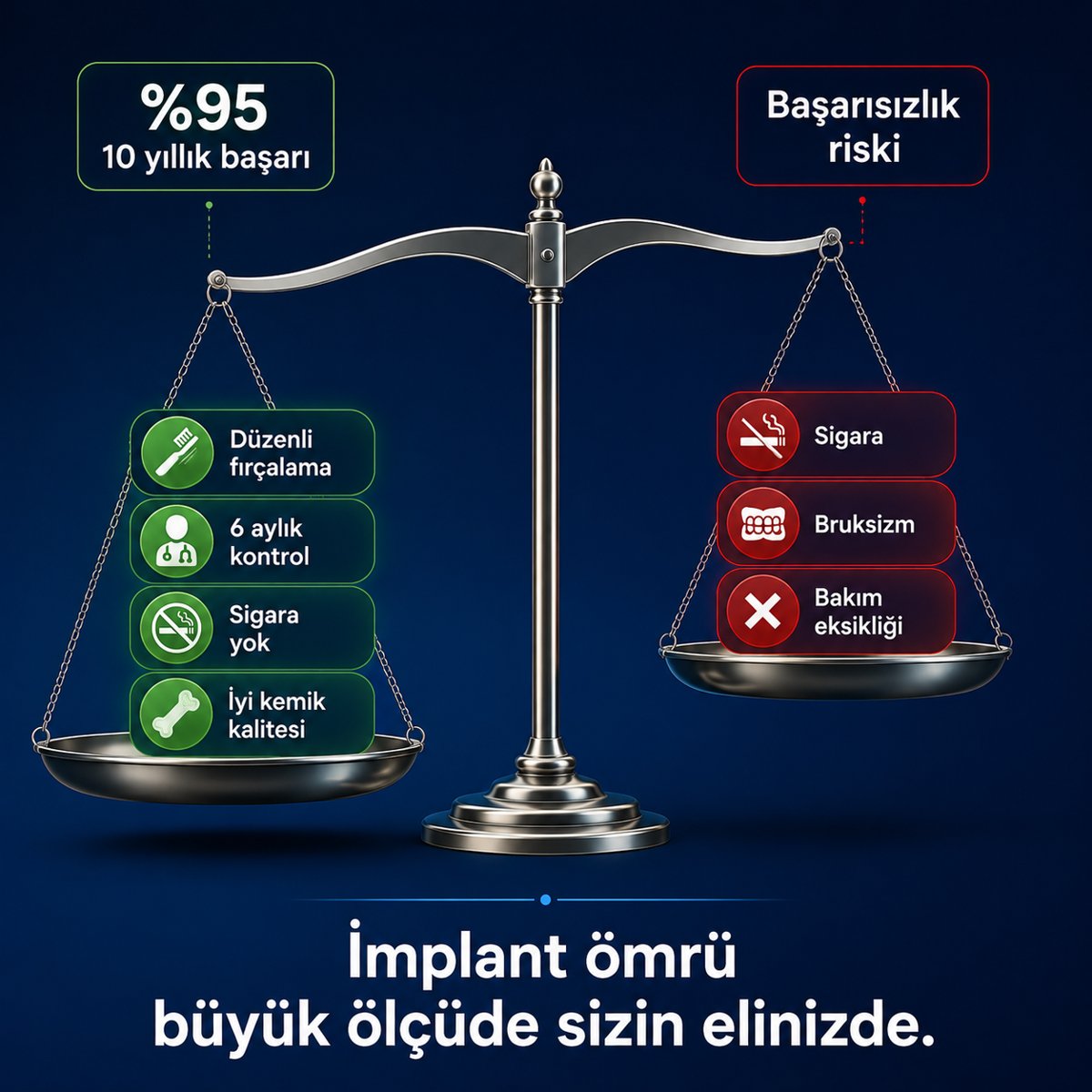
Clinical studies show that for properly placed and well-maintained implants, the 10-year success rate is above 95 percent. Trouble-free use for twenty years or more is not exceptional in the literature but a common finding.
The crown and abutment are the parts that may need to be replaced — this does not mean the implant body will break. Once the implant body has fully fused with the bone, it can remain for a lifetime.
The factors that determine implant lifespan are:
- Surgical technique and planning quality
- Osseointegration conditions
- The patient's oral hygiene
- Smoking
- Bruxism (if uncontrolled)
- Regularity of check-ups
Why Does Implant Failure Happen?
Implant failure is rare; however, it is a reality that must be considered.
Early-stage failures (first few months):
- Insufficient osseointegration
- Infection (early stage of peri-implantitis)
- Uncontrolled systemic disease
- Excessively early loading
Late-stage failures (years later):
- Chronic peri-implantitis (lack of long-term care)
- Mechanical fracture (increased force, bruxism)
- Progressive bone loss
In early-stage failures, once the area has healed, the implant can be placed again.
How Much Do Implants Cost? What Affects the Price?
The price of an implant varies according to the implant brand used, the crown material applied (zirconia, e-max, porcelain), the experience of the clinic and the clinic's technical equipment.
Turkey offers a globally competitive range in implant costs, both for domestic products and for foreign patients coming under health tourism. Treatments priced at 2,000–5,000 euros abroad can be carried out in Turkey at a much more accessible cost.
The factors that shape the price are:
- Implant brand (domestic, mid-range or premium)
- Crown material (zirconia is the longest-lasting and most aesthetic option)
- Additional procedures (graft, sinus lifting)
- The clinician's technology and training certificates
- Use of digital planning and a surgical guide
Price alone should not be the deciding criterion. The difference between a cheap implant and an expensive one may come back to you over time as the cost of redoing the treatment.
How Should You Choose a Dentist?
Implant placement is a surgical procedure. The choice of clinic, the working conditions and the dentist's experience are critical factors.
Questions you should ask:
- How many years have you been doing implants? What is your annual case volume?
- Which implant systems do you work with?
- Do you carry out digital planning and CBCT evaluations?
- What is the protocol in case of complications?
- What does the warranty cover?
Additional things to look out for:
- International certifications and memberships (such as ITI and EAO)
- Reference patient cases and before-and-after photos
- Clinic hygiene and sterilization standards
- A treatment plan that is stated in detail
Implants and Insurance: How Should Coverage Be Evaluated?
In Turkey, state insurance (SGK) may cover part of the implant cost under certain conditions. Supplementary and private insurance policies differ according to the scope of the policy.
Before treatment:
- Ask your insurer whether implants are covered.
- Find out which conditions apply.
- Discuss installments and the payment plan with your clinic.
Frequently Asked Questions
Up to what age can an implant be placed?
There is no upper age limit. People in their seventies and eighties can successfully have implants if their bone and general health are suitable. What matters is not age but biological capacity.
Do implants cause problems in an MRI scan?
Titanium is not magnetic. You can safely have an MRI.
I have diabetes. Can I get an implant?
Yes, if your blood sugar is under control. Uncontrolled diabetes negatively affects healing and osseointegration.
Is lack of bone a definite barrier?
No. With a bone graft and/or sinus lifting, a suitable foundation can be prepared in most cases.
Do implants fall out?
With correct planning and appropriate patient selection, the failure rate is around 2–5 percent. A failed implant can usually be placed again after healing.
How many days will I be unable to go to work?
Most patients return to daily life within 1–3 days. Desk jobs can often be resumed the same day or the next day.
What can I eat after an implant?
Soft, lukewarm foods for the first few days. Once osseointegration is complete and the crown is fitted, you can eat almost anything just as you would with your natural teeth.
How many implants can be placed at once?
More than one implant can be placed in the same session. This decision is determined by your general health and the case plan.
I smoke. Can I get an implant?
Yes; however, the success rate drops and healing slows. Cutting down or quitting before and after treatment is recommended.
Do implants come with a warranty?
Most clinics offer a lifetime or a fixed-number-of-years warranty on the implant body. A 5-year warranty is generally accepted as the standard for the crown. The factors that shape the warranty are care, smoking and keeping up with check-ups.
Conclusion: The One Thing to Know Before Deciding on an Implant
For missing teeth, the implant is the most comprehensive, longest-lasting and biologically healthiest solution that modern dentistry offers. Not only the tooth but also the function of the tooth root and of supporting the jawbone is rebuilt.
Postponing the decision — contrary to what is often assumed — does not reduce the cost; it increases it. As the bone melts away, additional procedures become necessary, neighboring teeth drift and the bite balance is disturbed.
No article can tell you whether you are suitable — only your specialist dentist, who sees your tomography and evaluates your bone structure and health, can say so.
The first step: an examination and 3D tomography. The rest is planned together.
Take the First Step for Your Implant
Get a free consultation with our specialist dentists for an examination and 3D tomography.
Book an Appointment