Single Tooth Implant: Who Is It Suitable For and How Is It Done? A Complete Guide
When a single tooth is missing, people usually say, "It's just one tooth, it's no big deal." Then we wait for months. But what happens in the jaw is silent: the neighbors of the missing tooth begin to drift toward the gap, the opposing teeth start to over-erupt, and the jawbone keeps shrinking because it receives no audible warning.
A single missing tooth looks minor, but its effect is not.
Modern implantology offers a well-established solution to this problem, both aesthetically and functionally: the single tooth implant. In this guide, we explain step by step what an implant is, who it is suitable for, how it is done, and what to pay attention to after treatment.
What Is a Single Tooth Implant?
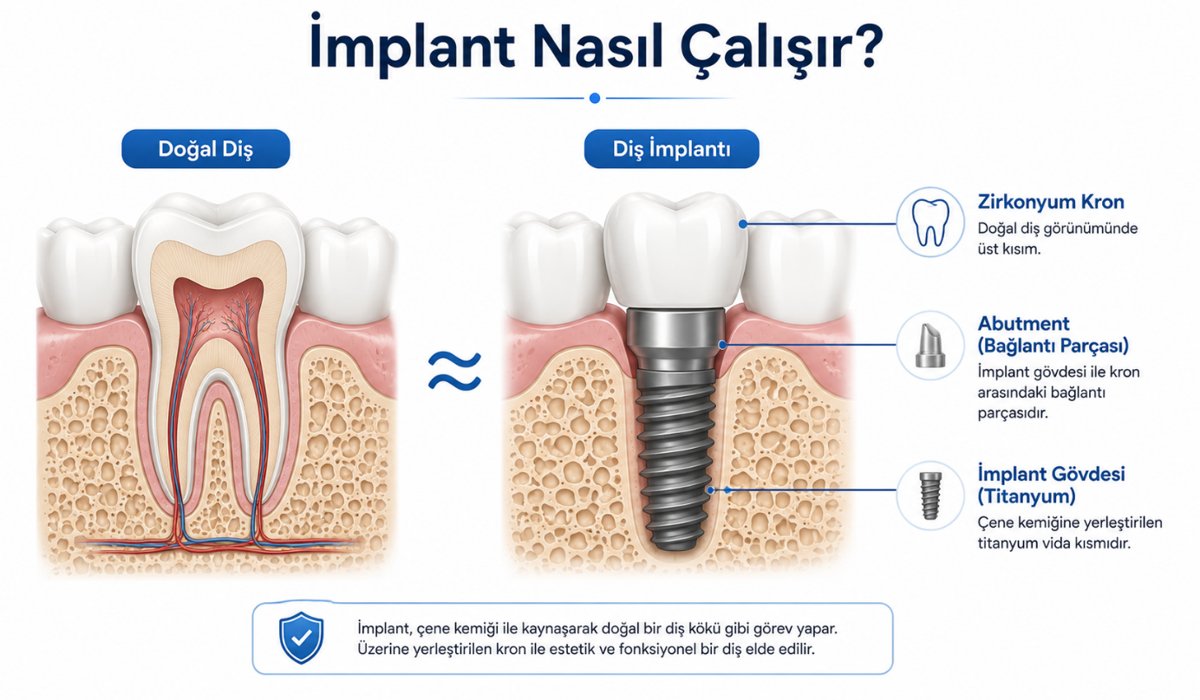
A single tooth implant is a two-part restoration system consisting of a titanium screw (the implant body) placed in the jawbone and an artificial tooth (crown) mounted on top of this screw.
Titanium is one of the rare metals that the human body does not recognize as a foreign object. Thanks to this biocompatibility, within weeks of placement the implant screw becomes virtually one with the jawbone. In medicine, this biological integration is called osseointegration.
Once full fusion with the bone is achieved, a connecting piece called an abutment is placed on the implant, followed by a custom-made zirconia or porcelain crown. The result is a functional, permanent tooth that dentists cannot distinguish from a real one.
An important difference: An implant replaces not only the visible tooth but also the invisible yet vital tooth root. Bridges and removable dentures cannot do this.
Why Is Leaving a Single Tooth Missing Risky?
Many patients treat a missing tooth as "not a problem as long as it causes no trouble." Yet the jawbone stays alive through the mechanical stimulation transmitted by the tooth. When this stimulation stops, the bone tissue dissolves, which is called bone resorption.
The amount of bone lost in the first year increases markedly. As the bone diminishes, the implant options become more limited, and sometimes an additional bone graft procedure becomes necessary. Delay increases both the biological and the financial cost.
Other effects:
- Neighboring teeth tilt toward the gap, and the dental arch is disrupted.
- The tooth in the opposing jaw, left with nothing to bite against, grows longer (supraocclusion).
- Chewing balance is disturbed; the other teeth are overloaded.
- Speech and tone of voice may be affected.
- Aesthetic concerns can turn into psychological problems.
Who Is a Single Tooth Implant Suitable For?
The decision for an implant is not made based on the missing tooth alone. Bone structure, general health, and oral hygiene are evaluated together as a whole.
General suitability criteria:
- Individuals who have completed 18 years of age: Jaw development continues through adolescence. Implants cannot be placed before development is complete. There is no upper age limit: in people aged 70-80, implants are applied successfully if the bone and general health are suitable.
- Those with sufficient bone volume: A certain bone height and width must be available for the implant to be held in the bone. These values are measured with digital tomography (CBCT). If the bone is insufficient, the ground can be prepared with a graft procedure; "I have no bone" is often not a definitive obstacle.
- Those whose other teeth are healthy: If there is active decay or advanced periodontitis in the neighboring teeth, these problems are treated first, and then the implant is planned.
- Those whose general health is under control: Diabetes, hypertension, thyroid diseases: with these under control, implant treatment is possible. Uncontrolled systemic disease risks the loss of success.
- Those who care about oral cleanliness: The soft tissues around an implant, if neglected, can develop an infection called peri-implantitis, which accelerates bone loss. For long-term success, oral care is as important as technique.
- Those who allow the extraction site to heal: After an extraction, a few weeks of waiting is generally needed for healing and for the bone structure to stabilize. In some cases, however, extraction and implant placement can be performed in the same session.
Can a Single Tooth Implant Be Risky for Some People?
Like any treatment, implants have contraindications. These situations are not always absolute obstacles; however, they require careful evaluation and a multidisciplinary approach.
- Uncontrolled diabetes: High blood sugar negatively affects wound healing and osseointegration.
- Active bone or gum infection: Implants are not placed until the existing infection is cleared.
- History of head and neck radiotherapy: Radiation impairs the blood supply of the bone tissue.
- Certain osteoporosis medications (bisphosphonates): They affect bone metabolism and must be evaluated before the implant.
- Heavy smoking: Smoking reduces osseointegration, increasing the risk and lowering the chance of success. Implants can be placed in smokers; however, reducing or quitting before and during treatment is recommended.
- Under 18 years of age (jaw development not complete): Implants are not placed while bone growth continues.
How Is a Single Tooth Implant Done? Step-by-Step Process
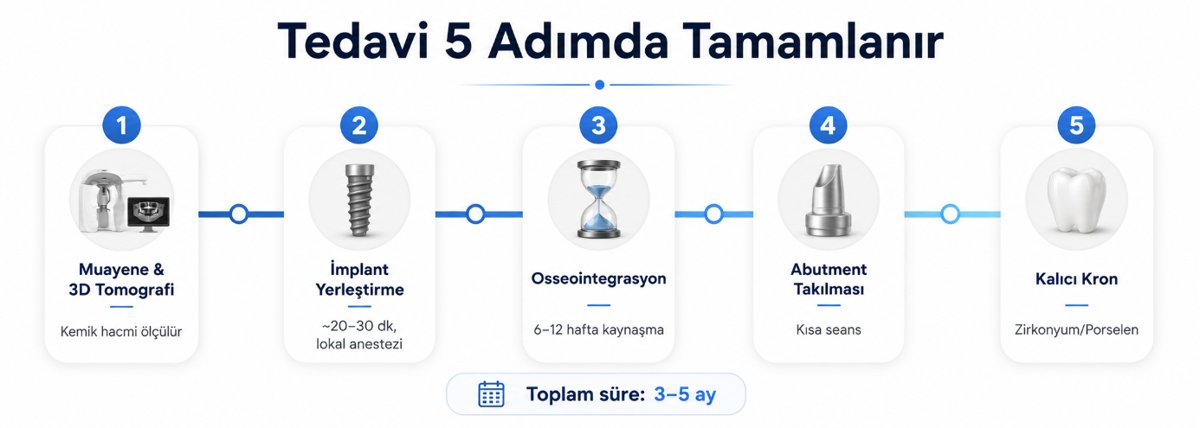
1. Detailed Examination and Radiological Assessment
Everything begins with a thorough evaluation. A panoramic X-ray gives the clinician a general view of the jaw and neighboring structures. However, the gold standard is three-dimensional dental tomography (CBCT).
With CBCT:
- Bone volume and density are measured with millimetric precision.
- Nerve canals and sinus structures are identified.
- The angle and depth at which the implant will be placed are simulated digitally.
- If necessary, a surgical guide is prepared.
This stage is directly the most critical step for long-term success.
2. Surgical Placement
Implant surgery does not deserve the anxiety created by the stereotypical idea of "dental surgery." It is performed under local anesthesia, and the patient feels no pain throughout the procedure; a sensation of pressure is normal.
The procedure steps:
- The treatment area is numbed with local anesthesia.
- The gum is opened with a small incision. (In some cases, a "stitchless/flapless" technique that requires no sutures can be applied.)
- The implant socket is prepared in the bone with special drills.
- The titanium implant screw is placed in the bone at the planned angle and depth.
- The area is closed; if necessary, dissolvable sutures are placed.
Placing a single implant takes an average of 20-30 minutes. After the procedure, you leave the clinic the same day.
3. Osseointegration: The Process of Fusing with the Bone
After the implant is placed in the bone, the most critical biological process begins. The surface structure of titanium attracts the bone-forming cells (osteoblasts); they form new bone tissue around the implant screw.
This process takes:
- On average 6-8 weeks in the lower jaw
- On average 8-12 weeks in the upper jaw
(Because the bone in the upper jaw is less dense, fusion takes slightly longer.)
During this period, hard foods, smoking, and excessive heat or pressure on the implant can negatively affect healthy contact. For implants in the front area, a temporary tooth can be applied to address aesthetic concerns.
4. Abutment Placement
When fusion with the bone is complete, one more short session is held. An abutment (intermediate connecting piece) is placed on top of the implant. This piece forms the bridge between the implant body and the permanent crown.
In some systems, the abutment and the surgery can be performed in a single session, which saves considerable time.
5. Placement of the Permanent Crown
In the final stage, a digital or conventional impression is taken; a custom zirconia or porcelain crown is produced in the laboratory. The crown is designed to match the neighboring teeth in color, form, and translucency.
The dentist then screws or cements the crown onto the abutment. The bite balance is checked, fine adjustments are made, and the treatment is completed.
How Many Days Does a Single Tooth Implant Take?
In a standard case, the total timeline can be summarized as follows:
| Stage | Duration |
|---|---|
| Examination & tomography assessment | 1-2 sessions |
| Surgery (implant placement) | 1 day, ~20-30 min |
| Osseointegration (waiting) | 6-12 weeks |
| Abutment | 1 short session |
| Impression + crown fabrication time | 1-2 weeks |
| Total duration | ~3-5 months |
Immediate Implant: In some cases, tooth extraction and implant placement can be performed in the same session. This technique is possible under conditions of suitable bone structure and absence of infection; it shortens the process significantly. However, it is not suitable for every patient and requires clinical evaluation.
Single Tooth Implant or Bridge? Which Is the Right Choice?
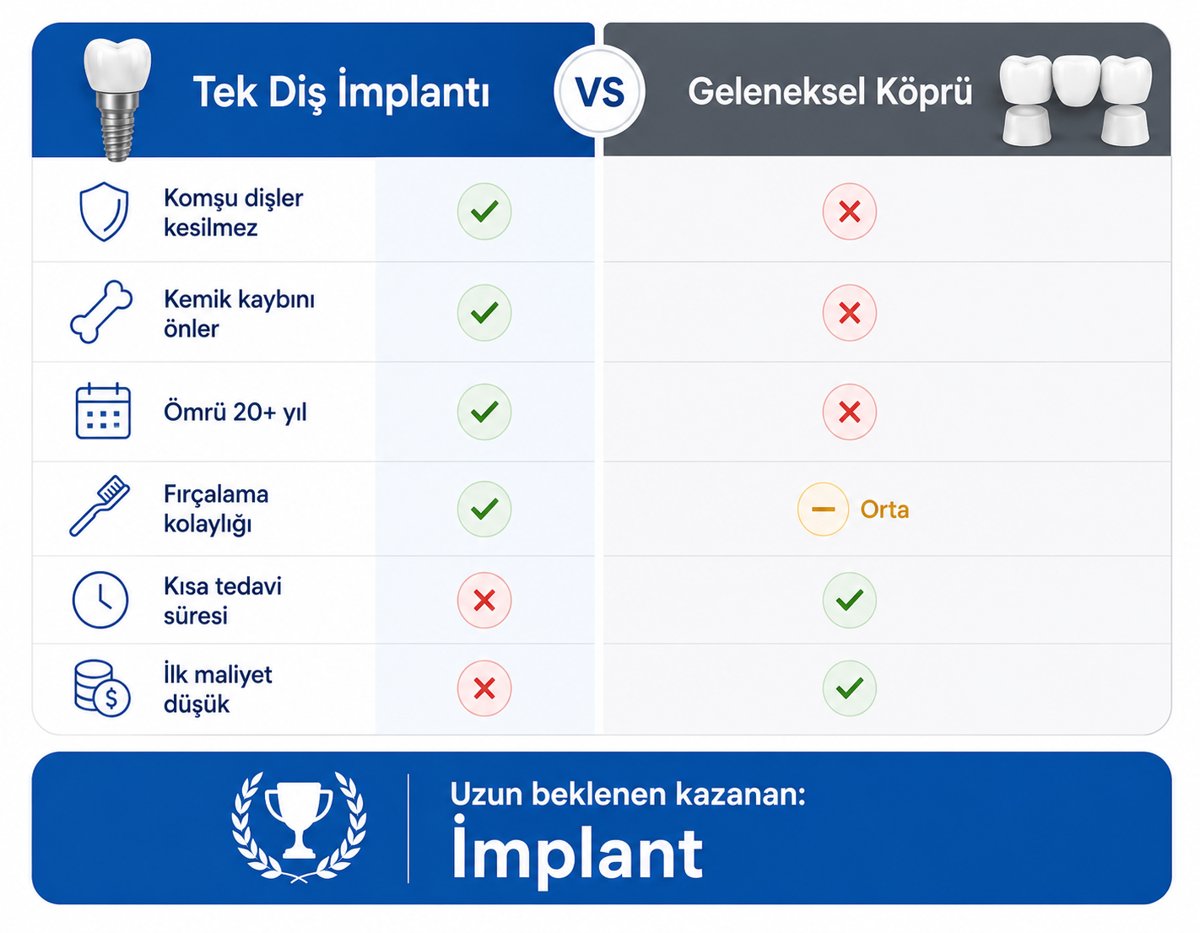
This is one of the most frequently asked questions about a single missing tooth. The answer almost always points in the same direction, but it is important to understand why.
| Feature | Single Tooth Implant | Traditional Bridge |
|---|---|---|
| Intervention on neighboring teeth | ❌ Not required | ✅ They must be cut down |
| Prevention of bone loss | ✅ Prevents | ❌ Does not prevent |
| Natural tooth feel | ✅ Highest | Medium |
| Oral hygiene | ✅ Easy (individual brushing) | Medium (cleaning under the bridge is difficult) |
| Lifespan | 20 years and above | 7-12 years |
| Treatment duration | Long (a process of months) | Short (a few sessions) |
| Initial cost | Higher | Lower |
The flaw of the bridge is not the bridge itself; it is the cutting down of the neighboring teeth. This puts two healthy teeth at risk for life. The total long-term cost of an implant is generally lower than that of a bridge.
Implant for a Front Tooth: A Special Case
An implant for a front tooth requires more delicate planning than implants in the back area. The reason is simple: the front area is constantly visible when speaking, smiling, and in facial expressions.
The following points are given particular attention when planning an implant for a front tooth:
- Smile line: The crown on the implant must match the neighboring teeth in color, length, and form.
- Gum level: The implant depth is calculated based on how it will shape the natural contour of the gum.
- Bone framework: The bone in the front area can be thin; this may occasionally require the support of a small bone graft.
- Temporary tooth: So that osseointegration can take place, a temporary crown is placed for aesthetic and functional reasons.
With the collaboration of an experienced implantologist and a high-quality dental laboratory, a front tooth implant cannot be distinguished from a real tooth by those around you.
The First Days After an Implant: What to Pay Attention To
The first 24 hours are critically important.
- Avoid hot foods and drinks; heat increases bleeding.
- Do not disturb the treatment area with your tongue, finger, or any foreign object.
- Do not use cigarettes or alcohol.
- Use the prescribed antibiotics and painkillers regularly.
- Prefer soft, lukewarm foods on the first day.
General recommendations during the healing period:
- Swelling and bruising are normal and usually resolve in 2-4 days.
- Oral hygiene must not be neglected; however, the stitch area is not brushed directly in the first few days.
- Heavy exercise and physical exertion should be postponed for the first few days.
- If you have bruxism (teeth grinding), be sure to tell your dentist; a night guard can be made.
How Long Does a Single Tooth Implant Last?
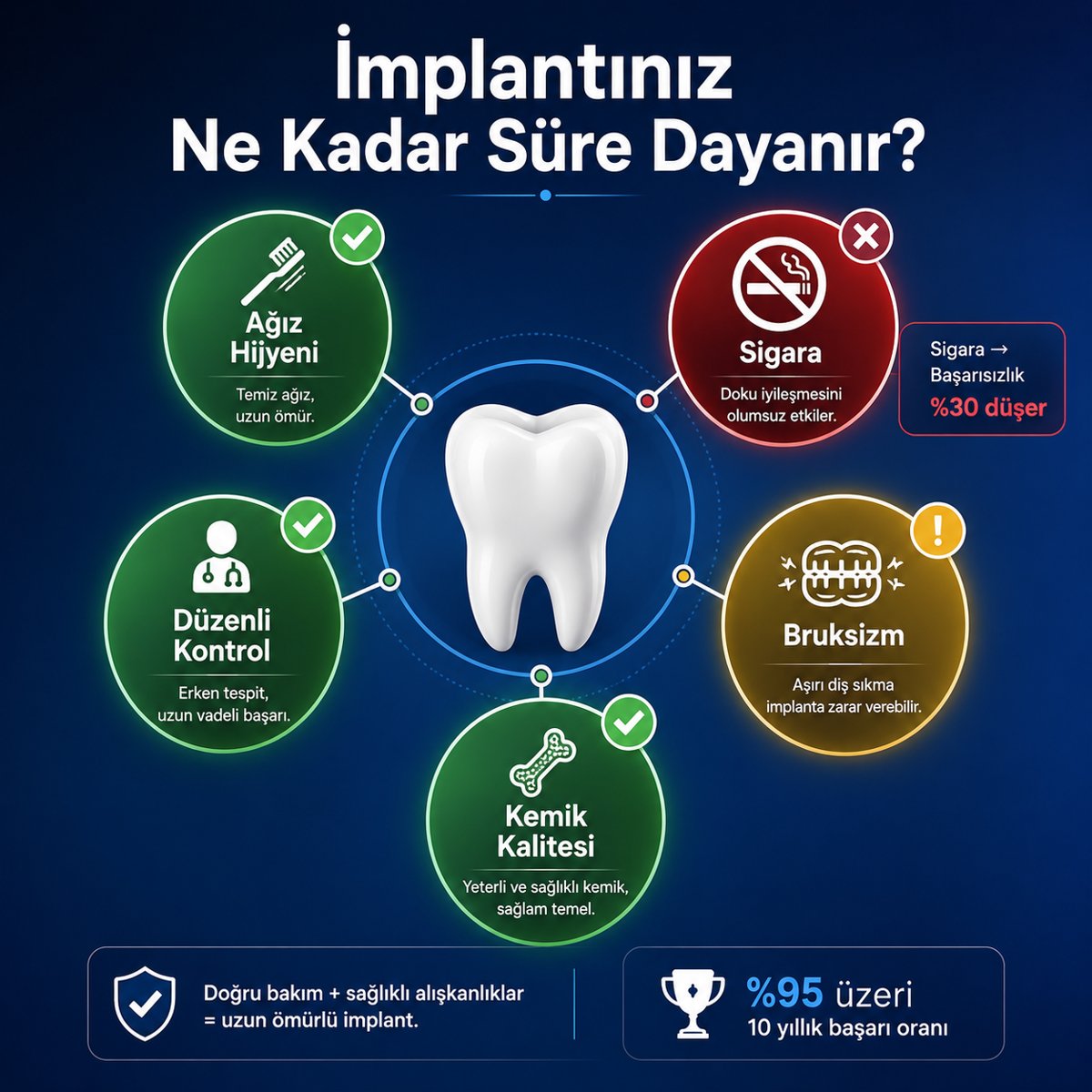
In clinical studies, the 10-year success rate of correctly placed and well-maintained implants has been shown to be 95%. Cases of trouble-free use for twenty years or more are not the exception.
Factors that affect implant lifespan:
- Quality of osseointegration: The success of the surgery and the bone structure.
- Oral hygiene: Regular brushing, dental floss, and cleaning aids minimize the risk of peri-implantitis.
- Smoking: The single most important factor shortening implant lifespan.
- Bruxism: Uncontrolled teeth grinding can damage the crown and connecting parts.
- Regular check-ups: A routine examination every 6 months ensures that early problems (abutment loosening, gum changes) are noticed in time.
Frequently Asked Questions
Can a single tooth implant be painful?
Since the procedure is performed under local anesthesia, no pain is felt throughout. Pressure and vibration are normal. After the procedure, mild soreness may occur for 2-3 days; this is easily managed with prescribed painkillers. Many patients state that the implant was much more comfortable than they expected.
Up to what age can implant treatment be applied for?
There is no upper age limit. People aged 70, 75, or even 80 can successfully have implants if their bone structure and general health are suitable. What matters is not age but biological capacity.
What if I don't have enough bone?
Bone deficiency is a surmountable situation in most cases. The appropriate ground is prepared with small bone graft procedures. If the bone in the upper jaw is insufficient, a sinus lift is performed. These additional procedures extend the duration, but they do not indicate an impossibility; they indicate a process involving more meticulous planning.
What is placed on the implant: zirconia or porcelain?
Both materials are used successfully. Zirconia is today's first choice in terms of durability and gum health. All-ceramic options such as E-Max may be preferred for front teeth to deliver the highest aesthetics. The decision is made together with the dentist according to the tooth's position and quality.
Will an implant cause problems in an MRI?
Titanium is a non-magnetic metal. For this reason, it causes no problem during MRI (magnetic resonance imaging) and can be scanned safely.
I have diabetes. Can I get an implant?
If your blood sugar is under control within the framework of HbA1c values, implant treatment is possible. However, uncontrolled diabetes negatively affects both healing and osseointegration. Before treatment, your endocrinological follow-up is arranged.
Do implants fall out?
In implants placed with correct planning, a sterile environment, and appropriate patient selection, the failure rate is extremely low (between 2-5%). Failure is generally associated with early-period infection, insufficient osseointegration, or uncontrolled systemic conditions. A failed implant can often be placed again after healing.
Can I get an implant right after having my single tooth extracted?
In some cases, extraction and placement can be done on the same day with the "immediate implant" technique. However, this requires the absence of infection, sufficient bone volume, and the dentist's clinical approval. It is not applied in every case; individual evaluation is essential.
Conclusion: The Most Sensible Investment for a Single Missing Tooth
Treating a single missing tooth as insignificant sets in motion a silent but cumulative chain of events. The bone dissolves, the neighboring teeth drift, and the bite stability is disrupted.
A single tooth implant breaks this chain: it rebuilds the tooth root, it is durable, it does not touch the neighboring teeth, and it gives nothing away to onlookers.
As the least invasive, longest-lasting, and bone-preserving option available for a long time, the implant deserves to be the first choice of modern dentistry for a single missing tooth.
Whether an implant is suitable for you can be decided only after a clinical examination and tomography. Seeking help early is always advantageous, both biologically and financially.
Take the First Step for Your Missing Tooth
Get a free consultation with our specialist dentists for an examination and 3D tomography.
Book an Appointment