What Are Dental Crowns and Veneers? Types, Differences and a Guide to Choosing the Right One
You are unhappy with the color, shape or appearance of your teeth, but you do not want a major procedure such as an implant. Or the opposite: a tooth you have used for years has suffered serious damage and now needs to be protected.
In either case, the first option that comes to mind is probably dental coating, that is, crowns and veneers. But should it be zirconium, porcelain or laminate veneers? For a front tooth or a back tooth? How many appointments does it take? How long does it last?
In this guide, we cover every question people ask about dental crowns and veneers in detail, from the types available and the treatment process to choosing the right material and care tips.
What Are Dental Crowns and Veneers?
A dental crown or veneer (dental crown or dental veneer) is a restoration method applied over, or onto the front surface of, teeth that are damaged, discolored, misshapen or structurally weakened. It has two purposes: protecting and strengthening the tooth (functional purpose) and improving its appearance (aesthetic purpose).
There are different applications: covering the entire tooth (crown) or covering only its front surface (veneer/laminate veneer). Which method is chosen depends on the current condition of the tooth, the patient's expectations and the dentist's clinical assessment.
Crowns and veneers can be made from different materials such as porcelain, zirconium, glass ceramic (E-Max) or composite. Each of these materials has different durability, aesthetic and price characteristics.
When Are Dental Crowns and Veneers Used?
Dental crowns and veneers are not a treatment only for people with aesthetic concerns. They are also frequently used for functional and medical reasons.
- Severely decayed or damaged teeth: A crown is used to preserve teeth whose root is sound but which are too damaged to be saved with a filling.
- Teeth that have had root canal treatment: After root canal treatment, a tooth becomes structurally prone to brittleness. A crown protects the tooth from external forces and reduces the risk of fracture.
- Worn or shortened teeth: In teeth worn down by teeth grinding (bruxism) or acid erosion, crowns restore both aesthetics and chewing function.
- Discoloration and stains: For deep internal discoloration that does not respond to whitening treatment (tetracycline stains, fluorosis, etc.), crowns and veneers offer a permanent solution.
- Shape irregularities: Crowns and veneers are preferred for the aesthetic correction of teeth that are congenitally small, short or misshapen.
- Diastema (gaps between teeth): Laminate veneers offer an effective solution for closing aesthetic gaps between the front teeth.
- Implant and bridge restorations: Crowns are placed on implants, and on the supporting teeth in bridge restorations.
- Smile design (Hollywood Smile): In comprehensive aesthetic treatments where the shape, color and size of many teeth are replanned in harmony, crowns and veneers are the fundamental building block.
What Types of Dental Crowns and Veneers Are There?
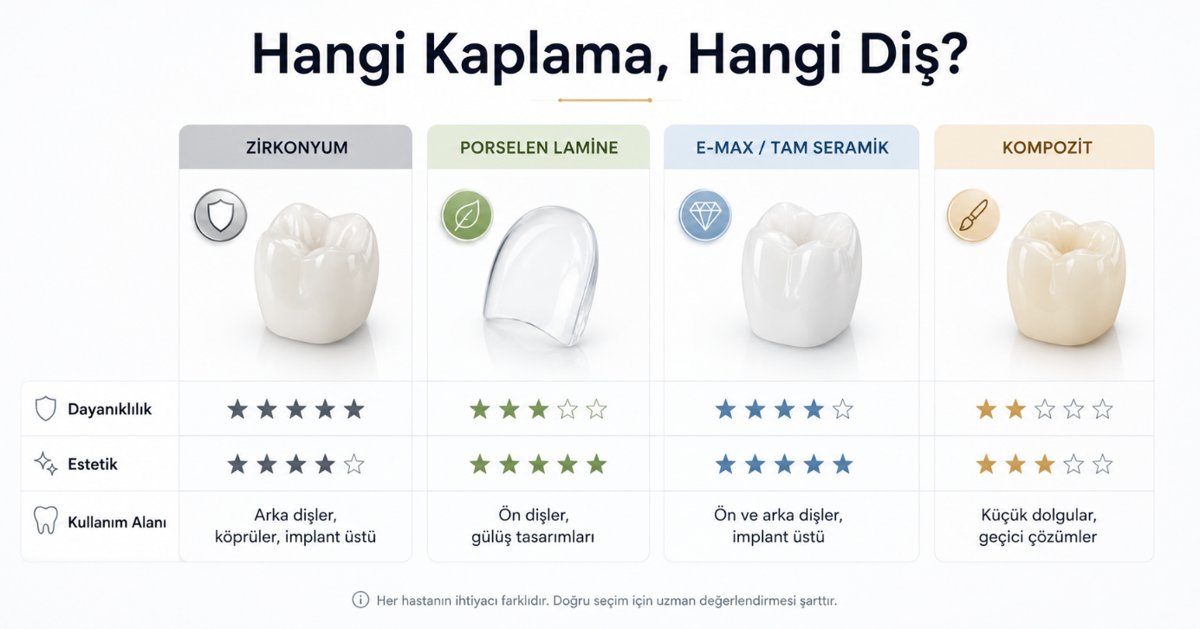
We cover the most widely used types of dental crowns and veneers in clinics in Turkey in detail, in terms of material, aesthetics, durability and area of use.
Zirconium Dental Crowns
Zirconium crowns are the most commonly preferred type of crown today. This ceramic material, based on zirconium dioxide (ZrO₂), stands out for being metal-free and for its superior durability.
Metal-supported porcelain crowns, widely used in the past, created a gray reflection at the gum line and led to aesthetic problems over time. The white structure of zirconium has completely eliminated this problem.
Key features of zirconium:
- It contains no metal. It is biocompatible, and the risk of allergic reaction is extremely low.
- It provides a translucent appearance close to natural tooth color.
- It shows high resistance to cracking, fracture and wear.
- Because it is produced with computer-aided CAD/CAM systems, it fits the tooth perfectly.
- It has strong gum compatibility, minimizing the risk of gum recession and inflammation.
- Its sealing property is high, so the risk of secondary decay is low.
Who Is Zirconium Suitable For?
Zirconium can be used on both front and back teeth, and it is an ideal choice for teeth that have had root canal treatment, bridge restorations, bruxism patients and smile design. Especially in bridge applications, where flexural strength is required, zirconium has an advantage over all-ceramic.
Porcelain Crowns and Veneers (Laminate / Leaf Veneer)
Porcelain laminate veneers, also known as "leaf porcelain" or "veneers", are extremely thin (0.3-0.7 mm) ceramic shells bonded only to the front surface of the tooth.
The key difference from traditional crowns is this: the entire tooth is not shaved down. Only minimal reduction is done on the front surface, or none at all. This makes the porcelain laminate veneer the least invasive method that preserves tooth tissue.
Key features of porcelain laminate veneers:
- They largely preserve the natural structure of the tooth. In suitable cases, no reduction is needed at all.
- With their glass ceramic structure, translucency is excellent, giving the most natural look.
- They give full control over color, shape and length.
- Thinning toward the tooth edges, transparency and shading effects can be realistically reproduced.
- Because they are made in the laboratory by a technician, a high aesthetic quality is achieved.
How does it differ from composite laminate veneers? Porcelain laminate veneers are made in the laboratory and bonded to the tooth by the dentist. Composite laminate veneers, on the other hand, are shaped directly in the mouth by the dentist. Composite is more economical and quicker to apply; however, porcelain is by far superior in terms of durability, color stability and aesthetics.
All-Ceramic Crowns and Veneers (E-Max / Empress)
All-ceramic restorations, commonly known as E-Max or Empress, are types of crowns and veneers made entirely of ceramic with no metal substructure. Made from lithium disilicate-based glass ceramic, these restorations offer both extreme aesthetics and satisfactory durability.
E-Max can be applied in two different forms:
- E-Max Crown: The whole tooth is reduced to a certain extent and fully covered. It is used for damaged teeth or teeth that have had root canal treatment.
- E-Max Veneer (Aesthetic Veneer): It is applied only to the front surface of the tooth. It is preferred in aesthetic cases requiring minimal reduction.
Key features of all-ceramic:
- Translucency and color depth give the closest appearance to a natural tooth.
- It contains no metal and is biocompatible.
- Because it can give successful results even at 0.2-0.4 mm thickness, it allows very thin work.
- Color gradations, transparency effects and tooth characterization can be reproduced best with this material.
How does it differ from zirconium? All-ceramic (E-Max) falls behind zirconium in terms of flexural strength. For this reason, zirconium is preferred in bridge restorations, while E-Max is more advantageous for single-tooth applications and for front teeth requiring high aesthetics.
Who is it suitable for? Ideal for single-tooth restorations in the front region, cases where high aesthetics are sought with minimal reduction, and smile designs where tooth characterization matters.Metal-Supported Porcelain Crowns
A metal-supported porcelain crown is a traditional type of crown with a metal alloy substructure underneath and a tooth-colored porcelain layer on top. It was the standard crown method for many years, but with the development of aesthetic alternatives, its area of use has narrowed markedly today.
Key features:
- Thanks to the metal substructure, its mechanical durability is high.
- Its load-bearing capacity is strong in long bridge restorations.
- It is more economical than other types of crowns.
Disadvantages:
- A dark gray reflection forms at the gum line and becomes noticeable over time.
- It has no translucency, so it is hard to achieve a natural tooth appearance.
- The metal component carries a risk of allergic reaction in some patients.
- It is not suitable for the front region in terms of aesthetics.
Composite Crowns and Veneers (Bonding)
Composite veneering is a method in which tooth-colored composite resin is applied and shaped directly on the tooth in the mouth. Technically, it is also known as "bonding" or "composite laminate".
Key features:
- It can be completed in a single appointment, with no laboratory stage.
- Minimal or no reduction of the tooth is needed.
- It is reversible and can be removed whenever desired.
- It offers a quick solution for small gaps, minor chips and mild discoloration.
- It is markedly more economical than other types of crowns and veneers.
Disadvantages:
- Color stability is low. Yellowing and discoloration may occur over time.
- It is less durable than porcelain and zirconium and can be scratched.
- Surface shine decreases over time.
- It is difficult to reach porcelain quality in comprehensive smile designs.
How Are Dental Crowns and Veneers Made? The Treatment Process
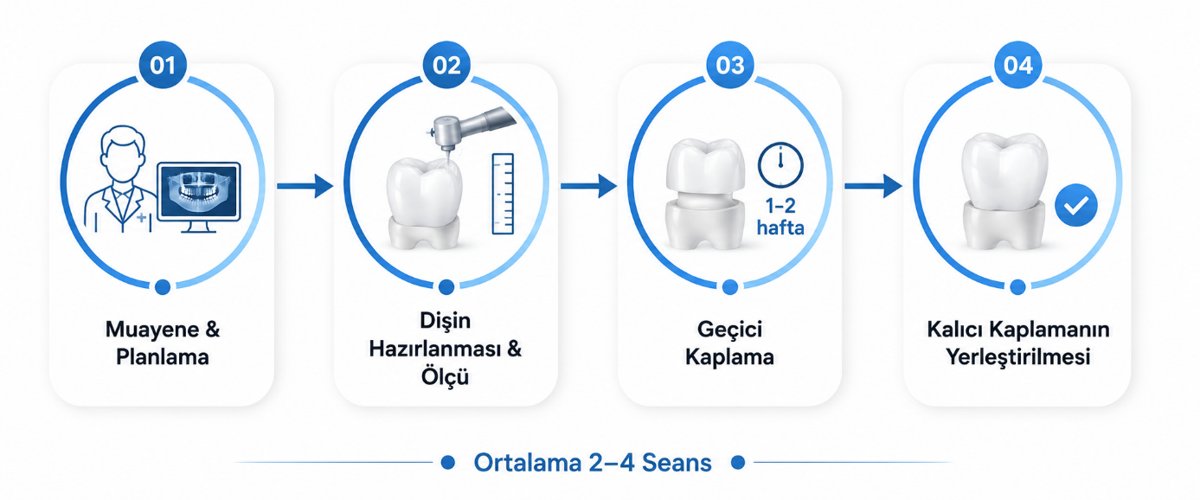
Depending on the type, the crown or veneer process is completed in 2 to 4 appointments. Below are the steps of a standard crown (full coverage) treatment.
1. Examination and Planning
At the first appointment, the structure of the tooth is evaluated with a clinical examination and a panoramic X-ray. Whether root canal treatment is needed, bone and gum health, and the bite relationship are all integrated into the treatment plan. The choice of material is made at this stage together with your dentist.
2. Tooth Preparation and Impression
The tooth to be restored is reduced and shaped to a certain extent under local anesthesia. In laminate veneer applications, this reduction is extremely minimal or not needed at all. Then a digital or conventional impression of the tooth is taken and sent to the laboratory.
3. Temporary Crown Placement
While the permanent restoration is prepared in the laboratory, a temporary crown is placed to reduce sensitivity in the prepared tooth and to avoid leaving a gap aesthetically. This temporary crown is usually worn for 1-2 weeks.
4. Placement of the Permanent Crown
The permanent restoration completed in the laboratory arrives at the clinic. The dentist tries it on the tooth, checks color and fit, and evaluates the bite relationship. Once approved, it is permanently fixed to the tooth with dental adhesive.
Which Crown or Veneer Suits Whom? Material Comparison
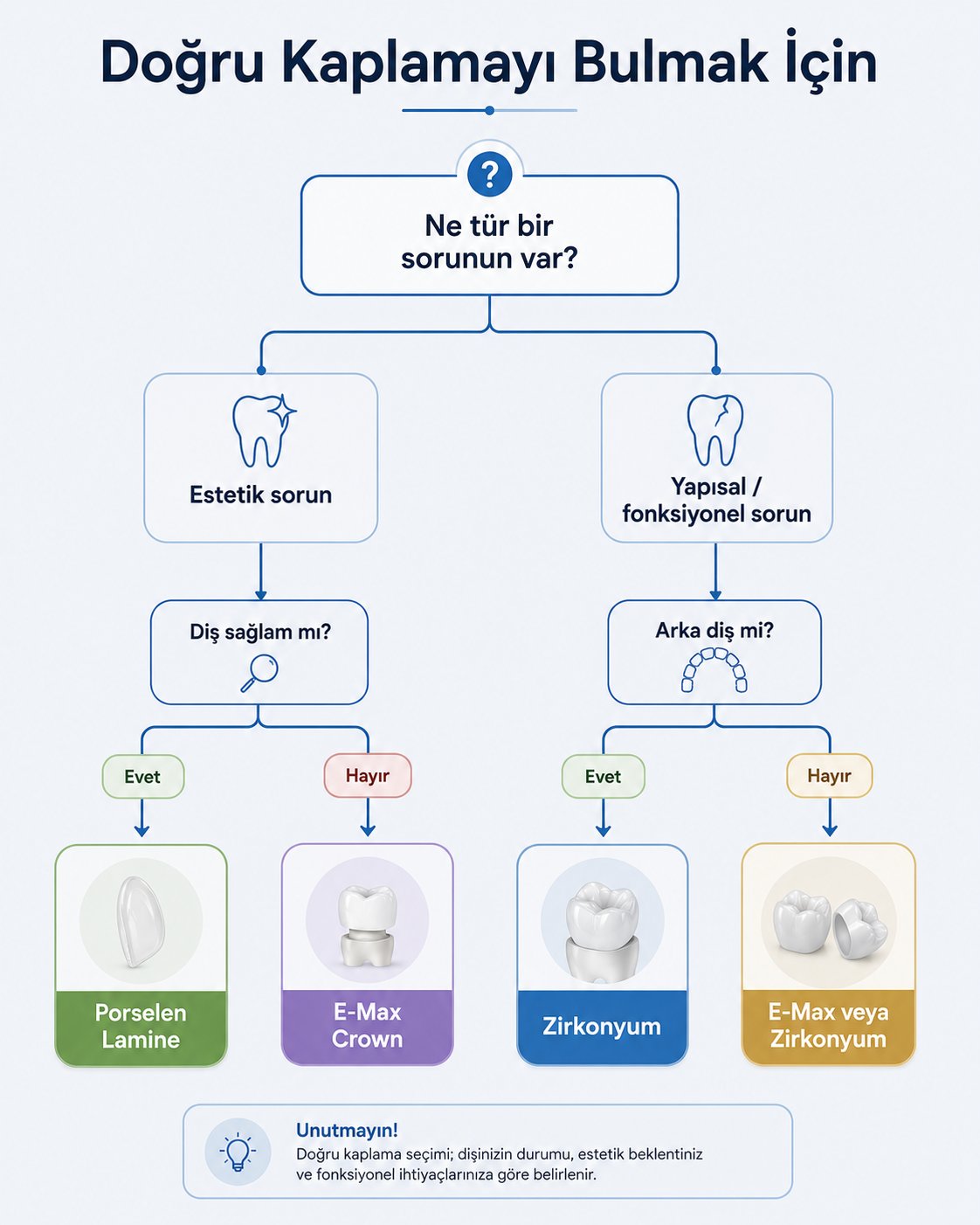
Below, we summarize different patient profiles and the types of crowns and veneers recommended for them.
- High aesthetics in the front region: E-Max (all-ceramic) or porcelain laminate veneers. Translucency and color depth are highest in these materials.
- Durability in the back region: Zirconium. The first choice for the region that needs the strongest ceramic under chewing load.
- Bridge restoration: Zirconium. In bridge structures requiring flexural strength, the flexural strength of E-Max falls short.
- Tooth that has had root canal treatment: Zirconium or E-Max crown. Full coverage minimizes the risk of the tooth fracturing.
- Bruxism (teeth grinding) patient: Zirconium. It is the ceramic material with the highest wear resistance.
- Smile design / Hollywood Smile: A combination of porcelain laminate veneers and E-Max. Aesthetics, naturalness and minimal invasiveness are achieved together.
- Minimally invasive treatment: Porcelain laminate veneers or composite bonding. The methods that disturb tooth tissue the least.
- Limited budget, quick solution: Composite bonding. Results in a single appointment, at an economical cost.
- Patient with a metal allergy: Zirconium, E-Max or porcelain laminate veneers. Metal-free materials.
What to Pay Attention to After Dental Crowns and Veneers
The success of a crown or veneer depends not only on the quality of the treatment but also on the patient's care habits after treatment.
- First 24-48 hours: It is recommended to avoid very hard, sticky and staining foods and drinks (coffee, tea, red wine).
- During the temporary crown period: A temporary crown is more delicate than the permanent one. During this period, be careful with hard foods and when using dental floss.
- Oral hygiene: Teeth with crowns or veneers should be brushed like natural teeth, and the spaces between them cleaned with dental floss. The restoration material does not decay; however, decay can form at the junction between the tooth and the restoration through neglect.
- If you have bruxism: Using a night guard is essential. Teeth grinding causes wear over time in all types of crowns and veneers, including zirconium.
- Regular check-ups: A routine dental check-up every 6 months is critical for assessing the fit of the restoration, the health of the gums and the junctions.
- Avoid hard objects: Habits such as biting pens, chewing ice and cracking nuts increase the risk of fracture in all ceramic restorations.
How Long Do Dental Crowns and Veneers Last?
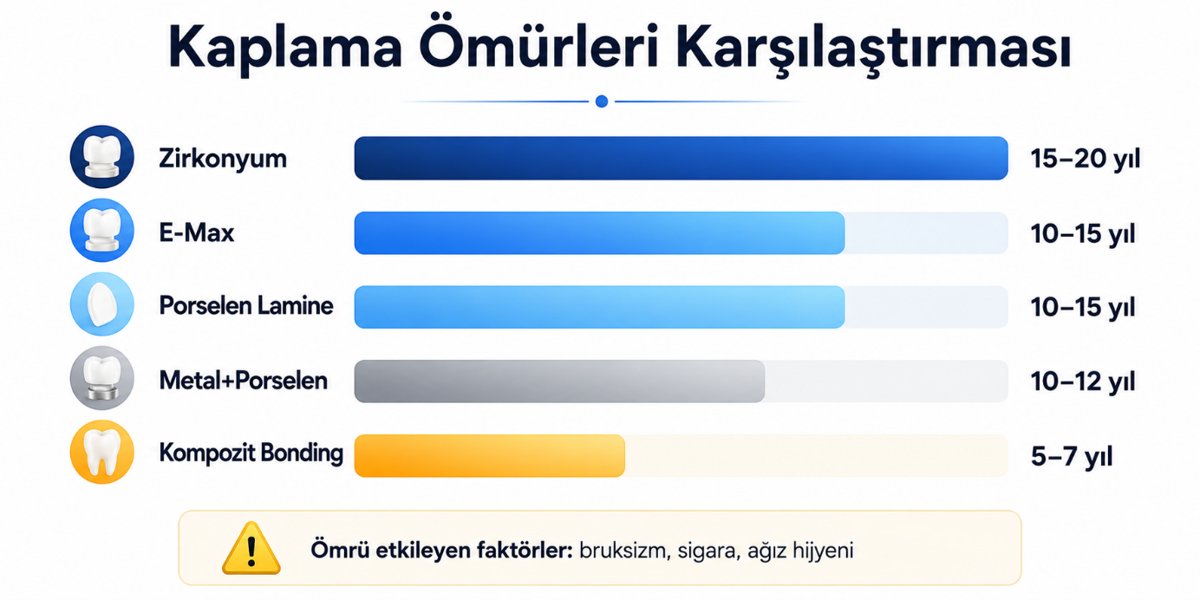
The lifespan of a crown or veneer varies considerably depending on the material used, the patient's oral hygiene and lifestyle habits.
- Zirconium: With proper care, a service life of 15-20 years or more is expected. It is the ceramic material with the highest wear resistance.
- E-Max / All-Ceramic: An average lifespan of 10-15 years. The long-term success rate is high for single front teeth.
- Porcelain Laminate Veneers: 10-15 years with proper care. In cases done with minimal reduction, the preservation of tooth tissue supports longevity.
- Metal-Supported Porcelain: Long-lasting thanks to its mechanical durability; however, aesthetic problems may require earlier intervention.
- Composite Bonding: 5-7 years. Replacement may be needed more often because of discoloration and surface wear.
The main factors that shorten the lifespan of crowns and veneers: bruxism, smoking, irregular check-ups, inadequate oral hygiene and excessive consumption of hard foods.
Frequently Asked Questions (FAQ)
Are dental crowns and veneers painful?
Because the procedure is performed under local anesthesia, no pain is felt during treatment. Temporary sensitivity may occur afterward, and it usually goes away on its own within a few days. During the temporary crown period there may be hot-cold sensitivity; once the permanent restoration is placed, this goes away.
Are crowns and veneers placed on front teeth or back teeth?
They can be done in both regions; however, the material used differs. On front teeth, aesthetics come first, and porcelain laminate veneers or E-Max are preferred. On back teeth, durability under chewing load comes first, and zirconium stands out.
How many appointments do dental crowns and veneers take?
A standard treatment is usually completed in 2-4 appointments. Composite bonding can be finished in a single appointment. Cases requiring root canal treatment may extend the process.
Zirconium or porcelain laminate veneers?
These two methods are not alternatives to each other but answers to different indications. Zirconium if most of the tooth is damaged, if root canal treatment has been done or if a bridge is needed. Porcelain laminate veneers if the tooth is sound and the problem is purely aesthetic and minor. The right choice is made together with your dentist after the examination.
Do dental crowns and veneers look like natural teeth?
Yes. Porcelain laminate veneers and E-Max restorations in particular offer the closest appearance to natural teeth in terms of translucency and color depth. With an experienced dentist and a quality laboratory working together, restored teeth are not noticed by people around you.
Can decay form under a crown?
The restoration material itself does not decay. However, decay can form at the junction between the tooth and the restoration through neglect. To minimize this risk, regular brushing, flossing and routine 6-month check-ups are necessary.
Does the tooth need to be reduced a lot for laminate veneers?
In modern porcelain laminate veneer applications, the amount removed from the tooth is extremely small (0.3-0.5 mm), and in some cases no reduction is done at all. This makes the laminate veneer the restoration method that disturbs tooth tissue the least.
Can a bruxism patient get crowns or veneers?
Yes, but it requires extra precautions. Bruxism patients should tell their dentist about this condition before treatment and use a night guard afterward. Zirconium is the most durable restoration material under teeth grinding.
Let Us Determine the Most Suitable Dental Crown or Veneer Method for You
Get a free consultation with our expert dentists to renew your smile.
Book an Appointment