What Is a Dental Filling? When Is It Necessary?
You've had a week of sensitivity in one tooth. It aches when you sip hot tea, and you flinch when cold water touches it. You look in the mirror but can't see anything. "It'll pass," you tell yourself. It doesn't.
Most tooth decay begins exactly like this — silently, out of sight, unnoticed. And very often, all it takes is a simple filling. But the word "filling" immediately brings to mind the sound of the drill, pain and long appointments. In modern dentistry, however, a filling is a procedure that, in most cases, is completed painlessly in 20–45 minutes.
In this guide, we cover everything you may wonder about dental fillings: when they are necessary, what types exist, how they are done, how long they last and what you should pay attention to afterwards.
What Is a Dental Filling?

A dental filling is a procedure in which tooth tissue damaged by decay, fracture, cracking or wear is cleaned out and repaired with special restorative materials. The goal is to restore both the chewing function and the aesthetic appearance of the tooth, and to stop the decay from progressing into deeper tissues.
A tooth consists of three main layers, from the outside in: enamel (the hardest outer layer), dentin (the softer layer beneath the enamel) and pulp (the living inner tissue containing blood vessels and nerves). Decay starts in the enamel layer; if left untreated, it progresses to the dentin and from there to the pulp. Once it reaches the pulp, a filling is no longer enough — root canal treatment becomes necessary.
This is exactly where the critical role of the filling comes in: catching the decay at the enamel or dentin stage and preventing it from reaching the pulp.
When Is a Dental Filling Necessary?
How Does Decay Progress? The Stages
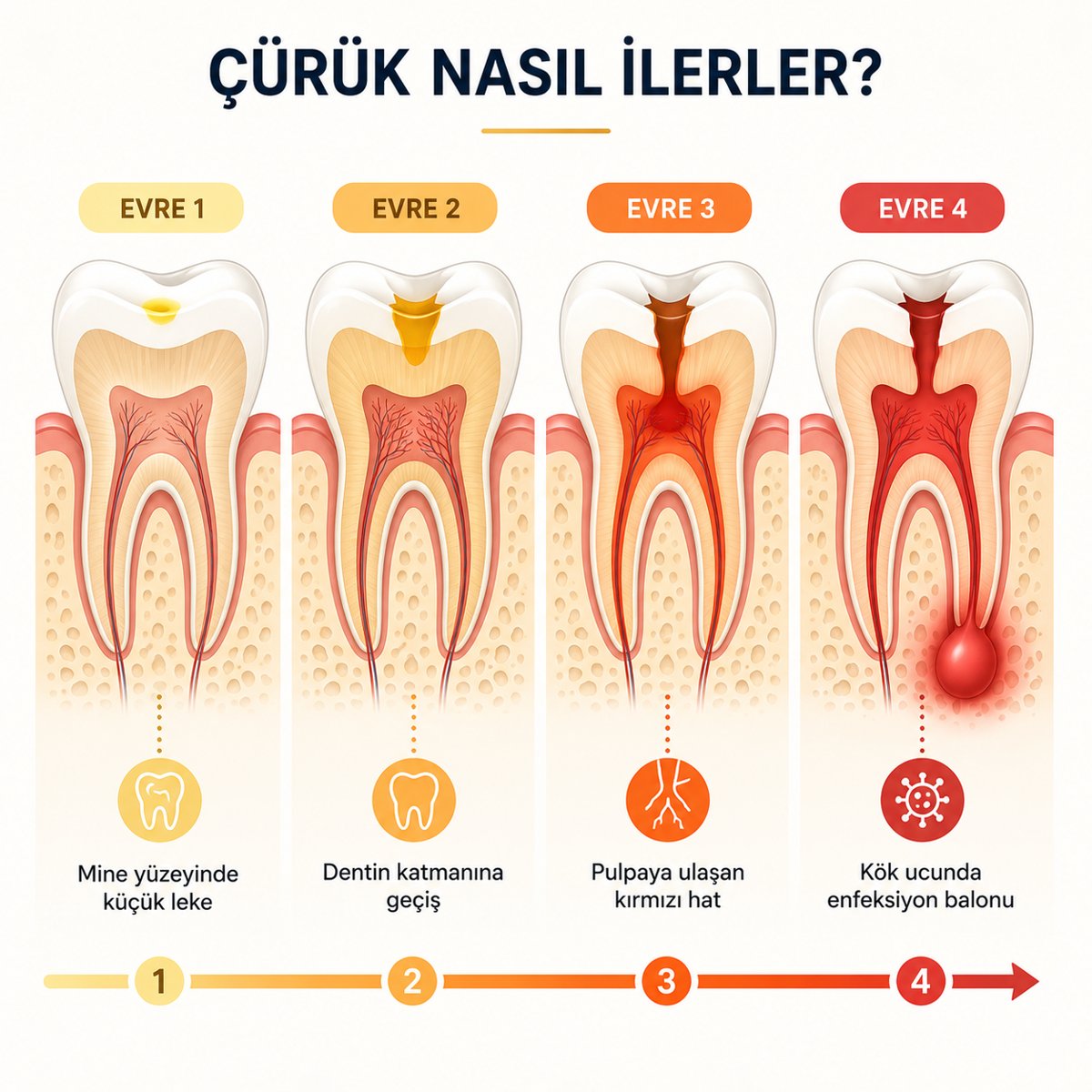
Tooth decay does not form all at once. Bacteria in the mouth convert sugar and starch into acids, and these acids gradually erode the enamel layer. The process progresses in four stages:
- Stage 1 — Enamel decay: A white or brown spot appears on the surface, and there is no pain yet. A filling at this stage is the simplest and shortest intervention.
- Stage 2 — Dentin decay: The decay has moved beneath the enamel. Hot-cold sensitivity begins. A filling is still sufficient, but the procedure is somewhat more extensive.
- Stage 3 — Pulp involvement: The decay has reached the nerve. Spontaneous throbbing pain that worsens at night is a sign of this stage. Now you need root canal treatment, not a filling.
- Stage 4 — Abscess: An infection has formed at the root tip. Swelling and fever may accompany it. Emergency treatment is essential.
A filling is the intervention for Stage 1 and Stage 2. Missing this window makes treatment both more complicated and more costly.
7 Situations That Call for a Filling
- Visible decay or a brown-black spot on the tooth — do not postpone it, especially if there is a pit on the tooth surface.
- Hot-cold sensitivity — if you feel a brief twinge when the tooth comes into contact with drinks or food, it may be a sign of dentin decay.
- Pain or discomfort while chewing — if pressure on a particular tooth causes pain, it should definitely be evaluated.
- A fractured or cracked tooth — fractures caused by trauma or biting hard food leave a door open for bacteria.
- A worn tooth surface — enamel thinned by bruxism (teeth grinding) or acid erosion can be restored with a filling.
- A broken or fallen-out old filling — new decay may have formed underneath; see your dentist without waiting.
- Restoring the upper structure of a tooth after root canal treatment — a filling or crown is used to seal a tooth whose canal treatment is complete.
When a Filling Is Not Possible
Not every damaged tooth can be solved with a filling. A filling falls short in the following situations:
- If the decay has reached the pulp, root canal treatment must be done first, followed by a filling or crown.
- If a large part of the tooth structure has been lost, an inlay, onlay or crown is required.
- If the tooth is damaged beyond saving, extraction is planned, followed by an implant.
- If there is active gum disease, periodontal treatment is essential first.
- If the tooth root is fractured, extraction may be unavoidable.
💡 Info Box: If you have spontaneous, throbbing pain in a tooth that worsens at night — this is a sign that you need root canal treatment, not a filling. Go to your dentist without waiting.
What Are the Types of Dental Fillings?
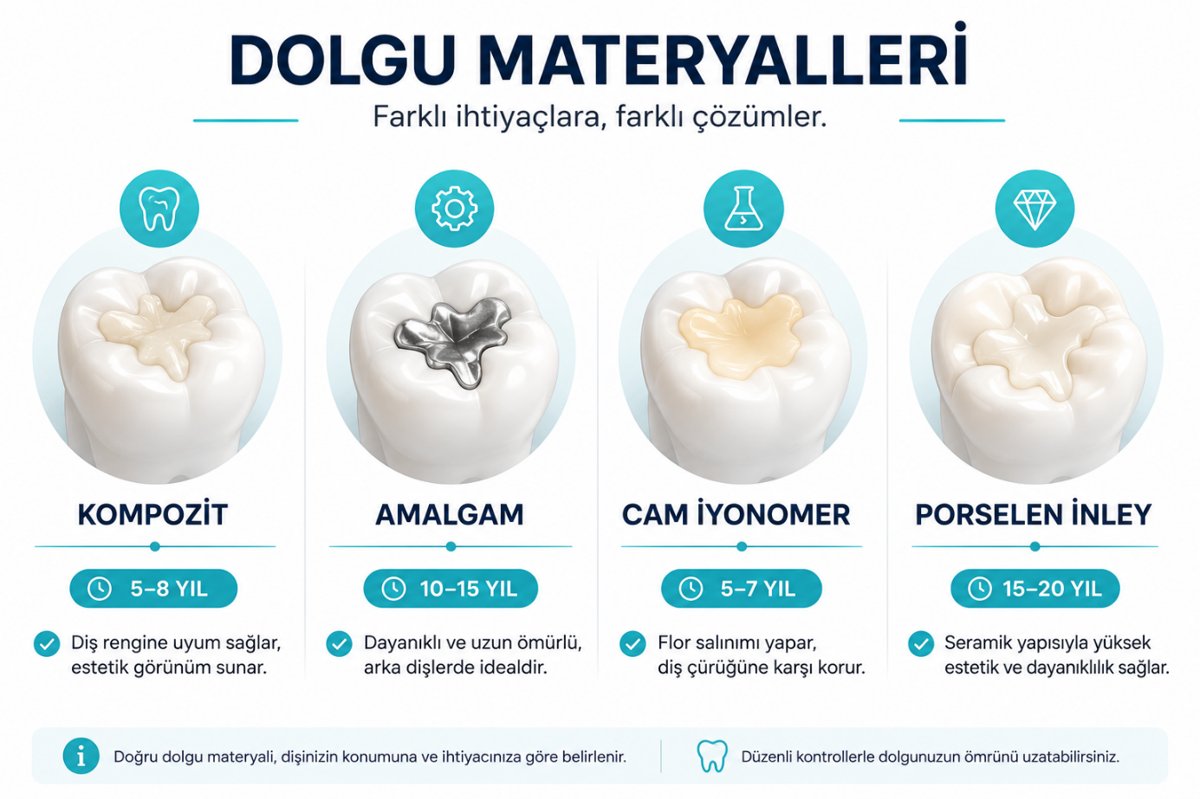
The choice of filling material is determined by the position of the tooth, the size of the decay, aesthetic expectations and the patient's general health. Today, four main types of fillings are used.
Composite Filling (White Filling)
It is a tooth-colored, light-cured, resin-based material and is the most widely used type of filling today. It can be applied to both front and back teeth; because it bonds chemically to the tooth tissue, less healthy tissue needs to be removed. It is completed in the same appointment. Its color may change slightly over time due to the effects of tea, coffee and smoking. Its average lifespan is 5–8 years; with good oral hygiene, this can be extended.
Amalgam Filling (Metal/Gray Filling)
It is a traditional filling material made of an alloy of mercury, silver, tin and copper. It has been used for decades and is very durable against high chewing forces, especially in back teeth. It is not preferred aesthetically because its gray color is clearly visible. In practice, it may require more healthy tooth tissue to be removed. Because of its mercury content, its use is restricted in some countries; in the EU, restrictions came into force as of 2025. Its average lifespan is 10–15 years.
Glass Ionomer Filling
It is a fluoride-releasing material made from a mixture of glass powder and organic acid. Thanks to the fluoride release, it provides a protective effect against decay. Because of this property, it is often preferred for baby tooth fillings in children and for temporary restorations. Its durability is lower than that of composite and amalgam; its aesthetic quality is moderate. Its average lifespan is 3–5 years.
Porcelain Inlay / Onlay
These are porcelain restoration pieces produced in the laboratory with CAD/CAM technology that fit the tooth precisely. An inlay is a filling placed in the area between the two cusps of the tooth; an onlay is a wider restoration that also covers one or several cusps. They require two appointments: an impression is taken at the first appointment, and bonding is done at the second. Although it is the most expensive option, it is the longest-lasting type of filling. Its average lifespan is 15–20 years.
Which Filling Is Right for You?
To summarize briefly:
- If aesthetics is the priority and the tooth is in the front → Composite filling should be the first choice.
- If long life and high durability are desired in a back tooth → Amalgam or a porcelain inlay can be considered.
- In children or when a temporary solution is needed → Glass ionomer is suitable.
- If you have large decay, high aesthetic expectations and want longevity all at once → A porcelain inlay/onlay is the most lasting solution.
- If you have bruxism (teeth grinding) → More durable materials such as a porcelain inlay or monolithic zirconia should be preferred.
The right choice is determined by the dentist after a clinical examination.
How Is a Dental Filling Done? Step by Step
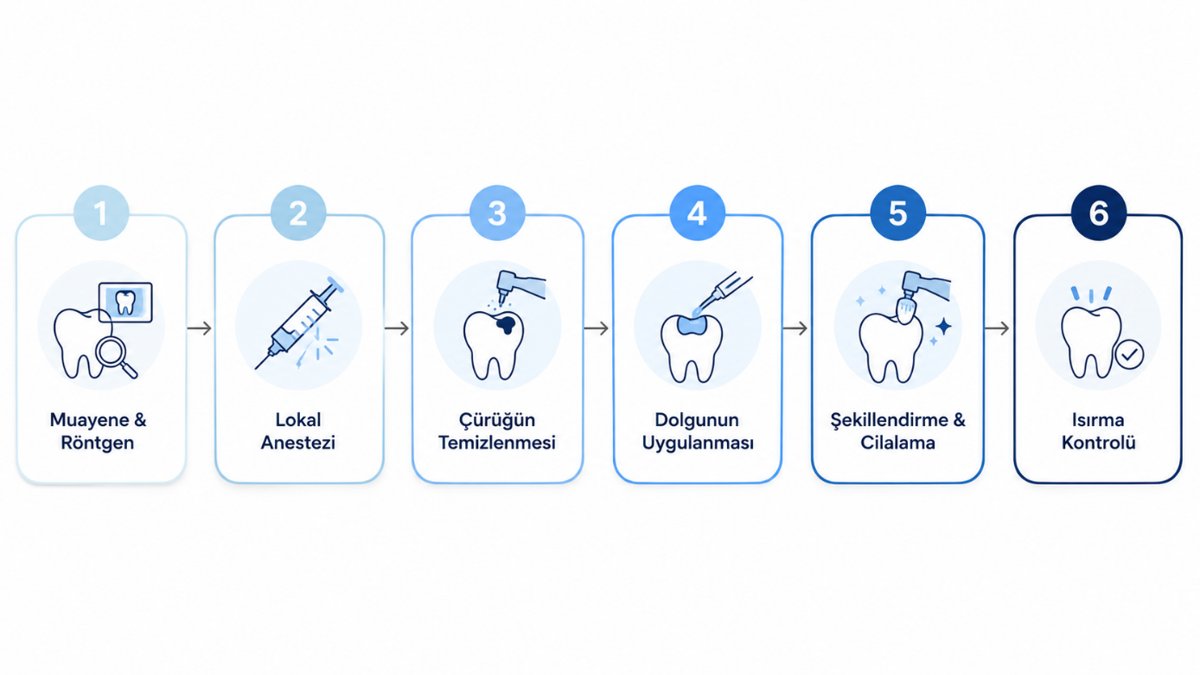
The filling procedure is completed in a single appointment in most cases, in 20–45 minutes. The process consists of six steps:
1. Examination and Diagnosis
The dentist performs a visual examination and, if necessary, takes an X-ray. The size and position of the decay and its proximity to the pulp are evaluated. At this stage, the decision is made on which filling material will be used.
2. Local Anesthesia
Local anesthesia is applied according to the depth of the decay and the patient's sensitivity. Anesthesia may not be needed for superficial decay. The effect of the anesthesia can last about 2–3 hours in the upper jaw and up to 4–5 hours in the back area of the lower jaw.
3. Cleaning Out the Decay
The infected tissue is completely removed with rotary instruments and, if necessary, hand instruments. Healthy tooth tissue is preserved. When the cleaning is complete, the cavity is made sterile.
4. Placing the Filling Material
For a composite filling, an acid gel (etching) is first applied to the tooth surface, followed by a bonding agent. The material is placed in layers, and each layer is hardened with LED light in 20–40 seconds. This layered technique provides both stronger bonding and a more natural look.
5. Shaping and Polishing
The hardened filling is shaped to match the natural form of the tooth. Excess material is removed, and the surface is polished until smooth. A smooth surface reduces plaque buildup and extends the life of the filling.
6. Bite Check
The contact between the upper and lower teeth is checked with carbon paper. If the filling sits too high, small adjustments are made. Once the bite balance is achieved, the procedure is complete.
Does a Dental Filling Hurt?
This is the question patients ask most. The short answer: no, it doesn't hurt — when the right anesthesia is applied.
Thanks to local anesthesia, no pain is felt during the procedure. What you feel is the vibration of the drill, the water spray and slight pressure. These are the sensation of touch, not pain.
The following are normal after the procedure:
- A feeling of numbness and slight swelling as the anesthesia wears off
- Mild sensitivity to hot and cold in the first 24–48 hours
- A few days of aching in the filled area
When you should see your dentist:
- Pain that lasts longer than 12 hours and gets worse
- Spontaneous, throbbing pain
- Sharp pain when biting — the filling may be too high
- If swelling or fever accompanies it
How Long Does a Dental Filling Last?
The lifespan of a filling does not depend on a single factor. The type of material, the position of the tooth, the patient's habits and the quality of the dentist's work together determine it.
Average lifespans by material can be summarized as follows:
- Composite filling: Average 5–8 years. Good oral hygiene and not smoking extend this period.
- Amalgam filling: Average 10–15 years. A back-tooth position and low chewing pressure increase its lifespan.
- Glass ionomer filling: Average 3–5 years. Generally used for temporary purposes or in children's teeth.
- Porcelain inlay/onlay: Average 15–20 years. With regular checkups and in the absence of bruxism, this period can be extended even further.
The main factors that shorten the life of a filling:
- Teeth grinding (bruxism) — applies excessive force to fillings, causing cracking and fracture.
- Habits such as chewing ice or gnawing on pens — wear down the filling surface.
- Inadequate oral hygiene — paves the way for new decay at the edge of the filling.
- Very hard foods — cracking nuts with your teeth in particular damages the filling.
- Irregular dental checkups — early wear and marginal leakage go unnoticed.
What to Pay Attention to After a Filling
First 24–48 Hours
- Do not eat before the anesthesia wears off — there is a risk of biting your tongue or cheek.
- With a composite filling, you can eat right after the anesthesia wears off; it hardens instantly with light.
- With an amalgam filling, waiting at least 2 hours is recommended for full hardening.
- Avoid very hot and very cold foods — sensitivity may increase.
- If the filling feels too high, call your dentist the same day; do not wait.
Long-Term Care
- Brush twice a day; take special care around the edges of the filling.
- Use dental floss — it prevents plaque buildup along the sides of the filling.
- Go for a checkup every 6 months — the condition of the filling, marginal leakage and new decay are evaluated.
- If you have bruxism, use a night guard — it significantly prevents wear on the filling.
- Cut down on colored drinks — it slows color change in composite fillings.
Special Situations
Can You Have a Dental Filling During Pregnancy?
Yes, it can be done. Although filling treatment can be performed at any stage of pregnancy, weeks 13–27 are considered the safest period. Acting with the approval of your obstetrician is recommended.
Amalgam fillings are not recommended during pregnancy — because of their mercury content. Composite fillings are preferred. Untreated tooth decay, on the other hand, can increase the mother's stress level along with the risk of pain and infection during pregnancy; this can negatively affect the baby's development. For this reason, having a dental checkup before pregnancy is the best approach.
Fillings for Baby Teeth in Children
"The baby tooth is going to fall out anyway, is a filling really necessary?" is a question often asked. The answer is clear: yes, it is necessary.
Untreated decay in baby teeth causes pain and infection; it can disrupt the development of the permanent tooth beneath it; and by causing early tooth loss, it negatively affects jaw development. Glass ionomer fillings are often preferred in children — they have a protective effect thanks to fluoride release.
Fillings for Teeth Grinders (Bruxism)
Bruxism is the greatest enemy of fillings. The excessive force applied throughout the night can crack composite fillings and break amalgam fillings. In this patient group, more durable materials such as a porcelain inlay or monolithic zirconia are preferred; the use of a night guard is made a requirement, and the frequency of checkups is increased.
Frequently Asked Questions
When can you eat after a dental filling?
With a composite (white) filling, you can eat after the anesthesia wears off. With an amalgam filling, waiting at least 2 hours is recommended for full hardening.
Can a filled tooth decay again?
Yes. A filling does not make the tooth immune to decay. If plaque builds up around the edges of the filling in particular, new decay can form. Regular brushing and flossing significantly reduce this risk.
Which is better, a white filling or a metal filling?
The two meet different needs. If aesthetics is the priority and the tooth is in the front, composite; if long life and high durability are wanted in back teeth, amalgam or a porcelain inlay may be more suitable. Today, the quality of composite materials has improved significantly, and it has become the preferred option in most cases.
What should you do if a dental filling falls out?
You should see your dentist without wasting time, even if there is no pain. Exposed tooth tissue is vulnerable to bacteria and can decay quickly. Avoid chewing on that side until your appointment day.
Which teeth cannot be filled?
Fillings are not done on teeth where the decay has reached the pulp, where a large part of the tooth is gone, that have a root fracture or that are damaged beyond saving. In these cases, root canal treatment, a crown or extraction is planned.
Does a dental filling last for life?
No. No filling material is permanent. Depending on the type of material and usage habits, it has a lifespan ranging from 3–20 years. Regular checkups ensure that the filling is replaced in time.
Can you have a dental filling during pregnancy?
Yes, it can be done safely, especially between weeks 13–27. Amalgam fillings are not recommended during pregnancy; composite is preferred.
How long does sensitivity last after a dental filling?
Mild sensitivity can last from a few days to a few weeks. In deep decay, this period can extend up to 6 months. Pain that gets worse or starts spontaneously is not normal; see your dentist.
Can you have a dental filling during your period?
Yes, there is no problem with it.
Can a dental filling be done at home?
No. A filling procedure requires cleaning the decay in a sterile environment, using special equipment and hardening the material with LED light. These conditions cannot be met at home.
Conclusion
A dental filling is one of the most commonly performed and most effective treatments in dentistry. A filling done at an early stage can prevent root canal treatment, crowns and tooth loss.
If you have sensitivity, pain or a visible spot on a tooth — don't wait. Decay does not go away on its own; it progresses. And at every stage it advances, treatment becomes both more complicated and more costly.
The best step: book an examination appointment, have the situation assessed and, if needed, solve the problem early with a simple filling.
Catch Tooth Decay Early
Book an appointment with our specialist dentists for an examination and filling treatment.
Book an Appointment