What Is Smile Design? How Is Digital Smile Design Done?
💡 Quick Definition: Smile design is the process of planning and creating a personalized, aesthetic smile by analyzing facial structure, lip line, gum level and tooth proportions as a whole. It is a multidisciplinary treatment approach that considers not just the teeth but the entire face.
Do you hide your smile every time you look in the mirror? Do you close your lips when photos are taken and slip into the back row?
If so, you are not alone. In Turkey, one in every three adults says they are unhappy with the appearance of their teeth. But here is the good news: you no longer have to look at your teeth thinking "I wish they were different." Smile design makes it possible to achieve a smile that is fully in harmony with your face, natural and long-lasting.
In this guide, you will learn step by step, from a specialist dentist's perspective, what smile design is, how the digital process works, which treatments it includes, whether it is right for you, and every stage from the mock-up session to the final treatment.
What Is Smile Design?
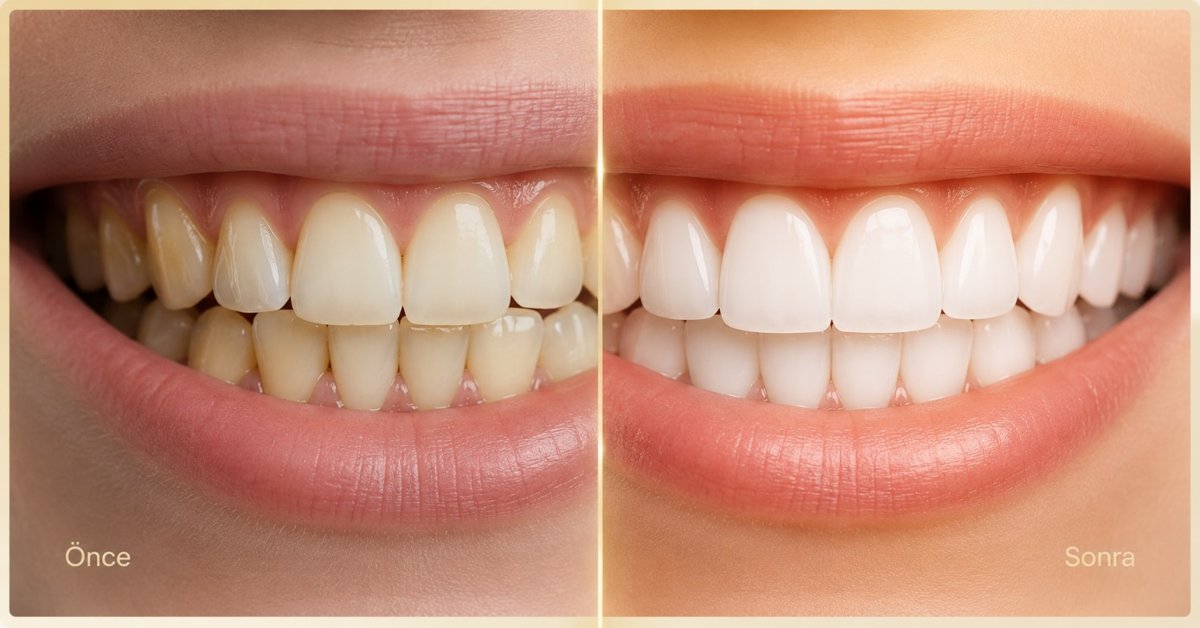
Medical Definition and Scope
Smile design, also called Smile Design or Aesthetic Smile Design, is a comprehensive cosmetic dentistry discipline in which the size, color, shape and alignment of the teeth and the level of the gums are re-planned in harmony with facial proportions.
This process is not the name of a single treatment. Rather, it is a systematic planning protocol made up of photo analysis, digital simulation, a mock-up (trial) session and the treatment that follows. Which treatment will be applied — laminate veneers, zirconium, bleaching or gum aesthetics — is determined at the end of this planning process.
Is Smile Design Only About Teeth, or the Whole Face?
Many people think of smile design only as "whitening or covering the teeth." However, a good smile design requires a much broader perspective.
When a dentist evaluates your smile, they look at the following parameters:
- Facial proportions — The proportional balance of the forehead, mid-face and chin area
- Lip line — How much of the gum the upper lip covers when you smile
- Gum level — Left-right symmetry and whether there is a "gummy smile" (excess gum display)
- Midline — Whether the teeth line up with the midline of the face
- Tooth length-to-width ratio — The ideal ratio is between 75% and 80%
- Color and texture harmony — How well the teeth match your skin tone and the whites of your eyes
- Occlusion (bite) — How the upper and lower teeth close together
When all of these parameters are evaluated together, the result is a personalized smile plan that blends with the face. For this reason, it is not possible for two different people to receive the same smile design — and it should not be.
What Is Visagism and What Is It Used for in Smile Design?
Visagism is an analysis method that determines the most harmonious tooth shape based on a person's face shape, personality and age group. Adapted to dentistry from the fields of fashion and beauty, this approach forms the "artistic" dimension of smile design.
For example:
- For someone with round facial features, longer, more prominent incisors make the face look more oval.
- For a person with a square jaw, softened, slightly rounded tooth edges balance the facial expression.
- If a dynamic, youthful look is the goal, a slight asymmetry is added to the lower edge of the teeth.
A dentist who does not apply visagism may produce a smile that is technically perfect but looks "stuck on" the face. Behind natural-looking smiles there is usually a careful visagism analysis.
💡 The Golden Ratio and Smile Design: Fibonacci's golden ratio (1:1.618) is also used in dentistry. Starting from the central incisor, each tooth being roughly 62% as wide as the one before it toward the side represents the "perfect" proportion. However, applying this mathematics blindly can lead to unnatural results — a good dentist uses the golden ratio as a guide, not as dogma.
What Is Digital Smile Design (DSD)? How Does It Differ From the Traditional Method?
How Does DSD Technology Work?
Digital Smile Design (DSD) is a planning protocol developed in 2007 by the Brazilian dentist Dr. Christian Coachman, which has spread rapidly around the world. Its basic principle is this: before any tooth is shaped or any procedure is carried out, the patient sees their new smile on screen and approves it.
The DSD process works as follows:
- Images are taken of the patient's face according to a standard photo and video protocol.
- Using special software, the tooth design is "drawn" over these images.
- The digital smile is created using facial proportions, the lip line and the existing teeth as references.
- While nothing in the mouth has yet been changed, the patient watches their new smile on a computer screen — in some clinics even on a hologram or 3D display.
- Revisions are made according to the patient's wishes, approval is obtained, and then the treatment begins.
This process fundamentally changes communication for both the patient and the dentist. Most complaints such as "I can't explain what I expect" or "The result wasn't what I wanted" disappear with the DSD protocol.
3Shape, Cerec and Other Digital Systems
Today there are different technology platforms that support DSD:
- 3Shape Trios — An intraoral (in-mouth) scanner; it eliminates the need for physical impressions and creates a full 3D model of the mouth within minutes.
- Cerec (Dentsply Sirona) — A system that can perform both scanning and CAD/CAM milling in a single session. Some restorations and fillings can be delivered the same day.
- Invisalign ClinCheck — Used to simulate orthodontic movements; it allows planning that is integrated with smile design.
- DSD App / Keynote-based DSD — 2D digital planning done on a photograph; it costs less and is the most widely used method in practice.
Traditional Smile Design vs. Digital Smile Design
| Feature | Traditional Method | Digital (DSD) |
|---|---|---|
| Planning | Manual measurement + wax model | 3D software + facial analysis |
| Preview | Plaster wax mock-up | Digital simulation on screen |
| Patient approval | Evaluation after the treatment | Visual approval before the treatment |
| Precision | Medium | High |
| Ease of revision | Limited | Easily done before approval |
| Estimated number of sessions | 3–5 | 2–3 |
| Technician-dentist communication | Written instructions | Digital file transfer |
How Does the Smile Design Process Work? Step by Step
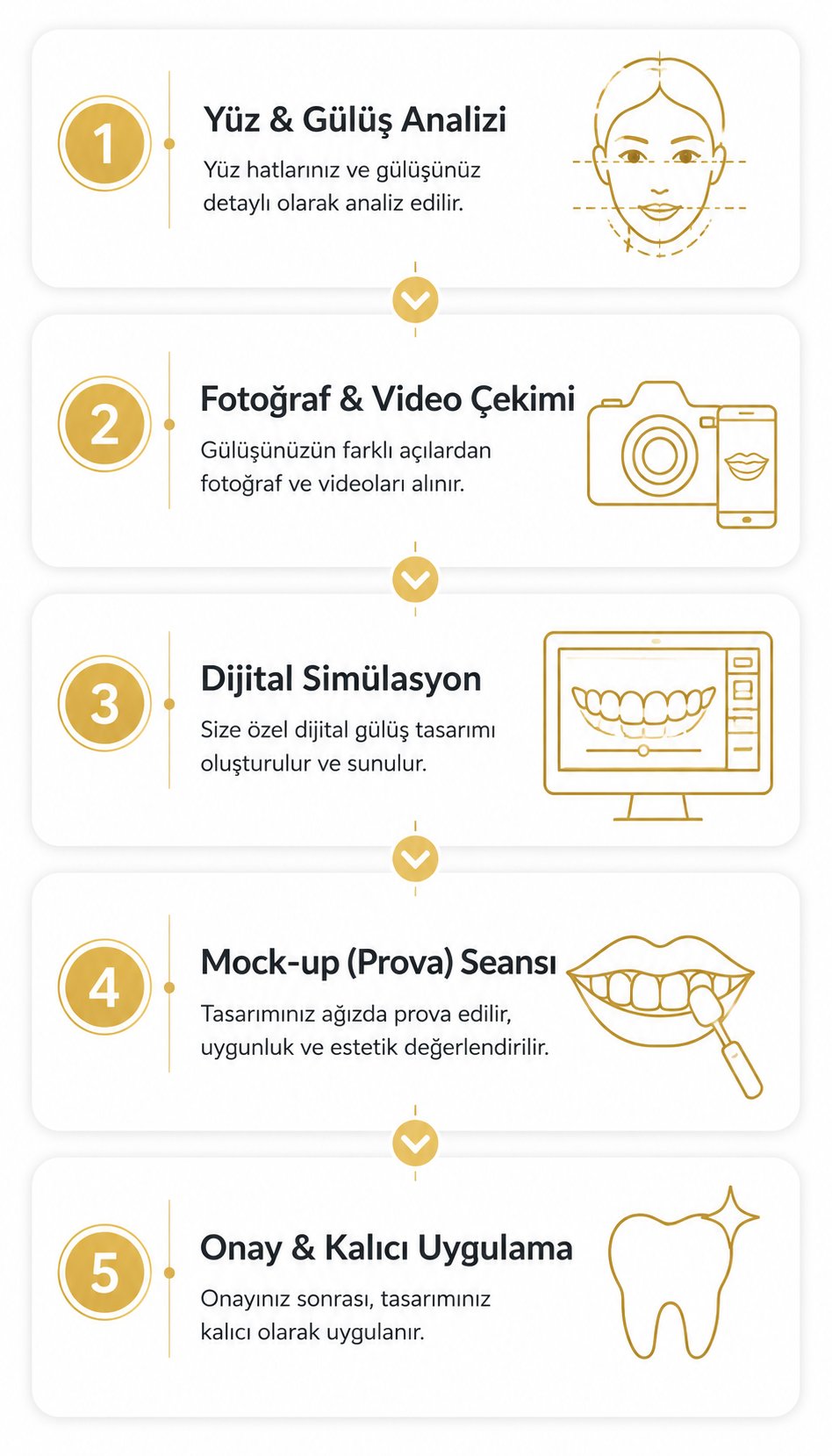
Although the smile design process differs slightly from clinic to clinic, the basic steps are standard. Here is what happens at each stage:
Step 1 — Face and Smile Analysis
In the first session, the dentist evaluates you "as a whole." At this stage:
- Facial symmetry and proportions are analyzed
- The color, size and wear of the existing teeth are examined
- Gum levels and possible asymmetries are identified
- The bite (occlusion) is evaluated
- If needed, a panoramic X-ray or CBCT (three-dimensional tomography) is taken
This analysis is necessary not only for aesthetics but also for functional planning. A smile that looks beautiful but has impaired chewing function will damage both the teeth and the joints in the long term.
Step 2 — Photo and Video Shooting
The "raw material" of the DSD protocol is standardized photographs. The standard shooting set includes the following:
- Frontal — Smile in natural position
- Frontal — Neutral position with lips closed
- Right and left lateral (side) views
- Upper and lower occlusal (chewing surface) views
- Full view of the teeth with a retractor (lip retractor)
- Short video — saying "E," saying "M," and smiling
These videos are critically important for understanding lip dynamics. This is because a smile is not a static photograph; it is a dynamic expression.
Step 3 — Digital Simulation and Design
The images are transferred to the software. The dentist or an experienced technician draws the new teeth over the current facial image. At this stage:
- Tooth sizes, proportions and color are tried out digitally
- Gum levels are simulated if desired
- Different shade options (A1, BL2, BL4, etc.) are compared side by side
- A tooth shape suited to the face shape is suggested according to visagism principles
The result is presented to the patient in the next session.
Step 4 — Mock-Up (Trial) Session
💡 What Is a Mock-Up? A mock-up is a trial session in which the designed smile is applied directly to your mouth using a temporary composite (filling) material. None of your teeth are shaped. For a few hours you can look in the mirror with your new smile, ask your friends for their opinion and have photos taken. Nothing becomes permanent until you say "Yes, this is what I want."
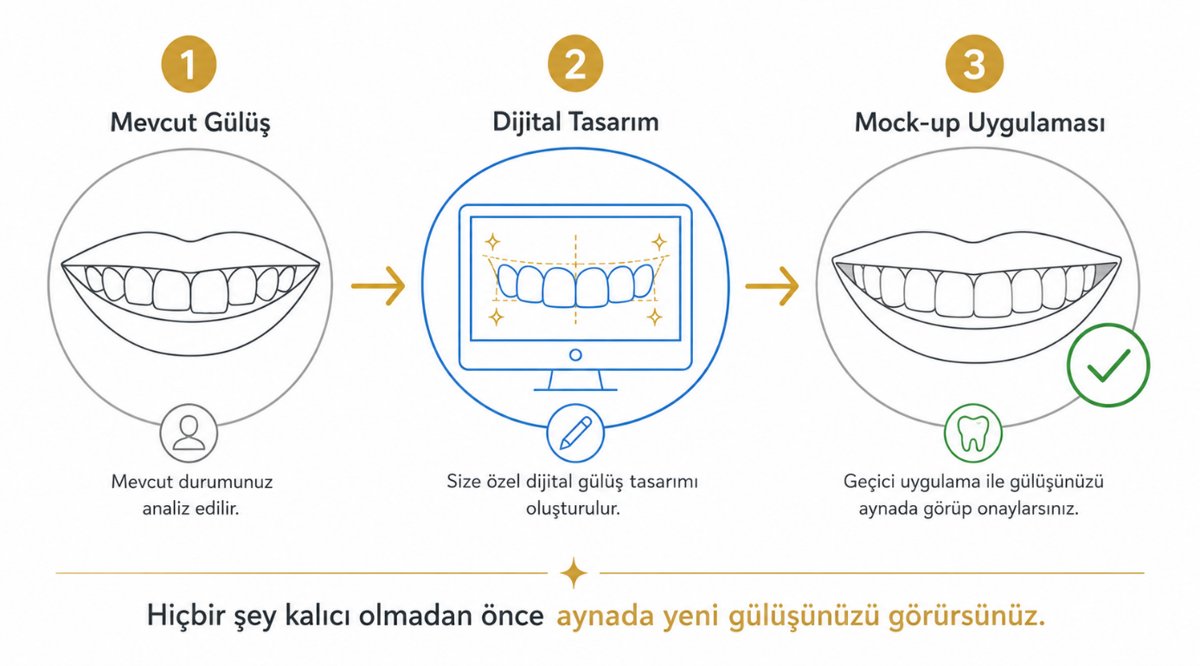
The mock-up session is very important because:
- It tests how well the digital simulation fits "real life"
- It captures the patient's realistic reaction to tooth length, width and color
- Its effect on pronunciation and chewing function is evaluated
- Any necessary revisions are easily made at this stage — nothing is permanent yet
In a good clinic, the mock-up session is never skipped. A practice that skips this step dramatically increases the risk of patient dissatisfaction.
Step 5 — Approval and Treatment
Once the mock-up has been approved:
- If necessary, minimal tooth preparation (shaping) is performed
- A digital impression (intraoral scanner) or a physical impression is taken
- The veneers / crowns are produced in the laboratory (usually 5–10 working days)
- Temporary restorations are placed (aesthetics and function are maintained during this period)
- The permanent restorations are bonded, the occlusion is checked and fine adjustments are completed
Which Treatments Are Used in Smile Design?
Smile design is not a "menu" but a "prescription." Which treatments are included is determined entirely by your current condition and the result you are aiming for.
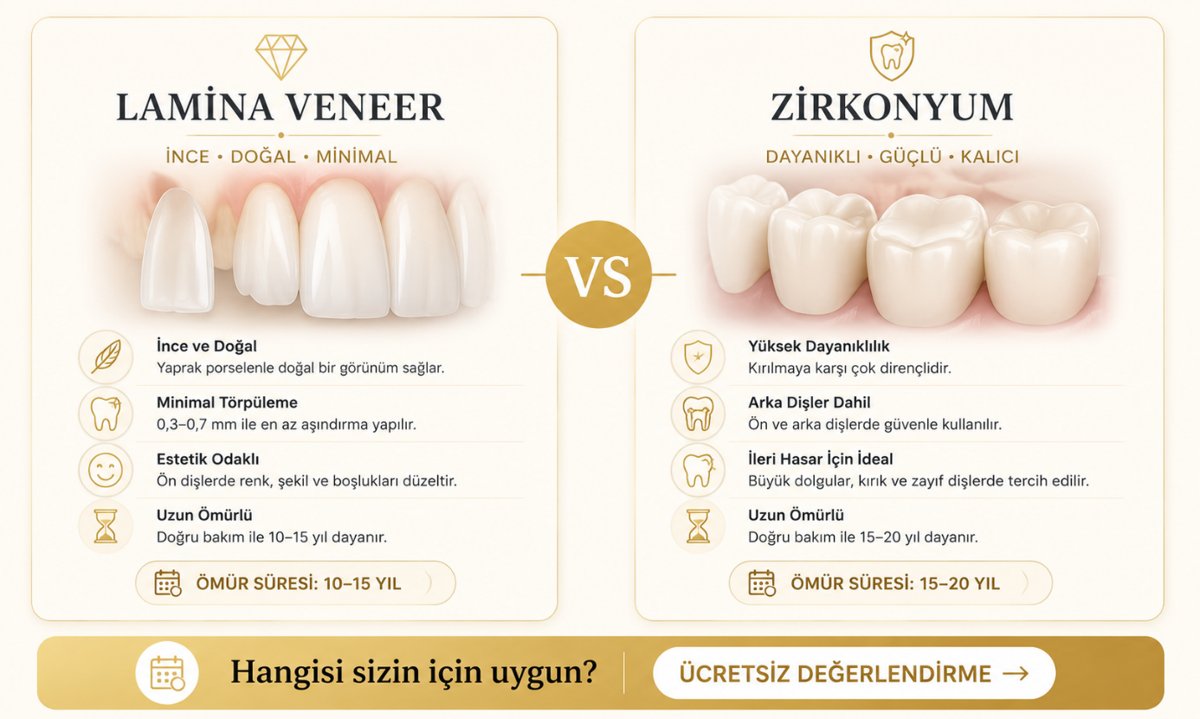
Laminate Veneers
This is a minimally invasive aesthetic treatment in which a thin porcelain shell is bonded to the front surface of the tooth. Only 0.3–0.5 mm of the tooth is shaped — in some cases not at all (no-prep veneers).
- When is it preferred? Color, minor shape irregularities, slight gaps, worn tooth edges
- Lifespan: 10–15 years (20+ years with proper care)
- Advantage: Most of the tooth is preserved and the aesthetic result is very natural
E.max and Zirconium Crowns
E.max (lithium disilicate) and zirconium are the materials preferred for more extensive restorations. Compared with laminate veneers, they require more tooth preparation.
- E.max: Thanks to its translucency it offers an extremely natural appearance; ideal for front teeth
- Zirconium: Durability is its main strength; it can be used on both front and back teeth, and its light transmission is more limited than that of e.max
Teeth Whitening (Bleaching)
Although it is the simplest component of smile design, it is usually combined with other treatments. The natural teeth are whitened before the shade of the veneers is chosen — so the veneers do not stand out noticeably from discolored natural teeth.
- In-office bleaching: 3–8 shades lighter in a single session
- At-home bleaching (tray): Gradual results within 2–4 weeks
- Lifespan: 1–3 years, depending on lifestyle habits
Pink Aesthetics — Gum Aesthetics (Gingivectomy)
The term "pink aesthetics" is used to describe the role of the gums in a smile. A beautiful smile does not consist of white teeth alone; having a symmetrical, healthy and well-proportioned gum line is just as important as the teeth.
- Gummy smile: Excess gum showing when smiling; can be corrected with gingivectomy or botox
- Asymmetric gums: Leveling is done with laser or surgery
- Teeth that look short: Often the tooth is not small, the gum simply covers too much of it — crown lengthening reveals the true tooth length
Gum Filler and Botox Combination
These methods, which are finding a growing place in modern smile design, are as follows:
- Hyaluronic acid filler: Adds volume to thin lips and makes the smile look more energetic
- Botox (muscle-relaxing injection): In gummy smile treatment, it slightly relaxes the upper lip muscles to reduce gum display; its effect lasts 4–6 months
Treatment Comparison Table
| Treatment | When Is It Chosen? | Durability | Is the Tooth Shaped? |
|---|---|---|---|
| Laminate veneer | Color, minor shape issues, gaps | 10–15 years | Minimal (0.3–0.5 mm) |
| E.max crown | Moderate damage, shape irregularity | 10–15 years | Little (0.5–1 mm) |
| Zirconium crown | Advanced damage, fracture, need for a bridge | 15–20 years | Substantial (1.5–2 mm) |
| Bleaching | Color issue only | 1–3 years | No |
| Gingivectomy | Gummy smile, asymmetric gums | Permanent | No |
| Botox | Mild gummy smile | 4–6 months (needs repeating) | No |
Who Is Smile Design Suitable For?
Ideal Candidate Profile
Smile design can be applied to a very wide range of patients. If you have one or more of the following conditions, smile design can be considered:
- Yellowed, dull or gray teeth
- Broken, cracked or worn tooth edges
- Teeth that look small or short
- Gaps between the teeth (diastema)
- Mild crowding (severe cases need orthodontics first)
- Gummy smile (excess gum display)
- Asymmetric smile line
- Cases where an implant or bridge was placed first and aesthetic harmony is desired afterward
Is Orthodontics Required for Smile Design?
This is a very frequently asked question. The short answer: It depends on the case.
- Mild crowding and small gaps: Can be corrected directly with veneers and crowns
- Moderate crowding: Clear aligners (Invisalign) or braces are recommended first; smile design follows
- Skeletal class discrepancies (jaw forward/backward): Collaboration between the orthodontist and a surgical team may be required
If orthodontics is completed before smile design, the results are both more aesthetic and more durable. This is because crowns placed on incorrectly positioned teeth can lead to occlusion problems in the long term.
Suitability Assessment Table — "Are You a Candidate?"
| Condition | Is Smile Design Suitable? |
|---|---|
| Yellowed, dull teeth | ✅ Yes |
| Broken or worn teeth | ✅ Yes |
| Small, short-looking teeth | ✅ Yes |
| Gaps between teeth (diastema) | ✅ Yes |
| Mild crowding | ⚠️ Orthodontic evaluation first |
| Gummy smile | ✅ Together with pink aesthetics |
| Active cavities or gum inflammation | ❌ Treatment is required first |
| Bruxism (teeth grinding) | ⚠️ Evaluation together with a protective night guard |
| Very little tooth structure left | ⚠️ Implant or root canal treatment first |
| Children and teenagers who are still growing | ❌ Wait until bone development is complete |
Are Smile Design and Hollywood Smile the Same Thing?
These two concepts are often confused. Clarifying the difference between them makes it easier for you to make the right treatment decision.
The Conceptual Difference
Smile design is a process and a protocol. It is a planning discipline made up of photo analysis, digital simulation, a mock-up and treatment. The result can be minimal or extensive.
Hollywood Smile, on the other hand, is an aesthetic goal. It describes placing veneers, typically on all the front teeth (8 to 12 teeth), for a "Hollywood-style" look — generally very white, uniform and bright.
In short: Every Hollywood Smile should be carried out through a smile design process. But not every smile design has to end in a Hollywood Smile.
Treatments Included in a Hollywood Smile
A classic Hollywood Smile treatment usually includes the following:
- Laminate veneers or e.max veneers on the upper 8–12 front teeth
- Bleaching or veneers on the lower front teeth (to match upper and lower shade)
- Gum level correction if needed (gingivectomy)
- Veneers on the lower front teeth as well in some cases
Which One Is Right for You?
- If you only have a color problem: Bleaching plus minimal veneers if needed may be enough.
- If shape, size and color problems exist together: Comprehensive smile design is recommended.
- If you want "the least possible intervention": Digital smile design lets you make this decision based on data.
- If you want a very white, dramatic smile: A plan that combines Hollywood Smile with smile design can be prepared.
Care After Smile Design
The lifespan of your investment in smile design depends largely on your care habits.
What Should You Watch Out for in the First 48 Hours?
The first 48 hours after the permanent restorations are bonded are a critical period in which the adhesive systems fully harden and the teeth adapt to the new restoration.
- Avoid very hard foods (baguette bread, hard nuts)
- Stay away from staining substances such as tea, coffee, red wine and cigarettes during this period
- Use dental floss and interdental brushes gently; do not apply excessive force
- Use the desensitizing toothpaste recommended by your dentist (sensitivity is temporary)
Long-Term Protection — Which Habits Extend Lifespan?
- Brushing twice a day: A soft-bristle brush and fluoride toothpaste
- Daily flossing or water flosser use: Prevents buildup around the edges of the veneers
- A night guard if you have bruxism: Teeth grinding is the most important risk factor that can damage veneers
- Cigarettes and hookah: Porcelain is resistant to staining; however, they harm gum health and negatively affect the long-term success of restorations
- Not biting objects such as pens and nails: Increases the risk of fracture at the veneer edges
- Cutting back on acidic drinks: Highly acidic drinks such as cola and energy drinks can, over time, affect the layer of bonding cement
How Often Should Check-Up Appointments Be Held?
- First year: Check-ups at 3 and 6 months
- Following years: A routine check-up and professional cleaning every 6 months
- If a veneer comes off or breaks, contact the clinic without delay — with early intervention the veneer can be saved, while delay usually requires remaking it
Frequently Asked Questions About Smile Design
Is smile design permanent?
It varies depending on the material used. Laminate veneers and e.max crowns can last 10–15 years with proper care, and zirconium crowns 15–20 years. Although no restoration can be guaranteed for a lifetime, these periods can be extended with regular care.
Does the mock-up session hurt?
No. No tooth preparation (shaping) is performed in the mock-up session. The temporary composite material is applied directly over the existing teeth. The procedure is completely painless and can be removed within a few hours.
How many days does smile design take to complete?
A comprehensive treatment usually requires 2–3 sessions: 1 session for analysis and simulation, 1 session for the mock-up and 1–2 sessions for the treatment. Including laboratory production time, the total process takes between 10 and 14 days. If the clinic has its own laboratory, this time can be shorter.
Are the teeth shaped in smile design?
This depends entirely on the treatment applied. With laminate veneers, minimal shaping (0.3–0.5 mm) is done; in some cases none at all. With zirconium crowns, more tissue needs to be removed. Once the treatment plan is determined, the dentist is obliged to inform you about this in advance.
What do smile design prices depend on?
The main factors that determine the price are: the material used (laminate veneer, e.max, zirconium), the number of teeth treated, the technology infrastructure of the clinic, the experience and training of the dentist, any additional treatments combined (bleaching, gingivectomy, etc.), and the city and location of the clinic. For this reason, the prices you see online can vary greatly; an examination is necessary for a realistic figure.
Is smile design covered by insurance?
In Turkey, cosmetic smile design procedures are generally not covered by the national health insurance (SGK) or private health insurance. Some veneers and treatments performed because of decay, fractures or functional loss may be partially covered depending on your insurance status. We recommend going over the details of your insurance with the clinic's accounting department.
What is visagism and why is it important?
Visagism is an analysis method that determines the most harmonious tooth shape based on a person's facial geometry, personality and age. Smile designs made without visagism can be technically successful but look "artificial" on the face. For a natural result, visagism analysis is a critical step.
What can you eat after smile design?
For the first 48 hours after the permanent restorations are bonded, avoid hard and sticky foods. After that, you can return to normal eating. In the long term, avoiding biting very hard objects (ice, bones, pens) and highly acidic drinks significantly extends the lifespan of the veneers.
Can smile design and orthodontics be done together?
Yes, and in some cases the combination gives the ideal result. First the teeth are moved into the correct position with orthodontics, then aesthetic fine-tuning is done with smile design. This approach results in less tooth structure being shaped and in longer-lasting results.
Who is smile design not suitable for?
People with active cavities or gum disease (treatment is required first), young people whose jaw growth is not yet complete, those in the first trimester of pregnancy (elective procedures can be postponed), and advanced wear cases in which there is not enough enamel left on the tooth surface are not considered directly suitable candidates. The vast majority of these conditions can be prepared with the relevant treatments first and made suitable for smile design.
See Your New Smile on Screen
Contact our specialist dentists for digital smile design and a free analysis.
Book an Appointment