When Is Wisdom Tooth Extraction Necessary? A Guide to the Process, Pain and Recovery
For weeks you have had a pain in your jaw. Your cheek is slightly swollen and you can't open your mouth fully. When you look in the mirror, you see a tooth at the very back that has only partly come through, partly hidden beneath the gum. The first question that comes to mind is: "Does this tooth really have to be pulled?"
In this article you will learn exactly when wisdom tooth extraction is truly unavoidable, how the process unfolds step by step, the difference between a surgical extraction and a standard extraction, and your complete recovery timeline.
Short Answer: Wisdom tooth extraction becomes necessary in situations such as an impacted tooth, recurrent infection, pressure on the neighboring tooth, or decay. Not every wisdom tooth has to be extracted — the decision is made with an X-ray and a clinical examination.
What Is a Wisdom Tooth? Why Does It Cause Problems?
The Place of the Wisdom Tooth in Oral Development
Wisdom teeth are known in medical terms as third molars. There are four in total: upper and lower jaw, right and left. They usually erupt between the ages of 17 and 25 — which is why they are also called "twenty-year teeth."
While the other teeth erupt during childhood and adolescence by making room in the jaw, wisdom teeth appear only after jaw growth is complete. This delay makes them the most frequent trigger of oral health problems.
Why Don't They Find Enough Space?
The modern human jaw is about 10–12% shorter than that of our ancestors. The main reason is an evolutionary adaptation linked to eating softer foods. The result: the number of teeth stayed the same, but the jaw got smaller. Each of the four wisdom teeth needs an average of 10 mm of space in the mouth. In most people this space is either too narrow or nonexistent. The tooth becomes partly or fully trapped in the jaw — this is called an impacted tooth.
What Does an Impacted Tooth Mean?
An impacted tooth appears in three forms. In the fully impacted type, the tooth stays entirely beneath bone or gum and is never visible. In the partially impacted type, part of the tooth is visible in the mouth while the rest is covered. In the malpositioned type, the tooth has erupted but sits tilted, rotated or leaning against the neighboring tooth.
💡 Info Box: Not every impacted tooth causes pain or needs extraction. Extraction comes into question when it causes problems — infection, pressure, decay.
In Which Situations Does a Wisdom Tooth Need to Be Extracted?
This question does not have a single answer. However, in the situations below, extraction is a far more sensible choice than the risks of waiting.
Pericoronitis: Recurrent Gum Inflammation
In partially impacted teeth, a small "pocket" forms between the gum and the tooth. This pocket is a perfect shelter for food debris and bacteria. The result: pericoronitis — a gum inflammation accompanied by swelling, pain, difficulty opening the mouth and sometimes fever. Pericoronitis can be suppressed temporarily with antibiotics, but it keeps coming back as long as the wisdom tooth stays in place. In cases of recurrent pericoronitis, extraction is the standard approach.
Pressure on the Neighboring Tooth and Root Resorption
A wisdom tooth that is tilted forward constantly presses on the second molar next to it. Over time, this pressure starts to dissolve the root of the neighboring tooth — this is called root resorption. It is an insidious process; there may be no pain, and it can progress unnoticed for years. By the time it is detected on a panoramic X-ray, serious damage has often already occurred in the neighboring tooth as well.
Decay and Positions That Cannot Be Cleaned
A toothbrush has difficulty reaching a wisdom tooth in the back of the mouth. An abnormal position makes this access even harder. The result: rapidly progressing decay. If the decay has gone deep and the tooth cannot be restored, extraction is unavoidable.
Cyst or Tumor Formation
Cysts can develop around impacted teeth over time. These cysts usually grow without pain, but they slowly dissolve the jawbone. Early detection and extraction prevent bone loss.
Orthodontic Treatment Planning
In some cases where braces or clear aligner treatment is planned, the orthodontist may recommend extracting the wisdom teeth. In particular, gaining space in the back of the mouth may be necessary to correct crowding of the front teeth.
When Is Extraction Needed, and When Is It Not?
To see this clearly, look at the following distinction:
- 🦷 For fully impacted teeth that cause no symptoms, extraction is usually not needed; regular monitoring is enough
- ✅ If the tooth is partially impacted and there is recurrent inflammation, extraction is recommended
- ✅ If it is pressing on the neighboring tooth or root resorption has begun, extraction is necessary
- ✅ If decay has progressed and repair is not possible, extraction is unavoidable
- ✅ If there is an orthodontic need for space, extraction is planned
- ✅ If cyst formation has been detected, extraction is mandatory
- 🦷 In a tooth that has erupted healthily, taken its place and can be cleaned, extraction is not needed
Wisdom Tooth Positions and Extraction Difficulty
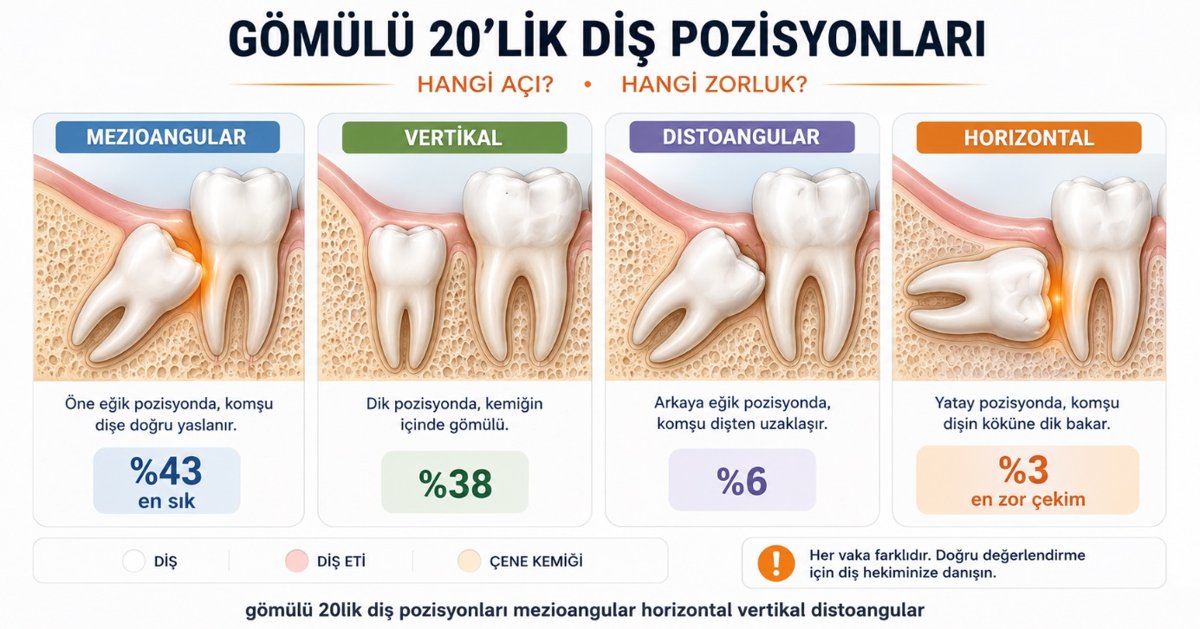
The angle of an impacted wisdom tooth in the jaw directly determines how complex the extraction will be. There are four basic positions.
Mesioangular (Tilted Forward)
This is the most common position, accounting for about 43% of cases. The tooth is tilted forward and rests against the neighboring second molar. It requires surgery of moderate difficulty, but in experienced hands it is a routine procedure.
Vertical Impaction
It covers about 38% of cases. The tooth is upright but remains beneath bone or gum. It looks "normal" on the X-ray, but it has not found a way to erupt. It usually requires surgery, and the difficulty level is moderate to low.
Distoangular (Tilted Backward)
It is seen in about 6% of cases. The tooth is tilted backward. Because of the access angle it is difficult, and if there is enough bone in the jaw, the risk of complications is slightly higher.
Horizontal
The least common (3%) but the most difficult type of extraction. The tooth lies almost horizontally — facing the root of the neighboring tooth at a full right angle. It most often requires the tooth to be sectioned and removed in pieces.
The Difference Between Surgical Extraction and Standard Extraction
Not every wisdom tooth extraction is an "operation." It varies according to the tooth's position, its eruption status and its relationship to the bone.
When Is Standard Extraction Enough?
If the wisdom tooth has fully erupted in a visible position in the mouth and its root structure has no complications, a standard extraction is performed. No incision or flap is needed. Under local anesthesia, the tooth is removed from its socket with forceps (the extraction instrument). The procedure usually takes 5–15 minutes, no stitches are needed, and recovery is largely complete within 3–5 days.
When Is Surgical Extraction Needed?
Surgical extraction comes into play when the tooth is impacted, broken or has a complex root structure. A small incision is made in the gum, the bone over the tooth is thinned if necessary, the tooth may be divided and removed in pieces, and the wound is closed with stitches. The procedure time ranges from 20 to 60 minutes; recovery can take 5–10 days. Don't let the word "surgical" scare you — all of these procedures are done under local anesthesia and you do not feel pain.
Is Extraction Under General Anesthesia Possible?
If several wisdom teeth will be extracted in the same session, if the patient has intense anxiety, or if there are special medical conditions, extraction under general anesthesia (sedation) may be preferred. This takes place in a hospital setting and is not needed in standard cases.
How Is Wisdom Tooth Extraction Performed Step by Step?
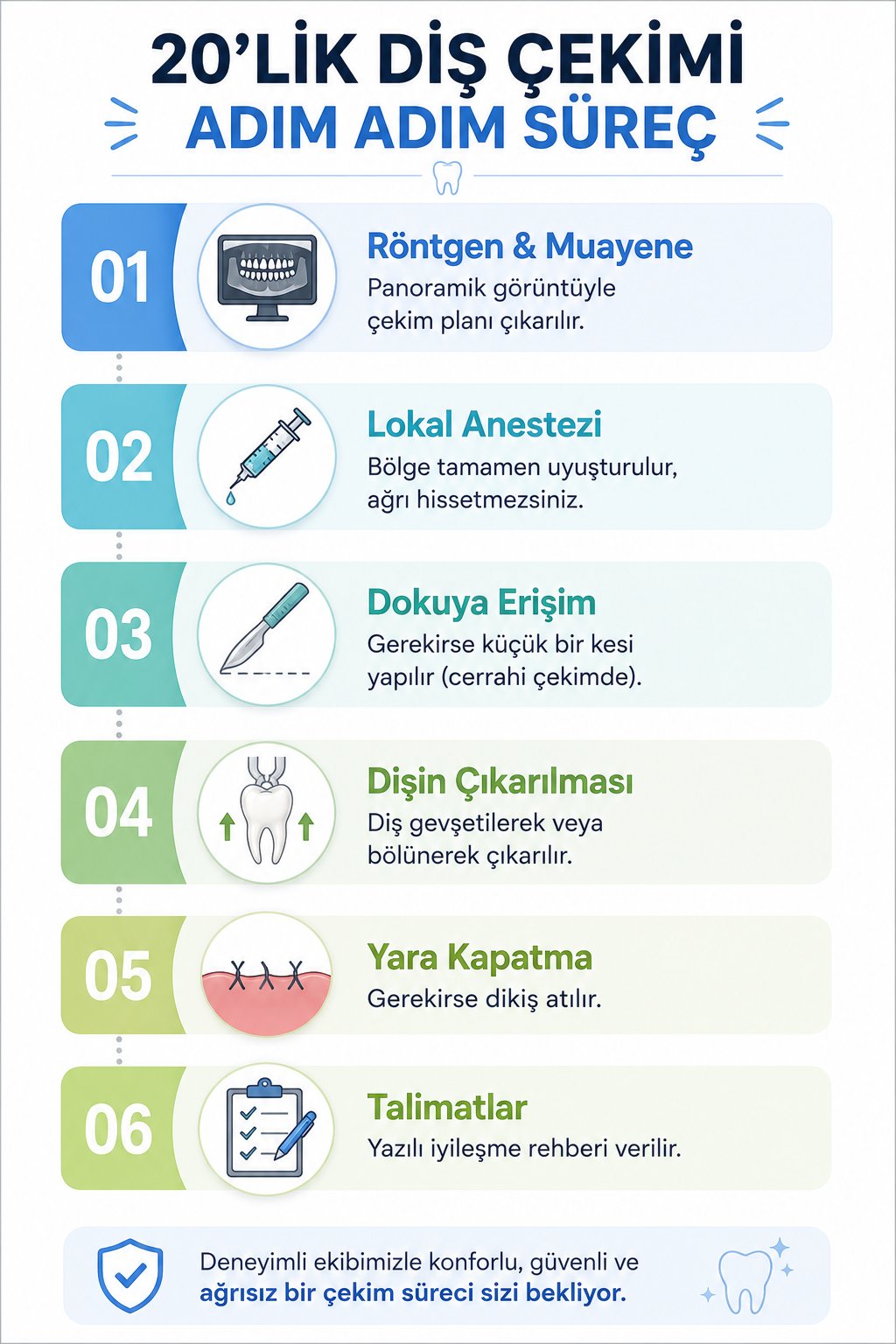
Knowing the process in advance significantly reduces anxiety. Here is what happens on the day of extraction:
- Panoramic X-ray and Examination: Everything starts with proper imaging. The panoramic X-ray shows the tooth's position, root structure, relationship to the nerve and bone density. In some cases, 3D cone beam computed tomography (CBCT) may be needed. The dentist creates the treatment plan from this imaging and explains it to you.
- Local Anesthesia: A local anesthetic that numbs the tooth and its surroundings is injected. The injection itself creates a momentary feeling of pressure; this means complete painlessness for the next 30–45 minutes. The dentist confirms that the anesthetic is working with a touch test.
- Access to the Tissue: In a standard extraction this step is skipped. In a surgical extraction, the dentist opens the gum with a small incision and gently pulls back the tissue over the tooth to reach it. During this time you may feel only slight pressure, not sensation.
- Removal of the Tooth: The tooth is gently loosened from its socket with special instruments and removed. With impacted teeth, the tooth may be divided into several pieces for removal — this shortens the procedure and reduces damage to the surrounding tissue. You feel no pain throughout the procedure; sensations of pressure, light pulling and vibration are normal.
- Wound Closure: After extraction, a sterile gauze pad is placed on the socket if needed. In a surgical extraction, stitches are placed. If the stitches are the self-dissolving type, they do not need to be removed separately; if non-absorbable stitches were used, they are removed on day 5–7.
- Post-Extraction Instructions: Before you leave the clinic, your dentist gives you written instructions. Take these instructions seriously — most of your recovery is secured by proper care in the first 72 hours.
💡 Info Box: You do not feel pain during the procedure. You may feel only pressure, slight movement and vibration. After the anesthetic wears off (3–6 hours), mild pain may begin — this is completely normal and is managed with the prescribed pain reliever.
Recovery Timeline After Extraction
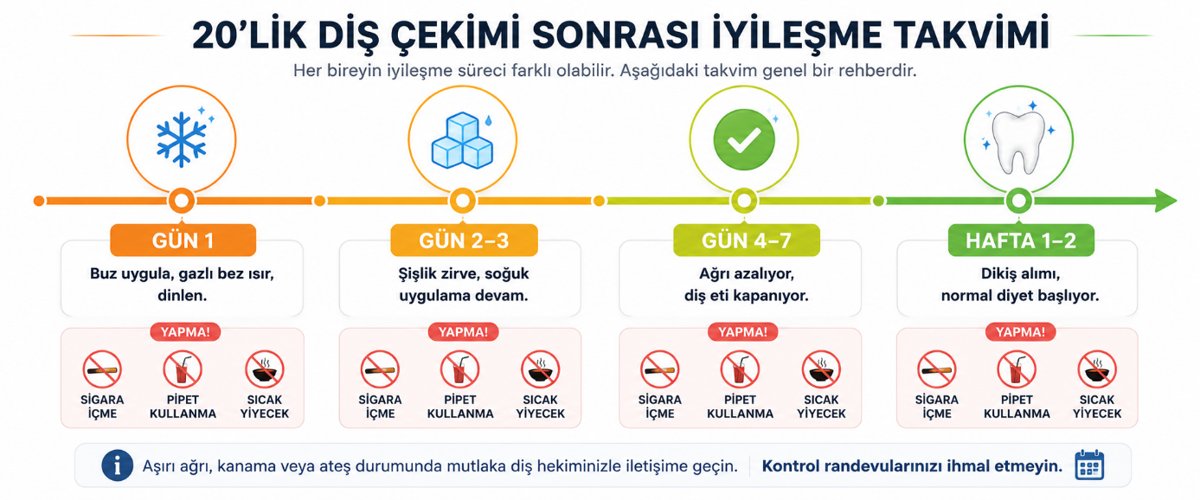
The recovery process varies from person to person; however, a general timeline can be summarized as follows.
The First 24 Hours — The Most Critical Period
What you need to do during this period:
- 🦷 Hold the gauze by biting on it for 30–45 minutes; the bleeding will stop on its own
- 🧊 In the first 6 hours, apply ice for 20 minutes, then take a 20-minute break — this significantly reduces swelling
- 💊 Take the prescribed pain reliever and antibiotic on time, according to your meal schedule
- 🛌 Rest with your head elevated and avoid lying flat
What you absolutely must not do during this period:
- 🚫 Do not smoke — for the first 72 hours, preferably 1 week; smoking prevents the clot from forming
- 🚫 Do not use a straw — the sucking motion dislodges the clot and increases the risk of dry socket
- 🚫 Do not poke the extraction site with your tongue or fingers
- 🚫 Do not eat hot, hard or fibrous foods
- 🚫 Do not do heavy exercise — increased blood pressure triggers bleeding
Days 2–3 — Peak Swelling
Swelling usually reaches its highest level on day 2; this is normal and should be expected. Bruising may appear on the cheek. Cold compresses and keeping your head elevated are the most effective ways to manage swelling. Do not apply moist heat during this period — it increases swelling.
Days 4–7 — Gum Closure
Pain decreases noticeably. The gum begins to close over the surface. The swelling in your face largely subsides. Continue with soft foods; skip brushing the extraction site, but brush the rest of your mouth gently.
Weeks 1–2 — Returning to Normal
Stitch removal takes place during this period (if non-absorbable stitches were used). Food restrictions are largely lifted. You may feel a slight depression or tenderness at the extraction site — this is normal. Full bone healing is completed in 3–6 months.
The Most Common Complications and Their Symptoms
Complications of wisdom tooth extraction are rare; however, if you recognize them, they are easily managed with early intervention.
Dry Socket (Alveolar Osteitis)
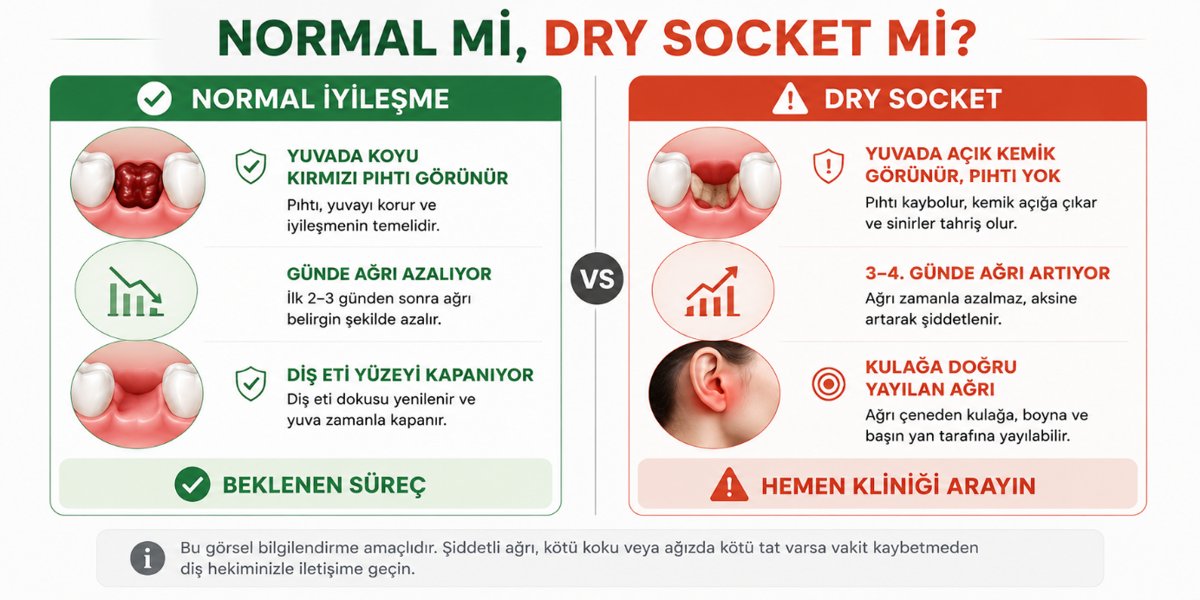
This is the most common complication. After extraction, the blood clot that protects the socket is lost early or never forms; the bone and nerve endings are left exposed.
The symptoms of dry socket are as follows:
- 🔴 Pain that increases instead of decreasing 3–4 days after extraction
- 🔴 Throbbing pain spreading from the jaw toward the ear
- 🔴 Seeing exposed bone instead of a blood clot when you look at the socket
- 🔴 A bad odor from the mouth
Treatment is provided with a special dressing applied at the clinic. Great relief is achieved in 1–2 sessions.
⚠️ Warning: If your pain increases instead of decreasing 3–4 days after extraction, call your clinic without delay. This is the classic sign of dry socket — it is simple to treat but very uncomfortable if delayed.
Signs of Infection
If one or more of the following signs appear together, an infection may have developed:
- 🔴 Fever above 38°C
- 🔴 Swelling that increases instead of decreasing after day 5
- 🔴 Yellow-green discharge at the extraction site
- 🔴 Difficulty swallowing or opening the mouth
If these signs are present, antibiotic treatment may be needed; call your dentist without delay.
Nerve Sensitivity (Temporary Numbness)
Wisdom teeth in the lower jaw can be close to the mandibular alveolar nerve. After extraction, temporary numbness may be felt in the lip, chin or tip of the tongue. This usually resolves on its own within weeks to months. Permanent nerve damage is extremely rare; preliminary planning with CBCT minimizes this risk.
Excessive Bleeding — When to Worry?
Light oozing for 30–45 minutes after extraction is normal. If it stops when you bite on the gauze, there is no problem. If you experience bleeding that lasts more than 2 hours and cannot be brought under control, call your clinic or the nearest emergency room.
What Happens If a Wisdom Tooth Is Not Extracted?
If you are saying "I need to have it removed but I keep postponing it," it is important to see clearly what risks develop in the long term.
Permanent damage to the neighboring tooth: If a wisdom tooth tilted forward presses on the root of the tooth next to it for years, root resorption occurs. In this case, both the wisdom tooth and the healthy neighboring tooth may be lost.
Chronic infection: When pericoronitis recurs, you have to use antibiotics every time. Over time, antibiotic resistance may develop; in rare but serious cases, the infection can spread to the throat or neck.
Cyst growth: A cyst around an impacted tooth can grow silently for years. Large cysts cause serious damage to the jawbone and can set the stage for a jaw fracture.
Disruption of tooth alignment: The tooth pushed forward by the wisdom tooth can push the teeth ahead of it as well, disrupting the overall order of the mouth. This can be the source of an orthodontic problem that is ignored for years.
📦 Conclusion Note: Not all wisdom teeth have to be extracted. Monitoring is enough for wisdom teeth that cause no symptoms, are correctly positioned and can be cleaned. But "symptom-free" and "problem-free" are not the same thing — a panoramic X-ray once a year makes this distinction clear.
Frequently Asked Questions
Should every wisdom tooth be extracted?
No. There is no need to extract wisdom teeth that have fully erupted, can be cleaned and do not harm the neighboring tooth. The decision is made based on the X-ray and clinical examination.
Is wisdom tooth extraction painful?
Because local anesthesia is applied during the procedure, you do not feel pain. You may feel pressure and movement. Mild pain may begin after the anesthetic wears off; the prescribed pain reliever manages it.
How long does wisdom tooth extraction take?
A standard extraction takes 5–15 minutes and a surgical extraction takes 20–60 minutes. The duration depends on the position of the tooth and whether there are complications.
How many days will I be unable to go to work after a surgical extraction?
Most patients can return to office work after 2–3 days. For jobs that require physical effort, waiting 5–7 days is recommended.
What can I eat after extraction?
For the first 24 hours, choose cold yogurt, pudding, smoothies and purees. On days 2–4 you can move on to soft, well-cooked foods. After the first week a normal diet is possible; continue to avoid hard and crunchy foods.
What is dry socket and how is it treated?
It is a complication that occurs when the blood clot that should form after extraction is lost early. It is treated by applying a special dressing to the socket. Your dentist provides great relief in 1–2 sessions.
Is wisdom tooth extraction done under general anesthesia?
General anesthesia is not needed in standard cases. In cases of multiple extractions, severe anxiety or special health conditions, sedation or general anesthesia may be preferred.
When does the swelling go away?
Swelling usually peaks on day 2 and largely subsides by day 5–7. Cold compresses reduce the severity of the swelling.
When are the stitches removed?
If non-absorbable stitches were used, they are removed on day 5–7. If self-dissolving stitches were used, no separate procedure is needed.
Can I get an implant after wisdom tooth extraction?
Yes. After the extraction site has healed completely — usually 3–4 months — an implant can be placed. However, implants are rarely placed in the wisdom tooth area; in most cases they are not needed.
Conclusion
When approached with the right information, wisdom tooth extraction is neither frightening nor a long process. If extraction is necessary, postponing it makes the problem worse; if it is unnecessary, worrying needlessly makes no sense either.
The golden rule is this: base your decision not on fear, but on your X-ray. Without a panoramic X-ray and a specialist examination, it is impossible to say "it should be extracted" or "it should not be extracted."
If you have pain, if swelling keeps recurring, or if questions about your wisdom tooth are piling up in your mind, the healthiest step is to book an evaluation appointment.
Book an Evaluation Appointment for Your Wisdom Tooth
Contact our dentists for a panoramic X-ray and a specialist examination.
Book an Appointment